
TL;DR:
- Luxury entertainment focuses on personalisation and immersive experiences rather than cost or scale alone. It emphasizes exclusivity, deep personalisation, storytelling, and guest involvement to create memorable events. Combining curated intimacy with spectacle and transforming venues elevates the overall luxury experience.
Luxury entertainment is defined by tailored exclusivity, immersive experience, and deep personalisation rather than cost or scale alone. The shift away from mass luxury toward bespoke encounters means that what makes entertainment luxurious in 2026 is the degree to which it speaks directly to each guest. Premium brand engagement now integrates experiential components in over 80% of cases to build loyalty beyond product possession. That figure tells you something important: the experience itself has become the product. For event organisers and individuals planning upscale celebrations, understanding the elements of luxury entertainment is the difference between a memorable occasion and a truly irreplaceable one.
What defines luxury entertainment experiences?
Luxury entertainment is not a price bracket. It is a set of deliberate choices that place the guest at the centre of every decision. The core elements of luxury entertainment are exclusivity, deep personalisation, immersive atmosphere, attentive hospitality, and co-creation.
Exclusivity means limiting access to protect the integrity of the experience. A private concert for forty guests carries more weight than a stadium show, not because the artist is lesser, but because proximity and scarcity create emotional intensity. Ultra-high-net-worth clients increasingly fund or directly influence the creative process, producing entertainment narratives that cannot be replicated elsewhere. That co-creation adds psychological value that passive attendance simply cannot match.
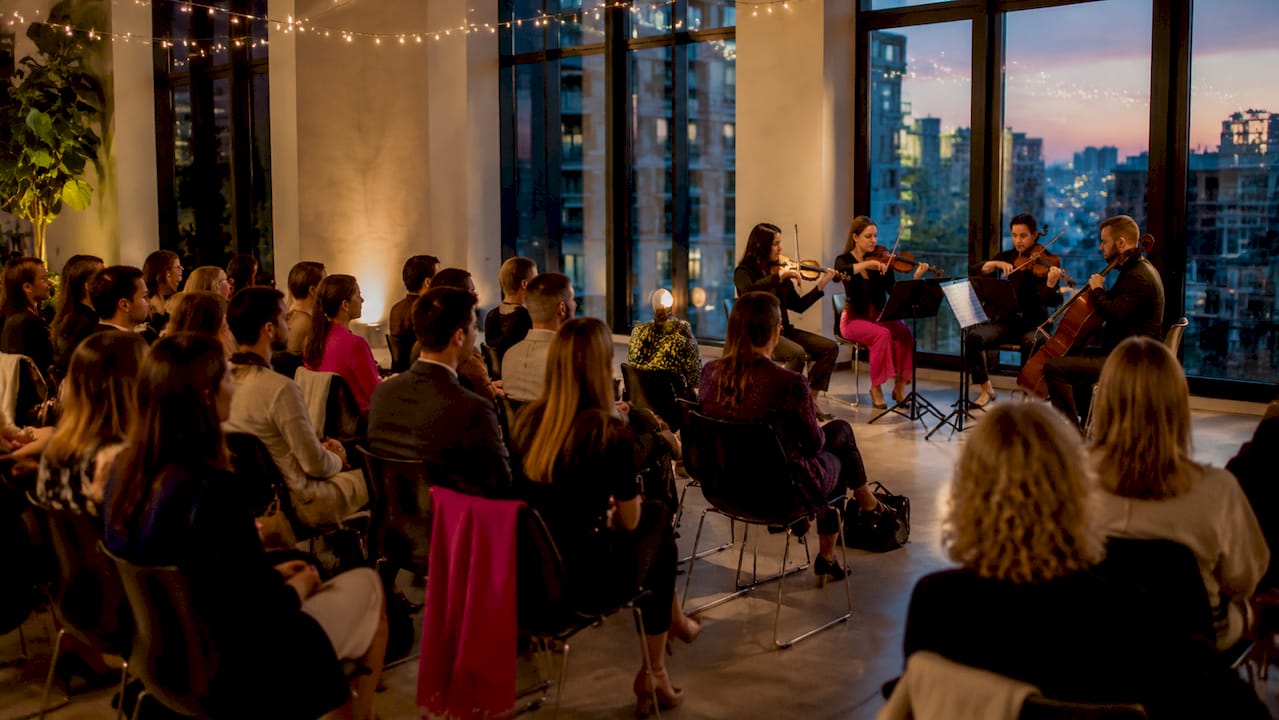
Deep personalisation goes beyond playing a guest’s favourite song. It means building an entire programme around the guest profile, the event narrative, and the emotional arc the host wants to create. Tailored entertainment for events might include a custom musical composition, a bespoke lighting design that responds to the room’s energy, or a live saxophone performance woven into a DJ set at precisely the right moment.
Immersive atmosphere is the environment that makes guests feel they have stepped into a world created specifically for them. Storytelling drives this. Every visual, sonic, and sensory element should reinforce a single coherent narrative rather than competing for attention.
Attentive hospitality is the quiet engine behind every successful luxury event. Guests should never have to search for what they need. Ease of movement, considered sightlines, and staff who anticipate rather than react all contribute to the feeling that the event was designed with care.
- Exclusivity: limited access and bespoke programming
- Personalisation: entertainment built around the specific guest profile
- Immersive atmosphere: storytelling through every sensory element
- Attentive hospitality: anticipatory service and considered environment
- Co-creation: guest or client involvement in the creative process
Pro Tip: When briefing an entertainment provider, share three words that describe how you want guests to feel at the end of the night. That emotional target is more useful than a playlist.
Curated intimacy vs grand spectacle: how do they differ?
Luxury event entertainment divides into two broad styles: curated and spectacle. Understanding both helps event organisers allocate budget and design experiences that land with the right impact.
Curated entertainment prioritises intimacy, storytelling, and guest participation. Think a string quartet that plays a bespoke arrangement of the couple’s favourite album, or a close-up magician who moves through a dinner table creating individual moments for each guest. The curated approach builds emotional connection through personalisation and proximity.
Spectacle entertainment delivers the immediate “wow” moment. High-tech productions such as 3D projection mapping, pyrotechnics, and aerial performances create shareable, brand-defining impact. Spectacle provides social currency and signals scale. Luxury budgets allocate 30–50% more toward bespoke productions of this kind than toward standard headline acts. That investment reflects the shift away from simply booking a famous name toward building a production that is unique to the event.
The most sophisticated luxury events combine both. A grand entrance spectacle sets the tone, then curated intimate moments throughout the evening sustain emotional engagement. Neither style alone achieves what both together can.
| Feature | Curated entertainment | Spectacle entertainment |
|---|---|---|
| Scale | Intimate, small group | Large-scale, full-room impact |
| Primary goal | Emotional connection | Immediate visual impact |
| Guest role | Active participant | Audience member |
| Best suited for | Weddings, private dinners | Galas, brand activations |
| Budget focus | Bespoke talent and personalisation | Production technology and staging |
| Social media value | Low intentionally | High by design |
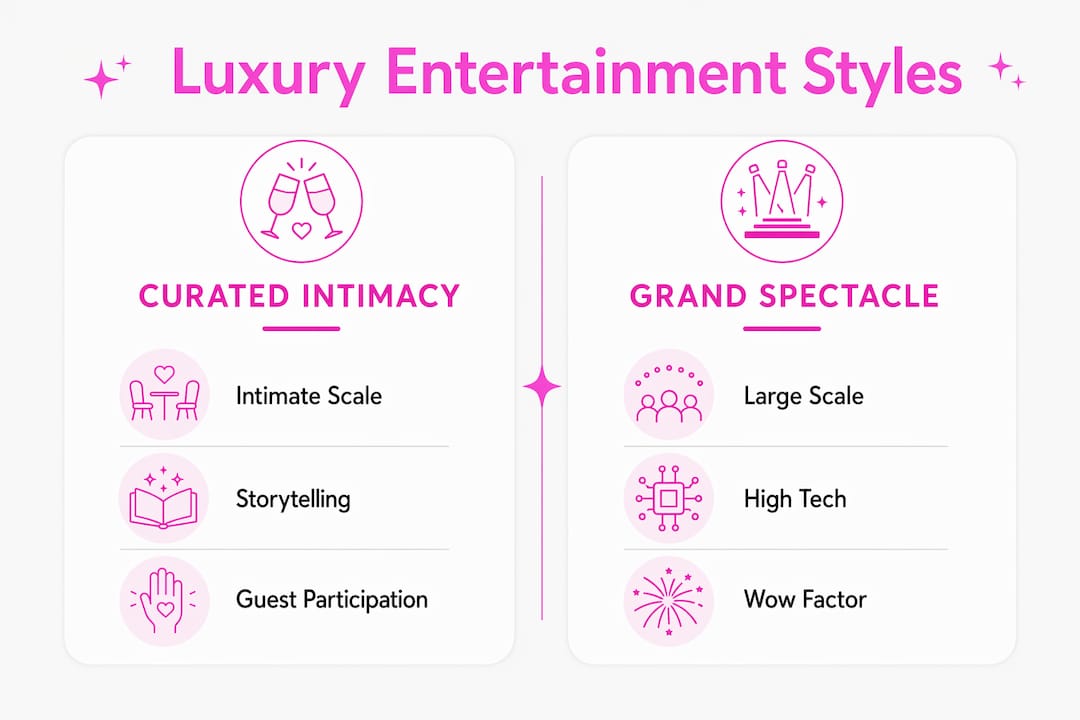
The table above shows that neither style is superior. The right choice depends on the event’s purpose and the guest profile. A wedding reception benefits from curated intimacy during dinner and spectacle during the first dance. A corporate gala might reverse that order. Event entertainment curation is the skill of knowing which style to deploy and when.
What role does intentional hospitality and venue transformation play?
The environment is not a backdrop. It is an active participant in the luxury experience. The concept of architectural overlays, where custom-fabricated scenic walls, lighting programmes, and botanical installations completely erase a venue’s existing aesthetic, transforms a familiar space into something guests feel they have discovered rather than attended. That distinction matters enormously. A discovered environment creates wonder. A decorated one creates appreciation.
Seventy per cent of premium guests rate the quality of environment and ease of movement higher than headline acts for overall satisfaction. That is a striking finding. It means that the physical experience of moving through a well-designed space contributes more to perceived luxury than the name on the bill. Event organisers who spend disproportionately on talent while neglecting environment are misallocating their budgets.
Pacing is equally critical. The Lexus Ambiance Beach Club activation at Art Basel demonstrated that slowing the event pace and integrating quiet, intimate moments within a larger spectacle leaves longer-lasting impressions than relentless stimulation. Event fatigue is real. Guests who are overwhelmed disengage. Guests who are given space to absorb and connect remember.
Hospitality-led luxury events function as what researchers describe as “modern third places”: environments that offer elegance, stability, and respectful attention rather than transactional service. A carefully designed environment gives guests confidence and heightens their attentiveness. That confidence is what makes guests feel genuinely looked after rather than merely processed.
- Use architectural overlays to erase the venue’s default aesthetic entirely
- Design clear sightlines and intuitive flow to remove friction from movement
- Build quiet zones or intimate breakout moments into the programme
- Align lighting design with the emotional arc of the evening
- Brief all hospitality staff on the event narrative, not just logistics
Pro Tip: Walk the venue as a guest would, from arrival to departure. Every point of friction you notice is a luxury detail waiting to be resolved.
How to select and create luxury entertainment for upscale celebrations
Practical execution is where luxury principles either hold or collapse. The following steps give event organisers a working framework for booking and building luxury entertainment experiences.
-
Define the emotional outcome first. Decide how guests should feel at the end of the event before selecting any act or supplier. Every entertainment decision should serve that outcome.
-
Prioritise participatory entertainment over passive performance. Interactive guest entertainment consistently outperforms passive acts in guest satisfaction. A live artist who responds to the room creates a different quality of memory than one who delivers a fixed set.
-
Seek co-creation opportunities. Ask entertainment providers whether the client can contribute to the creative process. A couple who selects the musical motif woven through their wedding reception has a deeper connection to that moment than one who simply approved a playlist.
-
Align entertainment style with venue and guest profile. A grand spectacle in an intimate venue feels aggressive. Curated entertainment in a vast ballroom can feel lost. The environment and the entertainment must be designed together.
-
Invest in bespoke production elements. Bespoke production elements such as custom musical compositions, tailored lighting design, and integrated live performance add more perceived value than upgrading to a more famous act. Guests remember the feeling, not the name.
-
Work with specialist providers who understand luxury hospitality. A provider who has worked with upscale venues understands the difference between delivering entertainment and curating an experience. Ask for evidence of previous bespoke work, not just a standard portfolio.
-
Build privacy into the design. Non-photographable experiences are a growing preference among premium clients. Designing moments that exist only for those present adds a layer of exclusivity that no production budget can replicate.
Key takeaways
Luxury entertainment is defined by personalisation, immersive environment, and intentional hospitality, not by budget size or celebrity presence.
| Point | Details |
|---|---|
| Personalisation over price | Bespoke programming built around the guest profile outperforms expensive generic acts. |
| Environment drives satisfaction | 70% of premium guests rate environment and ease of movement above headline acts. |
| Combine curated and spectacle | The strongest luxury events blend intimate moments with grand visual impact. |
| Co-creation adds lasting value | Involving clients in the creative process produces emotionally irreplaceable experiences. |
| Pacing prevents fatigue | Intentional quiet moments within larger events leave longer-lasting impressions. |
The shift I have watched redefine what luxury actually means
The most significant change I have observed in luxury entertainment is not technological. It is philosophical. For years, luxury was measured in visible signals: the famous name on the bill, the scale of the production, the cost per head. Those signals still exist, but they no longer define the experience for the most discerning clients.
What I find genuinely interesting is the rise of the non-photographable event. Premium clients are actively choosing experiences that cannot be easily documented or shared publicly. That is a direct response to visibility fatigue. When everything is photographed and posted, exclusivity evaporates. The most luxurious thing you can offer a guest in 2026 is a moment that belongs only to them.
The other shift worth noting is how interactive luxury has overtaken traditional passive entertainment in perceived value. Guests who participate remember more, feel more, and speak more warmly about an event than those who simply watched. That insight should change how every event organiser thinks about their entertainment brief.
The practical implication is this: stop asking “who can we book?” and start asking “what do we want guests to experience?” The answer to the second question will always produce a better event than the answer to the first.
— STUART
Freshentertainments: bespoke luxury entertainment for your celebration
Planning a wedding or upscale event in Scotland means making choices that guests will talk about for years. Freshentertainments specialises in exactly that kind of result, combining premium DJ hire, live MC services, and bespoke performance options including saxophone integration into fully personalised packages.
Every package is built around the couple’s story and the venue’s character, not a standard template. From crafting the perfect wedding party atmosphere to designing a full evening’s entertainment arc, Freshentertainments works with upscale venues across Scotland and beyond. If you want entertainment that feels discovered rather than hired, explore the wedding entertainment packages available and get in touch to start building something genuinely memorable.
FAQ
What is the difference between luxury and standard event entertainment?
Luxury entertainment prioritises deep personalisation, immersive atmosphere, and co-creation over generic performance. Standard entertainment delivers a fixed act; luxury entertainment builds an experience around the specific event and guest profile.
What are examples of luxury event experiences?
Examples include private concerts with bespoke musical compositions, architectural venue transformations using custom lighting and botanical installations, and interactive performances where guests participate in the creative process.
Does luxury entertainment have to be expensive?
Not necessarily. Luxury is defined by intentionality and personalisation rather than cost alone. A perfectly curated intimate performance can feel more luxurious than a high-budget generic production.
Why do premium guests rate environment above headline acts?
Research shows that 70% of premium guests rate the quality of environment and ease of movement higher than headline acts for satisfaction. A well-designed space creates confidence and attentiveness that no single performer can replicate.
What is co-creation in luxury entertainment?
Co-creation is when the client or guests contribute directly to the entertainment’s creative process, such as selecting musical motifs or influencing the event narrative. It produces emotionally irreplaceable experiences that passive attendance cannot match.