
TL;DR:
- Interactive guest entertainment transforms attendees from passive spectators into engaged participants, enhancing event energy and memories. Selecting suitable formats like live performers, digital installations, or participatory activities ensures inclusivity and seamless integration into your celebration. Planning pre-event engagement and reducing technological barriers help create a lively, connected atmosphere that guests will remember long after the event.
Most event organisers assume that keeping guests entertained simply means booking something to watch. A band plays. Guests sit. Applause follows. But what is interactive guest entertainment, and why is it rapidly replacing that passive model at weddings and special events? The short answer is that it turns every person in the room from a spectator into a participant. This guide covers the core definition, the most effective types, the real benefits, and how to put it all together so your event feels genuinely alive from start to finish.
Table of Contents
- Key takeaways
- What is interactive guest entertainment?
- Types of interactive entertainment for weddings
- Benefits of interactive guest activities
- How to engage guests interactively: planning that works
- My take on what interactive entertainment really changes
- How Freshentertainments brings this to life
- FAQ
Key takeaways
| Point | Details |
|---|---|
| Active participation is the goal | Interactive entertainment replaces passive watching with guest involvement, co-creation, and shared experiences. |
| Many formats to choose from | Options range from close-up magicians and digital graffiti walls to request-driven DJ sets and AR photo booths. |
| Benefits go beyond fun | Interactive activities break social barriers, generate user content, and create memories that last long after the event. |
| Start engagement before the day | Interactive invitations that prompt micro-actions significantly increase participation levels at the event itself. |
| Low-friction tech wins | QR codes and browser-based tools remove barriers and make digital interaction accessible to every guest, regardless of age. |
What is interactive guest entertainment?
Interactive guest entertainment is any planned activity or performance where the guests themselves are part of what happens, not simply observers of it. Interactive entertainment for guests shifts attendees from passive observation to active participation, whether through digital installations like AR photo booths, live performers who engage small groups directly, or crowd-driven music experiences.
The concept rests on four core principles:
- Guest involvement: Every activity is designed with participation built in, not bolted on.
- Personalisation: Experiences feel tailored to the specific group, not generic.
- Co-creation: Guests contribute to the outcome, whether that is a communal art piece, a shared gallery, or a crowdsourced playlist.
- Inclusivity: The best interactive formats work across ages, abilities, and comfort levels.
Historically, wedding entertainment meant a sit-down band or a DJ who controlled the music entirely. The evolution towards interactive formats tracks directly with broader cultural shifts. Audiences have grown accustomed to choosing what they consume, reacting in real time, and sharing their experiences online. Events that still rely purely on passive formats can feel oddly disconnected from how people actually socialise today.
It is also worth separating interactive entertainment from what is sometimes called immersive guest entertainment. Immersive experiences place guests inside a created world, think theatrical dining or a staged narrative. Interactive entertainment is broader and more practical. It does not require a complete production overhaul. A close-up magician working the room during a drinks reception counts. So does a digital graffiti wall at a wedding reception. The common thread is that guests do something, not just watch something.
Types of interactive entertainment for weddings
Understanding the range of formats available makes it far easier to match the right activity to your event style, venue, and guest profile. Here are the most popular categories, roughly ordered from lowest to highest technical complexity.
-
Live interactive performers. Close-up magicians, caricaturists, and strolling entertainers are among the most reliable options. Interactive live performers like close-up magicians naturally blend into event flow, creating memorable moments across all guest age groups without disrupting the schedule. They work best during transitional moments such as a cocktail hour when guests are mingling but the formal programme has not yet begun.
-
Live art and creation activities. Portrait painters, caricaturists, and calligraphers create bespoke keepsakes for guests. Live artists require approximately 12 to 15 minutes per portrait, so factor this into your scheduling if you want all guests to have the opportunity to participate.
-
Interactive installations. Digital graffiti walls, projection mapping games, and 360-degree video booths fall into this category. These work well in a dedicated space and can be left running throughout the reception so guests can drop in at their own pace.
-
Photo and video experiences. Modern photo booths have moved well beyond the curtained booth with printed strips. AR filters, animated GIF booths, and slow-motion video stations give guests a product they will immediately want to share.
-
Guest participation activities. Giant lawn games, communal art canvases, and live quizzes or polls give groups something to do together. These are particularly effective at mixed-age events because the rules are simple and the stakes are social rather than competitive.
-
Technology-enhanced music experiences. Request-driven DJ sets and live polling let guests shape the atmosphere in real time, increasing satisfaction because the music genuinely reflects the crowd rather than a pre-set list.
Pro Tip: Book interactive performers for the drinks reception and cocktail hour first. This is when guests are most likely to feel uncertain about where to stand or who to talk to. A roving entertainer solves that problem without you having to orchestrate anything.
Modern audiovisual solutions can engage 25 to 50 or more guests simultaneously, with adjustable difficulty settings that make them suitable for ages five and upwards. That kind of scalability is genuinely useful at multi-generational family weddings.
Benefits of interactive guest activities
The case for interactive entertainment is not purely about novelty. The benefits are practical and measurable, both during the event and afterwards.
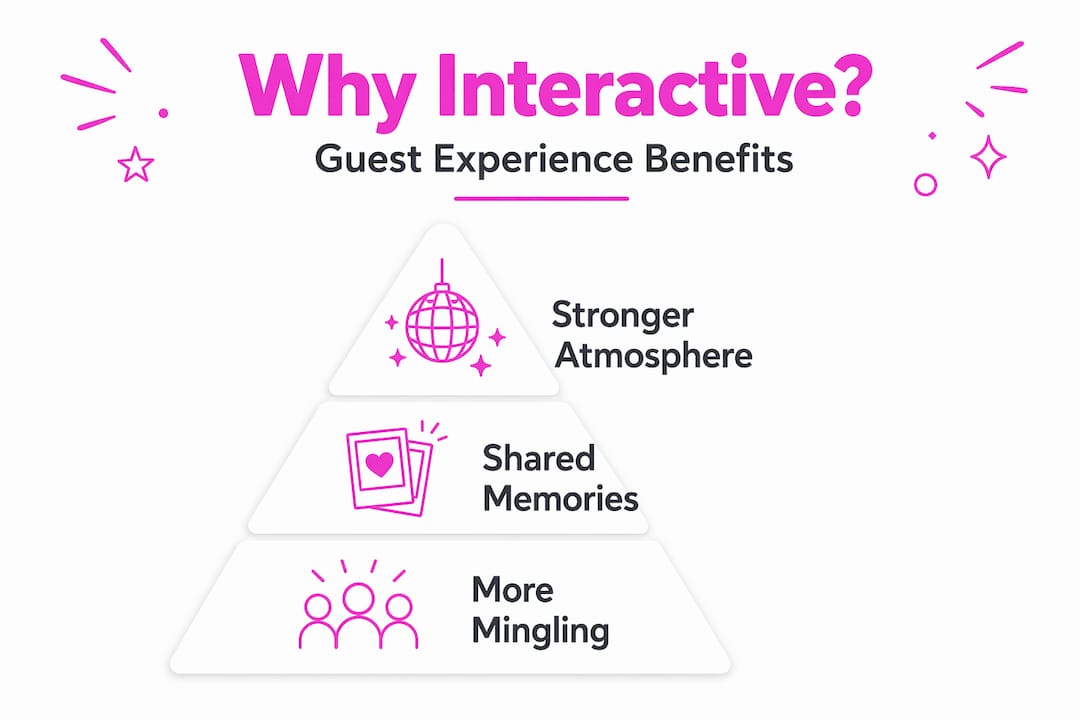
- Guests mingle more naturally. A shared activity gives strangers an immediate reason to talk. Two people competing at a giant Connect Four do not need a formal introduction.
- Atmosphere builds faster. Energy in a room is contagious. When guests are moving, laughing, and participating, the overall mood lifts far more quickly than when everyone is seated and waiting.
- Memories become sharper. Experiences where we actively do something are encoded more strongly than those where we passively watch. Guests remember the magician who made them the centrepiece of a trick, not the background music that played during dinner.
- Social media reach extends naturally. User-generated content such as shared galleries, event hashtags, and custom platforms extends the event narrative well beyond the day itself.
- Different guests find something for them. A diverse programme of interactive options means the quieter guests who dislike dancing can still engage fully through a quiz, a photo booth, or a live art activity.
“The single biggest shift I see at events that include interactive entertainment is this: guests stop being an audience and start being part of the story. That change in dynamic is felt by everyone in the room, including the couple.”
These benefits of interactive guest activities compound each other. When guests are mingling, the atmosphere improves. When the atmosphere improves, people participate more. When participation increases, the content guests create and share extends the reach of the event. It is a genuinely self-reinforcing cycle, and it starts with the decision to plan beyond passive formats.
How to engage guests interactively: planning that works
Good intentions do not automatically translate into good execution. Here is how to approach implementation so the interactive elements enhance the event rather than disrupt it.
Match format to guest profile
A tech-savvy crowd of thirty-somethings will respond differently to an AR experience than a family group spanning three generations. Review your guest list demographics before finalising any booking. Interactive audiovisual tools designed for ages five and upwards handle multi-generational events well precisely because the interaction is intuitive rather than technical.

Use the comparison table below to guide your decisions
| Format | Best timing | Space needed | Tech required |
|---|---|---|---|
| Close-up magician | Drinks reception | Minimal | None |
| Digital graffiti wall | Throughout reception | Medium | Power source |
| AR photo booth | Throughout reception | Medium | Power and Wi-Fi |
| Live portrait artist | Drinks or dinner | Small table area | None |
| Guest music polling | During dancing | None | Smartphone access |
| Communal art canvas | Throughout | Wall or table space | None |
Start engagement before the day itself
Interactive invitations that prompt micro-actions such as choosing a favourite song or selecting a seat name tag create an early participatory culture that carries through to the event itself. The psychology behind this is straightforward: small pre-event commitments make guests more likely to participate fully on the day.
Remove technology barriers
QR codes and browser-based interfaces reduce friction significantly. If guests need to download an app to participate, a meaningful percentage will simply not bother. Keep digital interaction as low-barrier as possible.
Balance variety with breathing space
Packing every hour with structured activities exhausts guests. Aim for interactive options that guests can choose to engage with rather than ones that demand full group participation at a fixed time. The goal is availability, not obligation.
Pro Tip: Brief your venue coordinator and entertainers together at least two weeks before the event. Mismatched expectations about space, power supply, and timing are the most common reasons interactive entertainment underdelivers.
My take on what interactive entertainment really changes
I have seen a lot of weddings where the entertainment was technically impressive but emotionally flat. A pyrotechnic display is spectacular. It is also entirely one-directional. Guests watch, react, and then go back to whatever they were doing. Nothing changes between them.
What I have found is that the events guests talk about for years are almost never the ones with the biggest production budgets. They are the ones where something unexpected happened that they were part of. The magic trick that used the father-of-the-bride as the volunteer. The photo booth that somehow turned into a group of guests competing for the most ridiculous pose. The DJ who read the room so well that three generations were on the floor at the same time because he let the crowd shape the set through real-time music requests.
The common misconception I hear from organisers is that interactive means complicated or expensive. It does not. A roving caricaturist costs less than most centrepiece budgets and delivers far more in terms of guest memory and atmosphere. The art is in choosing formats that feel natural to the event, not forced into it.
What I believe will shape entertainment trends in 2026 and beyond is the move away from entertainment as spectacle and towards entertainment as connection. Guests do not want to be impressed. They want to feel included. That shift changes everything about how you plan.
— STUART
How Freshentertainments brings this to life
Planning genuinely engaging interactive entertainment takes more than booking a few acts and hoping for the best.
Freshentertainments specialises in building wedding party atmospheres that keep guests involved from the first song to the last dance. Their wedding entertainment packages blend professional DJ hire, MC services, and interactive elements into a single, cohesive experience tailored to each couple’s vision. Whether you want a wedding party atmosphere built around crowd-led music, live saxophone integration, or participatory moments woven through the evening, the team at Freshentertainments handles the planning, logistics, and execution. They work with venues across Scotland and beyond, so you are not starting from scratch. Get in touch for a consultation and find out what interactive entertainment could look like at your event.
FAQ
What is interactive guest entertainment at a wedding?
Interactive guest entertainment at a wedding is any planned activity where guests actively participate rather than passively watch. Examples include close-up magic, digital photo installations, guest music polling, and communal art activities.
How does interactive entertainment differ from immersive entertainment?
Interactive entertainment involves guests doing or contributing something during an activity. Immersive entertainment places guests inside a fully created environment or narrative. Both overlap but interactive formats are generally easier to integrate into standard wedding programmes.
When during a wedding should interactive entertainment take place?
Interactive entertainment works best during transitional moments such as drinks receptions, pre-dinner gatherings, and the early part of the evening reception. These are the moments when guests are moving around and most open to engagement.
Do interactive activities work for all age groups?
Yes, particularly when you choose formats with simple entry points. Multi-generational interactive solutions are designed for ages five and upwards and can engage 25 to 50 or more guests at one time, making them well suited to family wedding receptions.
Can interactive invitations really improve guest engagement on the day?
Pre-event micro-actions such as choosing a song or personalising a name tag significantly increase attendance and participation rates. Guests who commit to small actions before an event are more likely to engage fully when they arrive.