
TL;DR:
- Tailored entertainment creates immersive event experiences designed around emotional objectives rather than mere scheduling. It maps the full emotional arc through deliberate transitions, production elements, and narrative flow to make moments memorable. This approach is scalable across event sizes and accessible with clear briefs, transforming events into meaningful journeys rather than simple performances.
Tailored entertainment is personalised event entertainment designed to create immersive, memorable experiences built around specific audiences and event objectives rather than simply filling a time slot in a programme. Where a standard booking places a performer on a stage and hopes for the best, bespoke entertainment, the recognised industry term for this approach, treats every moment of your event as part of a deliberate emotional journey. Freshentertainments specialises in exactly this model, building custom packages for weddings and corporate events across Scotland that combine DJ hire, MC services, live saxophone, and production design into a single, cohesive experience.
What is tailored entertainment and how does it work?
Tailored entertainment is defined as the practice of designing an event’s entire entertainment programme around the emotional goals of the host and the engagement needs of the audience. The key distinction is intent. A performer hired to fill ninety minutes is entertainment. A programme designed to carry guests from the warmth of a welcome reception through the energy of a first dance and into the euphoria of a late-night floor is an experience.
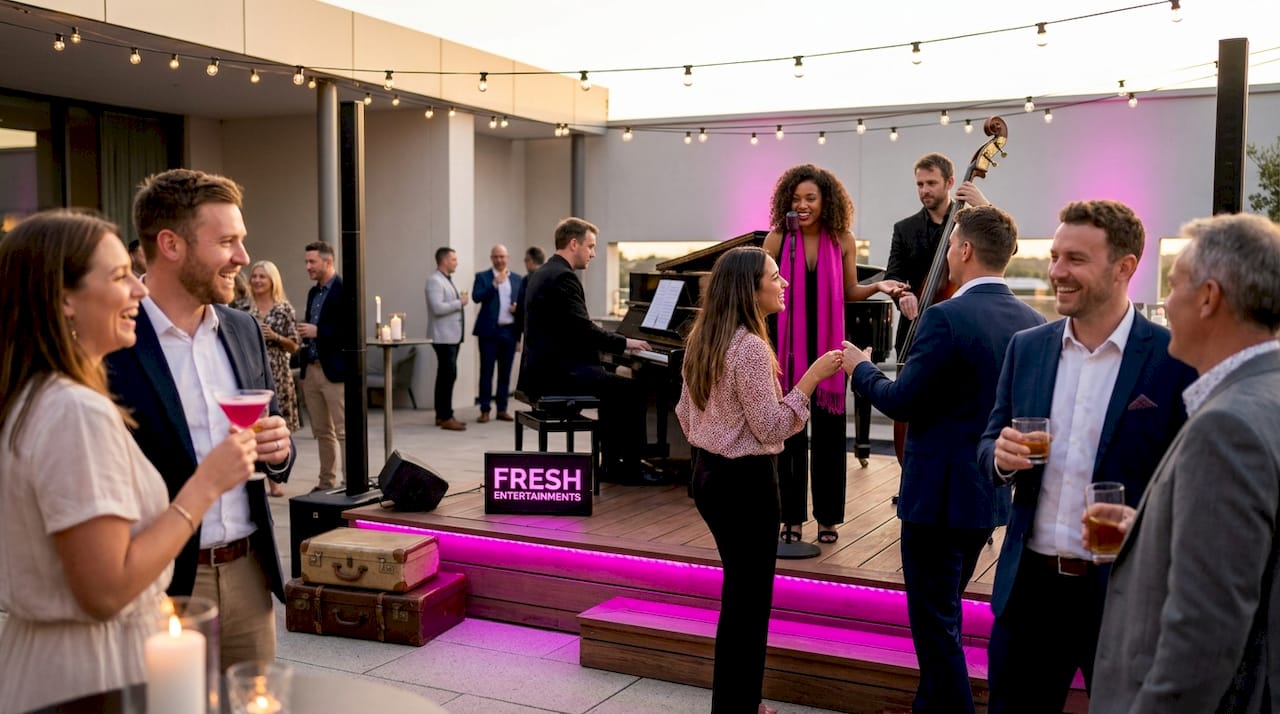
Experience design differs from entertainment booking by mapping the full emotional arc of an event, including the transitions between moments that most organisers overlook. Fusion Events describes entertainment as the “what” that fills a time slot, while experience design is the “why” that shapes energy and emotional states throughout. That distinction matters enormously for weddings and corporate events where the mood at 7pm needs to feel entirely different from the mood at 11pm.
Named examples make this concrete. Vaudezilla’s Voltage Speakeasy show is built around a 1920s narrative that guests enter rather than watch. VIPs Entertainment’s custom productions layer LED-enhanced performances, dancers, and drumlines over a live music core to create something guests cannot see anywhere else. These are not acts. They are designed experiences with a beginning, middle, and end.
How does bespoke entertainment differ from traditional event entertainment?
Traditional event entertainment treats performance as a commodity. You select from a catalogue, agree a fee, and a performer arrives on the night. The result is often competent but generic, disconnected from the specific character of your event and the people attending it.
Bespoke entertainment inverts that process entirely. The starting point is not “which act is available?” but “how do we want guests to feel at each stage of the evening?” From that emotional brief, every element of the programme follows. The choice of music, the timing of transitions, the lighting states, the MC’s tone, the moment a saxophonist joins the DJ set. All of it is designed, not assembled.
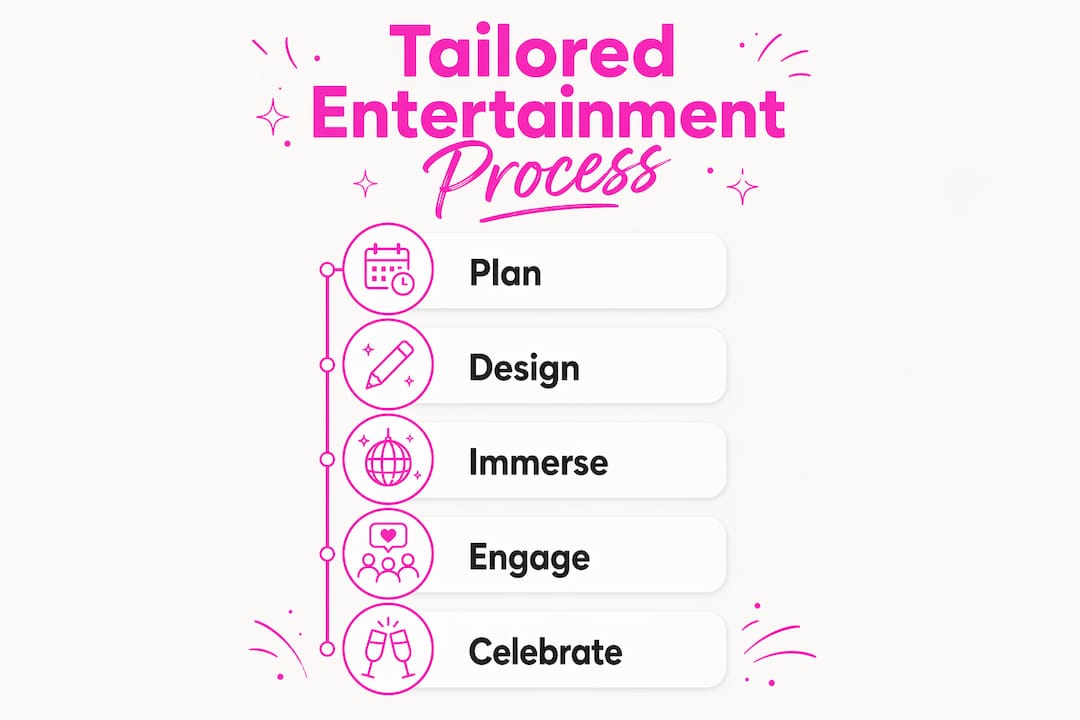
Clients are increasingly disappointed with entertainment treated as a slot-filler. They seek layered, tactile experiences that actively engage audiences rather than perform at them. This shift is visible across the wedding and corporate events sector, where organisers who once asked “who can we book?” now ask “what do we want people to remember?”
Pro Tip: Map your event on a simple timeline and write one emotional word next to each phase: arrival, drinks reception, dinner, first dance, evening party. Share that map with your entertainment provider before any other conversation. It changes everything about how they plan for you.
The practical difference shows up in transitions. The quality of audience transitions between event moments often determines whether guests stay engaged or drift. Lighting cues, music shifts, and MC announcements that bridge one phase to the next are the architecture of a great event. Traditional booking ignores these moments entirely.
Here is how the two approaches compare across four key dimensions:
- Brief: Traditional booking starts with availability. Bespoke entertainment starts with emotional objectives.
- Programme: Traditional booking delivers isolated acts. Bespoke entertainment delivers a connected narrative arc.
- Transitions: Traditional booking leaves gaps between acts. Bespoke entertainment designs every transition deliberately.
- Outcome: Traditional booking produces a night guests enjoyed. Bespoke entertainment produces a night guests remember.
What formats does tailored entertainment take at different scales?
One of the most practical advantages of the bespoke model is that it scales. You do not need a ballroom and a six-figure budget to benefit from personalised entertainment options. The principles of experience design apply equally to an intimate dinner for thirty and a corporate gala for five hundred.
Vaudezilla’s tiered immersive cabaret model demonstrates this clearly. Their Voltage Speakeasy show operates at three casting levels: Intimate with three to five performers, Cabaret with six to ten, and Full Immersive with twelve or more. The narrative and emotional intent remain consistent across all three. Only the scale of production changes.
| Format | Performer count | Best suited to |
|---|---|---|
| Intimate | 3 to 5 performers | Private dinners, small weddings, VIP receptions |
| Cabaret | 6 to 10 performers | Mid-size weddings, corporate dinners, milestone celebrations |
| Full immersive | 12 or more performers | Large galas, festival-style events, major corporate productions |
Production elements play a significant role at every level. LED-enhanced performances with dancers and choreography are becoming integral aspects of bespoke tailored experiences, not optional extras reserved for the largest budgets. Even at an intimate scale, a well-placed lighting change or a single live instrument joining a DJ set can shift the energy of a room completely.
Scalable immersive entertainment requires careful operational planning for staffing and guest flow to preserve experience quality. A show designed for twelve performers in a large venue will not simply shrink to five performers in a smaller space without thoughtful redesign. The spatial relationship between performers and guests, the sightlines, the acoustic balance, all of these need to be reconsidered at each scale.
Pro Tip: When briefing an entertainment provider on a scaled-down version of a larger show concept, ask specifically how they handle guest flow and performer positioning at your venue size. Providers who have thought this through will answer immediately. Those who have not will hesitate.
How do you book tailored entertainment for your event?
Booking personalised entertainment has historically been slow and opaque. Weeks of back-and-forth emails, demo reels that bear little resemblance to the live performance, and no clear way to compare options against your brief. That process is changing.
VIPs Entertainment’s booking platform reduces booking time from weeks to online management, featuring over thirty acts and production enhancements including custom LED shows. The platform gives organisers direct access to curated acts and full custom productions in a single place. That kind of transparency is exactly what the bespoke market has needed.
Technology is also reshaping what tailored entertainment means in digital and hybrid contexts. Fairground Entertainment’s Carousel uses AI to generate avatar-hosted television shows configured to specific brand objectives and audience profiles, automating content tailored to reduce decision fatigue for viewers. While this applies primarily to media and streaming, the underlying principle, that entertainment should be configured to the audience rather than broadcast at them, is the same one driving bespoke live event design.
For weddings and corporate events, the most effective booking approach combines three elements:
- A clear emotional brief shared before any act selection, describing how you want guests to feel at each stage of the event.
- A provider who asks questions about your audience, venue, and programme before presenting options. Providers who lead with their demo reel before understanding your brief are still operating in the traditional model.
- Production planning built in from the start, covering sound, lighting, and transitions as part of the entertainment package rather than as afterthoughts added on the day.
Freshentertainments builds all three of these into every booking, which is why their custom entertainment packages for weddings are structured around client briefs rather than standard set lists.
Practical tips for incorporating tailored entertainment successfully
The single most common mistake event organisers make is choosing entertainment before defining emotional objectives. The act comes first, the brief follows, and the result is a performance that is technically good but tonally wrong for the event.
- Define emotional objectives before anything else. Write down how you want guests to feel at arrival, during dinner, at the peak of the evening, and as they leave. Fusion Events advises planning emotional states from arrival to end-of-night, with entertainment serving those moments rather than simply filling time slots.
- Choose partners, not vendors. Providers who approach events as holistic experiences outperform those who simply offer performer demos. Ask any prospective entertainment provider how they handle the transitions between acts. Their answer tells you immediately whether they think in terms of experience design or slot-filling.
- Design transitions deliberately. The moment between dinner and dancing is as important as the dancing itself. A skilled MC, a lighting shift, and a musical build can turn a room from politely seated to genuinely excited in under three minutes.
- Match production scale to venue, not budget. A smaller, well-designed production in the right space will always outperform a larger, poorly fitted one. For Scottish wedding entertainment, this means understanding the acoustic and spatial character of your venue before committing to a production format.
- Brief your entertainment provider on your guests, not just your schedule. Age range, cultural background, musical preferences, and the relationship between different guest groups all affect how entertainment should be paced and pitched.
Pro Tip: Ask your entertainment provider to walk you through the emotional journey of a previous event they designed, not just show you a highlights reel. The ability to articulate why decisions were made at specific moments is the clearest indicator of genuine experience design capability.
Budget is rarely the limiting factor in bespoke entertainment. Strategic design, a clear brief, and the right provider can create a genuinely memorable experience at almost any spend level. The advantages of tailored entertainment are accessible to any event that starts with the right questions.
Key takeaways
Tailored entertainment succeeds because it treats every moment of an event as part of a designed emotional journey, not a sequence of booked acts.
| Point | Details |
|---|---|
| Start with emotional objectives | Define how guests should feel at each stage before selecting any act or format. |
| Design transitions, not just acts | The moments between performances determine whether energy builds or collapses. |
| Scale thoughtfully | Immersive formats like Vaudezilla’s tiered model work at intimate and large scales with proper planning. |
| Choose experience designers | Partners who ask about your audience before showing demos will always outperform slot-fillers. |
| Production elements multiply impact | LED, choreography, and live instrument integration transform good entertainment into memorable experiences. |
Why tailored entertainment is the future of events, not a luxury add-on
I have seen a lot of events where the entertainment was genuinely excellent and the guests were still underwhelmed. The band was tight, the DJ read the room well, and yet something was missing. What was missing, almost every time, was design. The entertainment existed in isolation from the rest of the evening. Nobody had thought about what came before it, what came after it, or what the guests were feeling when it started.
The shift I find most significant in the current events market is not the technology or the production values. It is the growing number of clients who arrive at a first meeting with an emotional brief already written. They know they want guests to feel welcomed and unhurried during the drinks reception, energised and celebratory during the evening party, and genuinely moved during the first dance. That clarity makes everything else easier and better.
What I would caution against is treating bespoke entertainment as a premium tier reserved for large budgets. The principles of experience design cost nothing to apply. Defining your emotional objectives, briefing your provider properly, and thinking carefully about transitions are free. The production elements that bring those decisions to life can be scaled to almost any budget. The benefits of personalised media and live entertainment are not about spend. They are about intent.
The event organisers who get the best results are the ones who stop asking “what entertainment can we afford?” and start asking “what experience do we want to create?” That question changes the entire conversation with every supplier involved.
— STUART
How Freshentertainments can create your tailored entertainment experience
Freshentertainments designs bespoke entertainment packages for weddings and corporate events across Scotland, building every programme around your emotional brief rather than a standard set list.
Whether you are planning an intimate ceremony or a large-scale corporate gala, Freshentertainments combines premium DJ hire, MC services, live saxophone, and full production design into a single, coordinated experience. Their wedding party atmosphere guide walks you through exactly how each element works together to create something genuinely unforgettable. For couples and corporate clients who want entertainment that is designed rather than booked, explore Freshentertainments’ wedding entertainment packages and start with your brief.
FAQ
What does tailored entertainment mean for a wedding?
Tailored entertainment for a wedding means designing the entire evening’s programme around the couple’s emotional objectives and guest profile, rather than booking individual acts independently. Every element, from the arrival music to the final song, is chosen to serve a specific moment in the event’s emotional arc.
What is the difference between bespoke and standard entertainment?
Standard entertainment fills a time slot with a competent performance. Bespoke entertainment designs the full event experience, including transitions, production elements, and emotional pacing, around the specific audience and occasion.
How do I brief an entertainment provider for a tailored experience?
Start by writing one emotional word or phrase for each phase of your event: arrival, dinner, first dance, and evening party. Share that emotional map with your provider before discussing acts, formats, or budgets. Providers who respond to that brief with questions rather than demos are operating as experience designers.
Can tailored entertainment work for smaller events and budgets?
Yes. Scalable immersive formats like Vaudezilla’s tiered model demonstrate that experience design principles apply equally at intimate and large scales. Strategic planning and a clear brief deliver bespoke results independent of production spend.
What production elements are typically included in tailored entertainment?
Tailored entertainment commonly incorporates LED lighting design, live instrument integration, choreographed performance elements, and MC-led transitions. VIPs Entertainment’s custom productions include dancers, drumlines, and LED-enhanced performances as standard components of their bespoke packages.