
TL;DR:
- Event entertainment curation involves intentionally selecting and sequencing performances to create a seamless emotional journey for guests. Proper planning, venue assessment, and guest profiling are essential to design engaging, personalized experiences that balance intimacy and spectacle. Avoiding common pitfalls like venue oversight and poor pacing ensures a memorable atmosphere aligned with event goals.
Most people assume planning event entertainment means choosing a band, booking a DJ, and calling it done. What is event entertainment curation, though, goes much deeper. It is the deliberate process of selecting, sequencing, and integrating entertainment to shape how guests feel from the moment they arrive to the moment they leave. Done well, it turns a well-organised event into one people talk about for years. This article explains the process, the pitfalls, and the practical steps you need to curate entertainment that genuinely serves your event.
Table of Contents
- Key takeaways
- What is event entertainment curation?
- The event curation process: key stages
- Matching entertainment to your event format
- Common challenges and how to avoid them
- Practical tips for wedding and celebration entertainment
- My honest view on what curation actually means
- How Freshentertainments can help
- FAQ
Key takeaways
| Point | Details |
|---|---|
| Curation is not just booking acts | Entertainment selection for events should create a coherent emotional journey, not a series of unconnected performances. |
| Process matters as much as talent | The event curation process involves technical checks, venue fit, pacing, and guest profiling alongside creative choices. |
| Venue scale shapes everything | Matching entertainment to your venue size and format prevents energy mismatches that undermine the whole experience. |
| Start planning early | Advancing entertainment details 8 to 12 weeks ahead reduces last-minute failures and preserves pacing. |
| Personalisation drives impact | Tailoring entertainment to your specific guests and event goals produces far stronger engagement than generic choices. |
What is event entertainment curation?
Curated entertainment focuses on intimacy, personalisation, and storytelling, while spectacle focuses on scale and visual impact. Both have their place, but the distinction matters enormously when you are deciding what kind of experience you want your guests to have. Curation is the act of intentionally selecting and sequencing entertainment to create a coherent emotional journey from start to finish.
Think of it this way. A wedding reception that opens with a solo saxophonist during the drinks reception, transitions into a live DJ set for the meal, and builds to an energetic dance floor later in the evening is curated. Each element serves a purpose in the overall arc of the day. A collection of unrelated acts dropped into the schedule at convenient times is simply programming.
The distinction matters because curation creates conditions for real interaction between guests. It manages pacing, room flow, and emotional tone rather than just filling time slots. When curation is working, guests do not notice the mechanics. They simply feel relaxed, engaged, and eventually euphoric. That is the goal.
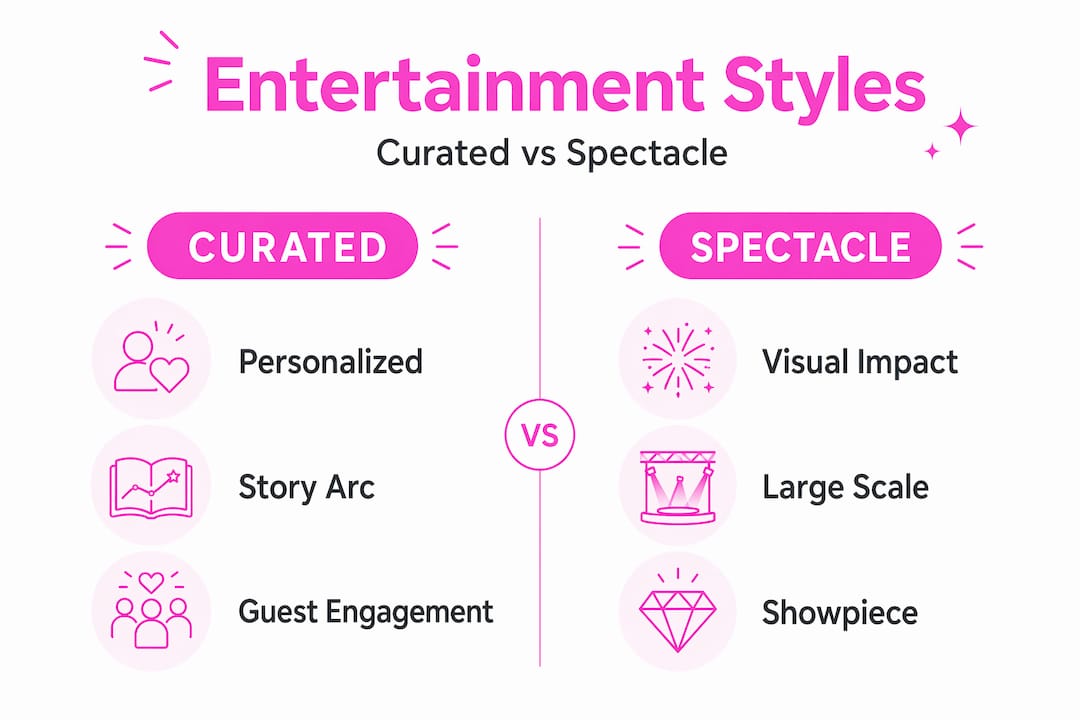
Here is a quick comparison to make this concrete:
| Curated entertainment | Spectacle-first entertainment |
|---|---|
| Emotional arc built across the event | Individual acts deliver peak moments independently |
| Guest journey and flow considered | Acts booked for wow factor |
| Intimate moments balanced with energy | Scale and impact are the primary measures |
| Entertainment integrated with food, speeches, lighting | Entertainment exists as a separate segment |
| Personalised to guest profile and event goals | Selected for general appeal or prestige |
The best events, particularly at luxury wedding level, combine both approaches. A grand pyrotechnics display is spectacle. The carefully chosen first dance song, the acoustic set during dinner, and the surprise performance at midnight are curation. Neither alone creates a truly memorable event.
The event curation process: key stages
Understanding how to curate event experiences requires a structured approach. The event curation process is not creative guesswork. It is a disciplined workflow that balances artistic vision with practical reality.
-
Define the event brief. Effective entertainment planning begins with gathering requirements through detailed briefs covering audience profile, timeline, budget, technical needs, and creative goals. Before you look at a single act or artist, you need clarity on who your guests are, what the event should feel like at each stage, and what success looks like.
-
Audit your venue. Technical and venue constraints are the most common source of failure. Ceiling height, power availability, licensing restrictions, noise curfews, and load-in access all determine what is physically possible. Aligning your emotional arc with what the venue can actually support is not optional. It is the foundation of clean execution.
-
Map the guest journey. Consider the event in chapters. Arrival and welcome, transition to dining, post-meal energy shift, main celebration, and close of evening each call for different entertainment energy. A jazz trio that works perfectly for a drinks reception will feel oddly quiet two hours later when guests are ready to dance.
-
Select and sequence entertainment. With the brief, venue audit, and guest journey mapped, you can now select acts and entertainment formats that fit each chapter. Think about how each element hands off to the next. Abrupt transitions kill momentum.
-
Advance technical details. Confirming riders, logistics, and set times keeps everything on track. Advancing all entertainment details 8 to 12 weeks ahead is particularly important for multi-day celebrations or events with complex technical requirements.
-
Rehearse critical moments. Do not leave transitions and technically complex sequences to chance. Rehearsing high-risk segments and validating technical cue sequences beforehand prevents expensive failures on the day.
Pro Tip: Create a run-of-show document that maps every entertainment element against a timeline, noting technical cues, transition points, and responsible contacts. Share it with all vendors at least two weeks before the event.
The importance of event entertainment planning cannot be overstated. Skipping any of these stages does not save time. It creates problems that cost far more time, money, and stress to fix under pressure.
Matching entertainment to your event format
Entertainment selection for events is never one-size-fits-all. A corporate awards dinner in a 500-person ballroom demands completely different thinking from a 60-person intimate wedding celebration. Entertainment matching venue scale ensures the energy is appropriate and engagement is maximised without overpowering the space.
Here is how to think about it across different event types:
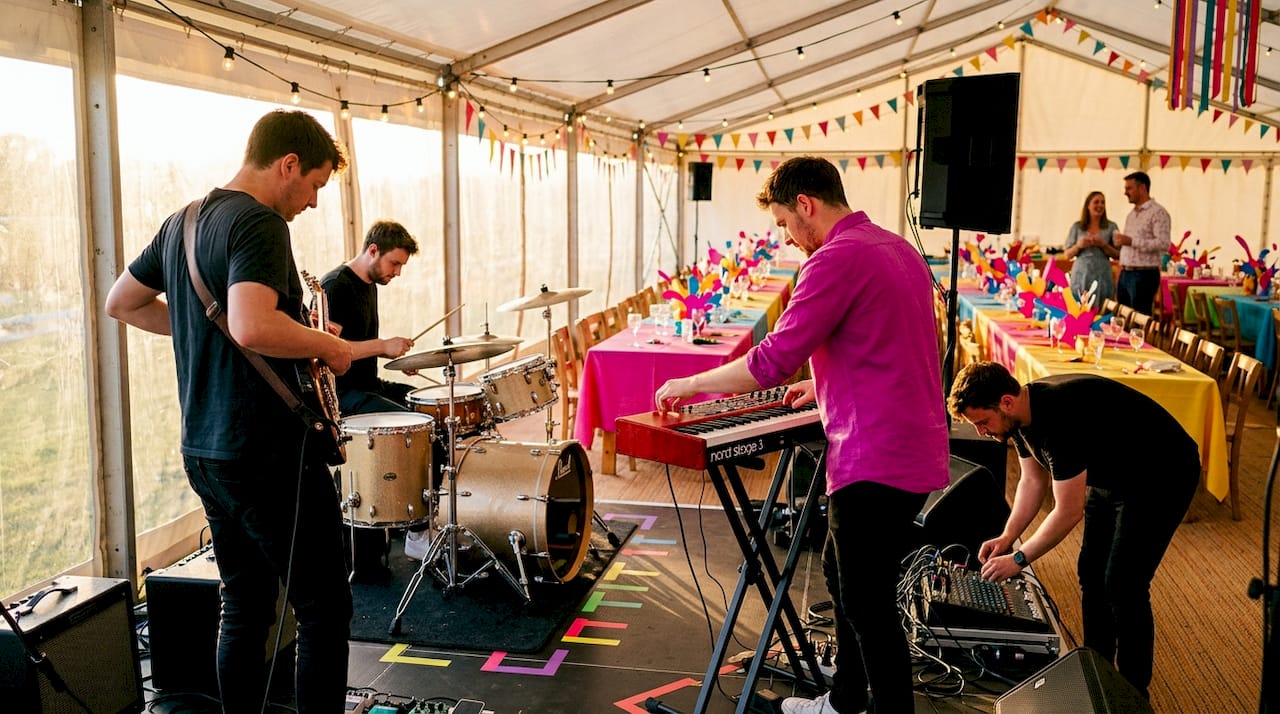
- Intimate weddings and celebrations (under 80 guests). Acoustic acts, close-up magicians, and live solo performers work beautifully in smaller spaces. Guests can actually engage with performers rather than watch them from a distance. A DJ with strong crowd-reading skills can hold an energetic room without needing a full production rig.
- Mid-size receptions (80 to 200 guests). This is the sweet spot where most wedding and corporate packages operate. You have enough guests to support a dance floor and enough intimacy to keep personal touches meaningful. A DJ and MC combination, potentially paired with a live instrument such as saxophone, creates a layered sonic experience that suits the scale.
- Large events and galas (200 guests and above). At this scale, entertainment needs sufficient visual and sonic presence to carry the room. Live bands, multiple performance zones, and production-grade lighting become necessary rather than optional.
- Corporate events. The entertainment needs to serve business goals as well as enjoyment. Interactive acts, quiz formats, and hosted entertainment that encourages networking tend to work better than purely passive performance. You can explore corporate event entertainment options that balance engagement with professional tone.
- Weddings. Personalisation is the dominant priority. Entertainment should reflect the couple’s identity, not just fill time. Look at 2026 entertainment trends for ideas on how couples are making celebrations feel genuinely unique.
The principle running through all of this is the same. Entertainment that fits the scale, tone, and audience of your specific event will always outperform technically impressive entertainment that does not.
Common challenges and how to avoid them
Even organisers who understand the event curation process can fall into predictable traps. Knowing what they are in advance is most of the solution.
Ignoring venue constraints until it is too late. This is the most common and most damaging mistake. Discovering that your headline act requires three-phase power your venue does not have, or that a noise restriction cuts off music at 10pm, hours before your planned finale, is entirely avoidable with early venue audit work.
Poor pacing and sequencing. Pacing is invisible when it works and catastrophic when it does not. An event that starts with its biggest entertainment moment has nowhere to go. Equally, leaving guests with nothing to engage with during long gaps between speeches and dinner destroys the energy a great opening created.
Weak or absent backup plans. Acts cancel. Equipment fails. Weather changes outdoor plans. Technical rehearsals catch these issues before the event, but you also need contingency plans in writing. What happens if your headline act cannot perform? Who makes the call, and what is the alternative?
Vague contracts and unclear deliverables. Every entertainment vendor should have a signed contract covering set length, technical requirements, arrival times, payment schedule, and cancellation terms. Verbal agreements dissolve under pressure.
Pro Tip: Ask every entertainment vendor for a technical rider and a stage plot before you confirm the booking. If they cannot provide one, that tells you something important about how professionally they operate.
For weddings specifically, the wedding entertainment coordination guide from Freshentertainments covers many of these logistics in practical detail.
Practical tips for wedding and celebration entertainment
Best practices for event curation at weddings and private celebrations come down to a handful of disciplines that consistently separate great events from average ones.
- Start earlier than you think you need to. Entertainment books up fast, particularly for peak wedding season. Beginning your entertainment selection 12 to 18 months out gives you access to the best acts at the best prices.
- Involve your entertainment provider in the vision, not just the logistics. A skilled DJ or MC is not just a technician. They are a collaborator who can help you shape the guest journey if you brief them properly on what you want the event to feel like.
- Prioritise guest engagement over guest impressiveness. An entertainment element that gets 80% of your guests actively participating creates a better event than one that impresses 10% of them. Guest interaction and chemistry are the real measures of success.
- Do a technical walkthrough with all vendors. Do not rely on venue floor plans alone. Walk the space with your DJ, lighting engineer, and any live performers to confirm sight lines, sound positions, and power access before the event day.
- Communicate your guest profile clearly. Age range, musical preferences, cultural background, and energy expectations all inform entertainment decisions. The more specific you are with your provider, the better they can tailor their performance to your crowd.
For couples wanting to understand how entertainment choices directly affect the guest experience, wedding guest engagement is worth exploring as a deeper resource.
My honest view on what curation actually means
I have seen beautifully decorated venues with terrible atmosphere and modest rooms that felt absolutely electric. The difference, almost without exception, came down to whether someone had genuinely thought about the guest experience or simply filled a schedule.
What I have learned is that curation is backstage work. Guests never see the run-of-show document, the three-hour setup call, or the emergency contingency plan. They just feel relaxed, connected, and energised. When an event feels effortlessly good, that is curation doing its job.
The detail that most hosts underestimate is pacing. Where you place a quiet moment matters as much as where you place the peak energy. An intimate acoustic set just before the dance floor opens does not kill the mood. It creates contrast, which makes the energy that follows feel earned rather than forced.
My advice is to stop thinking about entertainment as a list of acts and start thinking about it as a sequence of emotional states you want to create for the people you care about. The acts are tools. The experience is the goal.
— STUART
How Freshentertainments can help
Planning entertainment that genuinely serves your event takes expertise, experience, and honest advice. Freshentertainments is an award-winning entertainment provider based in Scotland, specialising in premium wedding DJ hire, MC services, and live music packages including saxophone integration. Whether you are planning an intimate celebration or a large-scale wedding, the team works with you to build an entertainment programme that fits your guests, your venue, and your vision.
You can explore the full range of wedding entertainment packages to see how bespoke combinations of DJ, live performance, lighting, and interactive elements come together. If budget planning is your starting point, the wedding DJ pricing guide gives you clear, transparent information to work with. For couples in Scotland, flawless entertainment coordination is built into every booking from day one.
FAQ
What does event entertainment curation mean?
Event entertainment curation is the deliberate process of selecting, sequencing, and integrating entertainment elements to create a coherent emotional journey for guests across an event. It goes beyond booking individual acts to shaping the overall atmosphere and guest experience.
How early should I start curating entertainment for my wedding?
Starting 12 to 18 months ahead is advisable for weddings, particularly if you want access to premium acts during peak seasons. Advancing entertainment details 8 to 12 weeks before the event is the minimum for confirming technical logistics and set times.
What is the difference between curated and spectacle entertainment?
Curated entertainment prioritises intimacy, personalisation, and storytelling across the event arc, while spectacle entertainment prioritises scale and visual impact. The strongest events typically combine both approaches to create peaks within a thoughtfully paced overall experience.
How do I match entertainment to my venue size?
Intimate venues under 80 guests suit acoustic acts and close-up performers, while larger spaces of 200 or more require entertainment with stronger visual and sonic presence. Matching entertainment to venue scale prevents energy mismatches that leave guests either overwhelmed or underwhelmed.
What are the most common mistakes in event entertainment planning?
The most common mistakes are ignoring venue technical constraints, failing to pace entertainment across the event arc, skipping rehearsals for complex transitions, and signing vague contracts with vendors. Each of these is avoidable with structured planning and early communication with all entertainment providers.