
TL;DR:
- Effective wedding entertainment coordination ensures timely vendor arrivals, seamless transitions, and unforgettable moments.
- Thorough planning, shared schedules, and clear communication are essential for a flawless celebration.
Picture this: your dream reception is just weeks away, the venue is booked, the flowers are sorted, and then it hits you. Who confirms the DJ’s arrival time? When does the saxophonist know to start playing? What happens if the lighting rig takes longer to set up than expected? For many couples in Scotland, entertainment coordination is the part of wedding planning that creeps up quietly and threatens to unravel everything else. Get it right, and your guests talk about the night for years. Get it wrong, and awkward silences fill the gaps where magic should have been.
Table of Contents
- What you need to coordinate wedding entertainment
- Step-by-step: Coordinating your wedding entertainment
- Common pitfalls and expert troubleshooting tips
- What success looks like: A perfectly coordinated wedding celebration
- Why seamless entertainment coordination is the hidden key to an unforgettable wedding
- Ready to enjoy a truly seamless wedding celebration?
- Frequently asked questions
Key Takeaways
| Point | Details |
|---|---|
| Start with a checklist | Gather all the details and confirm vendors with a single, shared document. |
| Communicate your timeline | Send your schedule to all entertainment vendors well in advance to prevent surprises. |
| Finalise details early | Lock in all music choices and unique moments at least two weeks before your celebration. |
| Prepare for the unexpected | Have a coordinator and backup plans ready to handle any last-minute surprises on the day. |
What you need to coordinate wedding entertainment
Now that you understand why expert coordination matters, let’s outline what you’ll need at your fingertips before you begin. Think of this stage as building your toolkit. Without the right materials, even the most enthusiastic planning effort can fall apart under pressure on the day itself.
The single most important starting point is identifying your primary contacts. These are the people who hold the threads together: you and your partner, your wedding planner if you have one, your venue coordinator, and every entertainment provider on your list. Each of these people needs to know who the others are, and they all need a single, shared point of reference for the day’s schedule.
Your essential timelines form the backbone of coordination. You need two distinct documents: a broad planning schedule covering everything from booking confirmations to final rehearsals, and a day-of logistics sheet that maps every hour of the reception. These are not the same thing, and conflating them is one of the most common mistakes couples make. The planning schedule keeps your vendor relationships on track over weeks and months. The day-of sheet is an operational tool, almost like a script for the event itself.
In terms of key resources, you will want a vendor checklist, individual entertainment briefs for each act or supplier, and a detailed music plan. As wedding logistics experts recommend, you should create an end-of-planning vendor confirmation and day-of logistics checklist that includes your music plan plus all vendor confirmations, finalising the most critical details in the final month and tightening everything up in the last two weeks.
Here is a quick overview of the core materials you need:
| Resource | Purpose | Who manages it |
|---|---|---|
| Master day-of schedule | Maps every moment of the event | Couple or planner |
| Vendor contact sheet | Emergency numbers for all suppliers | Couple or planner |
| Entertainment brief | Sets expectations for each act or DJ | Entertainment provider |
| Music plan | Song choices, transitions, special moments | DJ and couple together |
| Venue layout plan | Confirms setup zones and power sources | Venue coordinator |
For a complete reference on all the moving parts, the entertainment coordination guide at Fresh Entertainments is an excellent starting point for Scottish couples who want a thorough overview before they begin planning.
Before moving to the practical steps, here is a concise checklist of what you need ready:
- Confirmed contact details for every entertainment vendor
- Venue technical specifications (power points, ceiling height, noise limits)
- A draft running order for the full reception
- Any special performance requests or interactive moments documented in writing
- A named coordinator who will be present on the day
Step-by-step: Coordinating your wedding entertainment
With preparations done, you’re now ready to tackle the practical steps that transform your plans into a well-run celebration. This is where planning becomes action, and where the difference between a good wedding and a brilliant one is made.
Step 1: Fix your master timeline
Start by building a single master timeline that covers everything from vendor arrivals through to the final song. Include buffer time. If your DJ is booked to start at 7pm, your timeline should have them arriving no later than 5pm for setup and sound checks. Interactive elements such as a saxophone walkthrough during the drinks reception, a photo booth opening, or a group dance lesson all need their own dedicated slots with realistic durations.

Step 2: Share the schedule with all vendors
This step is non-negotiable. A comprehensive wedding checklist strongly recommends creating a wedding day schedule and distributing it to all vendors so they know precisely when to arrive for setup, including entertainment providers. Vendors operating without this information are almost always the source of delays and miscommunications. Email it, print it, and follow up verbally.
Step 3: Finalise your song lists and interactive moments
Book in a planning call with your DJ and MC specifically to lock in your song choices, including the first dance, parent dances, and any walk-in or walk-out tracks. Discuss interactive moments: when does the crowd participation element happen? Does the MC need any special scripts or cues? These conversations, had early, prevent on-the-day panic. For a structured approach to building this out, the entertainment workflow guide for Scottish weddings covers every detail you need to work through.
Step 4: Confirm all logistics two weeks before the wedding
Two weeks out is your final chance to correct anything. Expert planning guidance is clear that the tightest deadlines come in these final two weeks, making this your last practical window for changes. Re-confirm arrival times, recheck technical requirements with the venue, and make sure your day-of coordinator has everything they need. Use the entertainment timeline guide as a reference for exactly what to check at this stage.
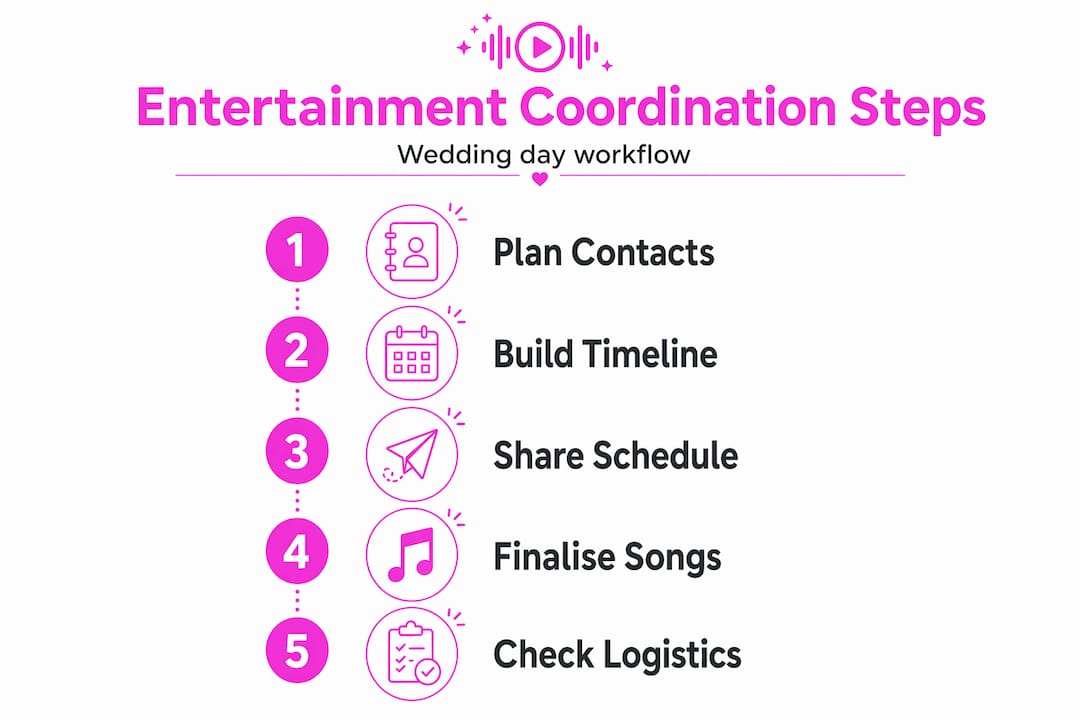
Step 5: On-the-day checks and backup plans
Assign a specific person, your coordinator, planner, or a trusted friend, to be the enforcer of the schedule on the day. This person should have printed copies of every timeline and contact number. They need to know where the DJ’s setup is, what time the first dance starts, and what the backup plan is if a vendor is delayed.
Here is a comparison of coordinated versus uncoordinated entertainment approaches:
| Factor | Coordinated approach | Uncoordinated approach |
|---|---|---|
| Vendor arrival | Pre-scheduled, confirmed in writing | Assumed, often unclear |
| Song transitions | Planned and briefed in advance | Left to improvisation |
| Timing of key moments | Locked into a shared schedule | Decided on the day |
| Backup plans | Documented and communicated | Non-existent |
| Guest experience | Smooth, immersive, memorable | Patchy, with noticeable gaps |
Pro Tip: Send your master timeline to every vendor as a PDF attachment and also paste the key times into the body of the email. This way, there is no chance of anyone missing the critical information because an attachment went unopened.
Common pitfalls and expert troubleshooting tips
Even the best-laid plans can encounter surprises. Here is how to stay calm, fix issues swiftly, and keep the dance floor buzzing.
The most common problem entertainment coordinators see is late vendor arrivals caused by unclear schedules. When vendors have not been given a precise call time, they estimate, and estimates drift. The fix is simple: every vendor gets a written arrival time, a setup deadline, and a named contact on site.
Technical mishaps with sound or lighting are the second most frequent headache. A speaker that hums, a lighting rig that flickers, or a microphone that cuts out mid-speech can bring a reception to a grinding halt. The solution is a proper sound check, conducted well before guests arrive, and a brief conversation with your venue about the power supply, circuit breakers, and any known technical quirks of the space.
Confusion over special requests or custom moments tends to surface when the couple and the DJ have only had one brief conversation months earlier. Custom elements, such as a surprise song, a choreographed entrance, or a live instrument overlay from a saxophonist, need to be briefed in writing with specific timing cues and trigger signals. Verbal agreements made at a show or event viewing are not enough.
“A well-shared schedule is the single most powerful tool in live event management. When everyone knows their role and their timing, the event almost runs itself.” This principle underpins everything that professional entertainment management for Scottish weddings is built upon.
Handling guest song requests on the day requires a clear policy agreed in advance. Ask your DJ to keep a request system that honours the spirit of the evening without derailing the curated programme. Most professional DJs will work requests around the planned set rather than abandoning it entirely.
To prevent awkward silences during transitions, plan specifically for the gaps: cocktail hour, the break between dinner and dancing, and the changeover between acts. Pre-recorded ambient sets, background playlists, or a musician playing softly all work beautifully here. The work you put into personalising your music for these quieter moments pays off enormously in the overall feel of the day.
Here is a quick-reference list for troubleshooting on the day:
- Vendor late? Call the emergency contact immediately and alert your coordinator.
- Technical fault? Have the venue’s technical contact number saved on your coordinator’s phone.
- Timing running over? Empower your MC to make smooth, natural adjustments without fuss.
- Guest tension over requests? Let your DJ handle it professionally; that is what they are trained for.
- Unexpected schedule change? Brief all relevant vendors within minutes; do not wait.
Pro Tip: Create a laminated one-page “emergency reference sheet” for your on-the-day coordinator. Include vendor mobile numbers, technical contacts, and a simplified timeline. It takes ten minutes to make and can save an hour of chaos.
What success looks like: A perfectly coordinated wedding celebration
With troubleshooting in your toolkit, let’s paint a picture of how brilliant the results can be when every element comes together flawlessly.
When entertainment is well-coordinated, guests rarely notice the effort behind it. That invisibility is the goal. The ceremony ends and soft, warm music fills the air before the applause has faded. Guests move to the drinks reception guided gently by atmosphere, sound, and a confident MC voice. Dinner unfolds with background music carefully pitched so conversation flows. Then the lights shift, the DJ reads the room, and the dance floor fills naturally.
The specific benefits of a properly coordinated celebration include:
- No awkward silences between ceremony, reception, and dancing
- Every vendor on time, because they had clear written instructions and a named contact
- Couples genuinely relaxed on the day, able to be present rather than managing logistics
- Guests fully engaged, moving through each moment of the evening as if it were choreographed
- Unique interactive touches landing at exactly the right moments for maximum impact
- Memories centred on entertainment, which studies consistently show is what guests remember most
Finalising most major details during the final month, with the tightest deadlines in the last two weeks, is what allows couples to step into their wedding day with confidence rather than anxiety. The planning work is invisible on the day, but its absence is anything but.
For further inspiration on what is possible when a celebration is executed beautifully, the collection of premium entertainment ideas showcases what is achievable for couples who invest in proper planning.
Research into guest satisfaction consistently shows that entertainment quality and flow are the top two factors cited when guests describe a wedding as “unforgettable.” The food might be exceptional and the flowers extraordinary, but if the DJ drops the energy at the wrong moment or the transitions feel jarring, those are the details that linger.
Why seamless entertainment coordination is the hidden key to an unforgettable wedding
Here is our honest, professional perspective: most couples spend considerable energy and budget on visible elements like flowers, catering, and photography, while treating entertainment coordination as an afterthought. We have seen this pattern repeatedly across Scottish weddings at every price point, and it is the single biggest missed opportunity in the industry.
Coordination rarely gets the headline. Nobody photographs a well-organised vendor schedule or posts a timeline spreadsheet to social media. Yet it is precisely this invisible scaffolding that holds the whole experience together. The moments guests describe with genuine emotion, a surprise song that made the couple cry, the spontaneous conga line that lasted twenty minutes, the saxophonist appearing unexpectedly during dinner, all of these “magical” moments exist because someone planned them carefully and briefed every vendor involved.
The most experienced professionals in live event entertainment will tell you that last-minute flexibility and well-informed vendors are what turn potential panic into pure magic. When your DJ knows the schedule inside out, they can adapt in real time without losing momentum. When your MC has been thoroughly briefed, they can fill a gap with warmth and humour rather than awkward silence. This is not luck. It is preparation expressed as confidence.
What we find most striking, after working across hundreds of Scottish celebrations, is that couples who spend the most money on entertainment but invest least in coordination often have worse outcomes than those with modest budgets and meticulous planning. A thorough briefing document and a well-shared schedule cost nothing except time, yet their impact on the day is enormous. As the insights on why reliable entertainment makes or breaks a venue demonstrate, it is the consistency and professionalism of coordination that separates a good night from a legendary one.
Personal touch and planning will always outperform spending ever more on additional extras. The couple who knows exactly which song to play for their first dance, who has discussed the lighting mood for dinner, and who has asked their DJ to watch for the moment the grandparents reach the dance floor — that couple will have a better wedding than one that simply booked the most expensive package and assumed it would sort itself out.
Ready to enjoy a truly seamless wedding celebration?
If you want extra peace of mind — or simply want your day to be as seamless as it is spectacular — explore these expert solutions built for Scottish couples.
At Fresh Entertainments, we specialise in taking the stress out of wedding entertainment planning entirely. From premium wedding entertainment packages that combine DJ hire, MC services, and bespoke lighting, to creative interactive wedding ideas that get every guest involved, we build your entertainment experience around your specific vision. Whether you are planning an intimate gathering or a grand celebration across a historic Scottish venue, our team handles coordination from first brief to final song. Start planning today and discover how we can help you create a wedding party atmosphere your guests will never forget.
Frequently asked questions
When should entertainment be finalised before a Scottish wedding?
Aim to confirm all entertainment details, including songs and schedules, by at least two weeks before your wedding. Major details should be confirmed during the final month, with the tightest deadlines falling in the last two weeks.
What should be included on my wedding entertainment checklist?
Include vendor confirmations, music plans, timelines, interactive elements, and backup contacts for all entertainment providers. A thorough vendor confirmation checklist should also cover your music plan and finalise the key details in the final month.
Who should have the wedding day entertainment schedule?
Share your entertainment schedule with all vendors and your coordinator to avoid any confusion on the day. A comprehensive wedding checklist recommends distributing the schedule to all vendors specifically for arrival and setup timing.
How do I keep entertainment running smoothly on the day?
Assign a coordinator and have backups for tech or timing issues to ensure smooth transitions throughout the event. On-the-day coordination via a named coordinator, combined with prepared entertainment materials like a DJ song list, is the most reliable way to maintain the flow.