
TL;DR:
- Experiential event entertainment involves immersive, participatory experiences that actively engage guests in every phase of an event. This approach creates emotional journeys, enhances memory, and encourages organic sharing, making each event unforgettable. Effective planning requires layering interactions throughout the event, focusing on experience design rather than solely booking entertainment acts.
Experiential event entertainment is entertainment designed so that guests actively participate, interact, and feel immersed in the event itself, rather than watching a performance from the sidelines. Where traditional entertainment fills a time slot, experiential entertainment shapes the entire emotional journey of an event. Sources including HB Live and Fusion Events describe this shift as moving from “entertainment you book” to “experience design” where every act, installation, and interaction is felt rather than merely observed. For wedding couples, corporate planners, and event organisers, understanding this distinction is the difference between a night guests enjoyed and a night they cannot stop talking about.
What is experiential event entertainment and how does it differ from traditional formats?
Experiential event entertainment is defined as immersive, participatory entertainment that is integral to the guest experience rather than a standalone act. The industry term most professionals use is experience design, and it treats entertainment as architecture for the event’s emotional journey. Fusion Events describes this precisely: experience design maps specific feelings at arrival, peak, and exit phases, whereas booking entertainment is largely a logistical exercise in filling schedule gaps.
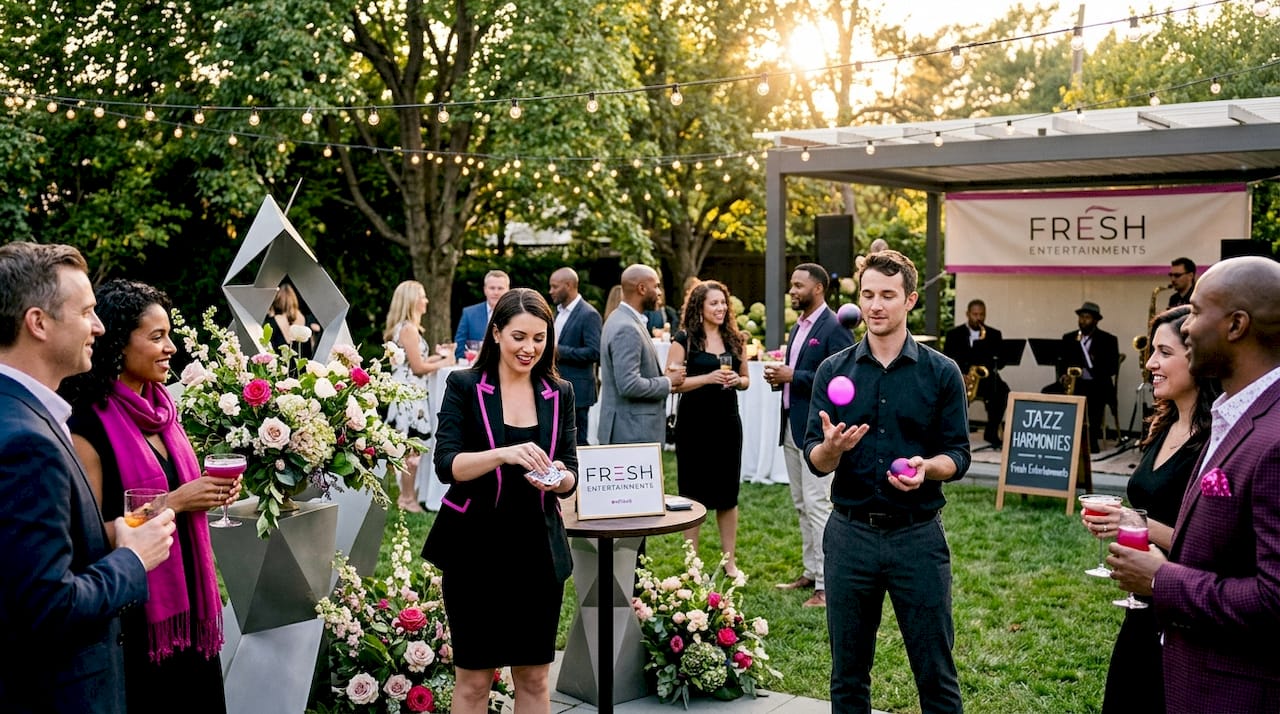
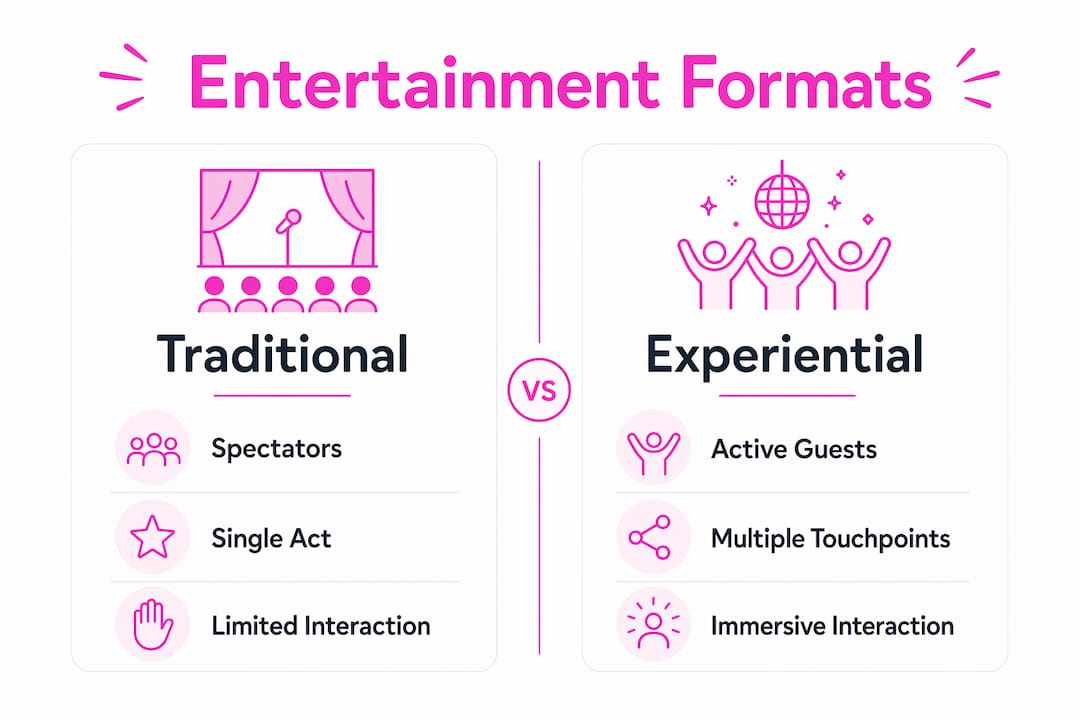
Traditional entertainment positions guests as spectators. A band plays, guests watch. A comedian performs, guests listen. Experiential entertainment repositions guests as participants. They step inside the moment, contribute to it, and carry it with them long after the event ends. This is not a subtle distinction. It changes how you budget, how you plan your run-of-show, and how you measure success.
The shift from passive to active experience design is now the dominant trend in corporate and wedding events, reflecting a genuine audience desire for tactile, dimensional environments. Guests increasingly arrive at events expecting to be engaged, not entertained at. Organisers who recognise this early hold a significant advantage.
What are the main types of experiential entertainment?
Experiential entertainment takes many forms, and the variety is one of its greatest strengths. Salesforce’s marketing guide identifies interactive formats including immersive environments, pop-ups, installations, workshops, and VR-style demonstrations as core examples of the category. Each format invites participation rather than observation.
Here are the most widely used types across weddings and corporate events:
- Immersive environments. Entire spaces are designed to transport guests into a theme, narrative, or sensory world. Think a wedding reception where every corner tells a chapter of the couple’s story, with scent, lighting, and sound working together.
- Interactive installations. Physical structures or art pieces that guests can touch, alter, or contribute to. A collaborative mural at a corporate away-day is a classic example.
- Ambient and integrated performances. Living statues, roaming musicians, and aerial performers who move through the crowd rather than performing on a stage. Elan Productions uses greeters and living statues at arrivals to set the emotional tone before guests even reach the main space.
- Workshops and co-creation sessions. Cocktail-making classes, calligraphy stations, or group songwriting activities that give guests a skill and a story to take home.
- Hybrid and tech-enhanced experiences. VR demonstrations, livestreaming layers, and augmented reality photo moments that blend physical and digital participation.
The table below shows how these formats compare across key planning considerations.
| Format | Guest involvement | Best event phase | Social sharing potential |
|---|---|---|---|
| Immersive environment | Passive to moderate | Throughout | High |
| Interactive installation | High | Arrival and cocktail hour | Very high |
| Ambient performance | Moderate | Arrival and dining | Moderate |
| Workshop or co-creation | Very high | Cocktail hour or breakout | High |
| VR or tech experience | High | Dedicated activation zone | Very high |
Pro Tip: When selecting formats, choose at least one type that works without explanation. Guests should be able to walk into an interactive installation and immediately understand how to engage with it. Friction kills participation.
What are the benefits of experiential events for organisers and guests?
The benefits of experiential events extend well beyond guest satisfaction scores. HB Live notes that experiential events blend performance, environment design, and interactive storytelling to build community and encourage exploration. That combination produces outcomes that traditional entertainment simply cannot replicate.
The core advantages include:
- Stronger emotional recall. Guests who participate in an experience remember it more vividly than guests who watch one. Sensory and emotional engagement deepens memory encoding.
- Organic social sharing. Experiential entertainment is camera-friendly by design, producing shareable moments that extend the event’s reach far beyond the guest list. Photo opportunities and immersive environments generate organic content without any prompting.
- Brand and event prestige. For corporate planners, experiential entertainment signals investment in the audience. For couples, it signals that their wedding is genuinely different from every other one guests have attended.
- Continual engagement. Layering entertainment across arrival, cocktail hour, dinner, and dancing means guests are never in a lull. There is always something to step into.
- Advocacy and word-of-mouth. Two-way involvement drives recognition and organic sharing in a way that one-way messaging never achieves. Guests become advocates because they feel ownership of the experience.
“Experience design is architecture for events, crafting emotional journeys that transform passive audiences into active participants.” — Fusion Events
For corporate event entertainment, these benefits translate directly into measurable outcomes: higher attendee satisfaction, stronger brand recall, and content that continues working for the organiser long after the event closes.
How do you plan and implement experiential entertainment effectively?
Planning experiential entertainment requires a fundamentally different mindset from booking a headline act. The starting point is the emotional narrative of the event, not the entertainment catalogue. Ask what you want guests to feel at arrival, at the peak of the evening, and as they leave. Every entertainment decision should serve those three moments.
Elan Productions recommends structuring entertainment across multiple touchpoints: interactive arrivals, cocktail-hour activations, and focal moments during the main programme. This layering creates several opportunities for guest interaction and prevents the flat energy that comes from a single scheduled act. The emotional arc across transitions is what separates a well-designed event from one that simply had good entertainment.
The table below compares a traditional entertainment approach with an experiential one across key planning dimensions.
| Planning dimension | Traditional approach | Experiential approach |
|---|---|---|
| Budget focus | Headline act fee | Experience architecture across phases |
| Guest role | Spectator | Participant |
| Entertainment timing | Single scheduled slot | Multiple layered touchpoints |
| Success measure | Applause and reviews | Recall, sharing, and advocacy |
| Spatial design | Stage and seating | Flow, zones, and capture points |
Spatial design deserves particular attention. Guest flow determines whether an interactive installation gets used or ignored. Place activations along natural movement paths, not tucked into corners. Consider where guests will naturally pause, gather, and reach for their phones. Those are your prime positions for experiential moments.
Pro Tip: Avoid the common mistake of confusing busyness with engagement. Ten activities nobody understands is worse than two that guests cannot resist. Design intentional moments, not a crowded programme.
Budget allocation is where many organisers go wrong. Spending the majority on a single headline act and treating everything else as decoration misses the point of experience design entirely. Distribute investment across phases. A well-planned wedding entertainment package that layers music, atmosphere, and interactive moments throughout the evening will consistently outperform a single expensive act bookended by silence.
For those exploring interactive wedding entertainment, the same principles apply at a personal scale. The arrival experience, the cocktail hour, and the first dance are all distinct emotional phases that deserve their own entertainment consideration.
Key takeaways
Experiential event entertainment works because it replaces passive observation with active participation, designing emotional moments across every phase of an event rather than filling a single time slot.
| Point | Details |
|---|---|
| Definition is distinct | Experiential entertainment is experience design, not entertainment booking. Guests participate rather than observe. |
| Emotional arc is the framework | Plan entertainment for arrival, peak, and exit phases to create a coherent emotional journey. |
| Format variety matters | Immersive environments, ambient performances, and workshops each serve different phases and guest behaviours. |
| Social sharing is built in | Camera-friendly activations extend event reach organically and produce content without prompting. |
| Budget across phases | Distribute investment across multiple touchpoints rather than concentrating it in a single headline act. |
Why experiential entertainment is the only direction worth moving in
I have worked with enough events to say this plainly: the gap between a good event and an unforgettable one is almost never the quality of the headline act. It is almost always the absence of intentional design between the acts.
The events that guests talk about for years share one characteristic. Guests felt like they were inside the experience, not watching it from a safe distance. A roaming saxophonist who weaves through dinner tables does something a stage performance never can. A collaborative installation at a corporate gala gives colleagues a shared memory that no keynote speaker produces. These are not expensive additions. They are design decisions.
What I find most underestimated is the power of the arrival moment. Most organisers spend their entire budget on the main event and treat the first fifteen minutes as logistics. That is a significant error. The emotional tone guests arrive with shapes how they experience everything that follows. A well-designed arrival activation, whether it is an ambient performer, an interactive installation, or simply a beautifully considered sensory environment, sets a standard that the rest of the evening rises to meet.
The future of events is hybrid and tech-enhanced, and that is genuinely exciting. But the core principle does not change. Guests want to feel something, and they want to feel it together. Technology is a delivery mechanism, not the experience itself. The organisers who understand that distinction will always produce better events than those chasing the latest gadget.
— STUART
Create unforgettable moments with Freshentertainments
Freshentertainments specialises in building exactly the kind of layered, participatory event atmospheres described throughout this article. From premium DJ and MC services to saxophone integration and bespoke lighting design, every package is built around the emotional arc of your event rather than a generic run-of-show. Whether you are planning a wedding or a corporate gathering across Scotland and beyond, Freshentertainments brings the experience design thinking that transforms good events into genuinely memorable ones. Explore the wedding party atmosphere guide or browse tailored packages to find the right fit for your event vision.
FAQ
What is experiential event entertainment in simple terms?
Experiential event entertainment is entertainment designed so guests actively participate and feel immersed, rather than watching passively. It treats entertainment as part of the event’s emotional design rather than a scheduled performance.
How does experiential entertainment differ from traditional entertainment?
Traditional entertainment positions guests as spectators watching a single act. Experiential entertainment layers interactive moments across the entire event, from arrival through to exit, making guests active participants in the experience.
What are good examples of experiential entertainment ideas?
Common examples include immersive themed environments, roaming ambient performers, interactive art installations, cocktail-making workshops, and VR activations. Each format invites participation and creates shareable, memorable moments.
Why does experiential entertainment improve event memorability?
Sensory and emotional participation deepens memory encoding. Guests who contribute to or interact with an experience recall it more vividly than guests who observe one, and they are far more likely to share it on social media.
How much does experiential entertainment cost compared to traditional acts?
Cost varies widely by format, but the key difference is in budget distribution. Experiential approaches spread investment across multiple touchpoints and phases rather than concentrating spend on a single headline act.