
TL;DR:
- Effective entertainment in corporate events boosts engagement, enhances memory through emotional peaks, and resets attention during energy slumps. Well-designed, participatory formats aligned with the event’s purpose foster authentic social connection and amplify overall success. Integrating entertainment early into planning ensures it serves as a strategic, memorable component rather than a forgotten afterthought.
Most corporate events fail quietly. The agenda runs on schedule, the speakers deliver their slides, and attendees leave having forgotten the majority of what they heard. Yet the fix is rarely more content. Global employee engagement fell to just 20% in 2025, costing businesses an estimated $10 trillion in lost productivity. That statistic reframes why entertainment matters in corporate events entirely. Entertainment is not the part of the programme you add when budget allows. It is the mechanism through which people reconnect, remember, and feel something worth taking back to work.
Table of Contents
- Key takeaways
- Why entertainment matters in corporate events
- How entertainment shapes memory retention
- Balancing professionalism and fun
- Practical strategies for selecting entertainment
- My honest take on entertainment as strategy
- How Freshentertainments can help
- FAQ
Key takeaways
| Point | Details |
|---|---|
| Entertainment drives engagement | Well-placed entertainment prevents the energy slumps that cause attendees to disengage during long corporate programmes. |
| Memory is emotional, not factual | People retain experiences shaped by emotional peaks; entertainment creates those peaks deliberately. |
| Forced fun backfires | Managed entertainment that feels inauthentic breeds cynicism and can undermine the event’s credibility. |
| Match entertainment to purpose | The best corporate entertainment signals company culture and aligns directly with the event’s objectives. |
| Timing and agency matter | Allowing attendees to choose their participation level increases satisfaction and reduces disengagement. |
Why entertainment matters in corporate events
Ask most event organisers what entertainment does, and they will tell you it fills time between sessions. That framing explains why so many corporate events feel flat. Entertainment resets attention spans during the predictable energy slumps that occur roughly every 90 minutes in a structured programme. It is not decoration. It is energy management.
Consider the practical reality. After two hours of keynote presentations, attendees are not passively absorbing information. They are checking phones, managing email, and mentally departing the room. A well-timed entertainment break does not just give people a rest. It resets the neurological baseline so the next session lands with full attention rather than half of it.
The formats that work best here are not passive. Interactive formats drive the most value:
- Live music or a DJ set between sessions shifts the physiological state of the room within minutes.
- Hosted group challenges or quick-fire competitions create lateral thinking that primes people for creative work.
- Comedy sets or improvisational performers reduce cortisol and lower social defences, which is particularly useful before networking segments.
- Interactive technology experiences, such as augmented reality activities or live polling with a comedic host, give attendees something to do rather than just observe.
- Physical activities, even brief ones like a group stretching segment led with humour, counteract the fatigue of extended sitting.
Active participation increases satisfaction and connection at events, which means the format matters as much as the content. Passive entertainment at best entertains. Active entertainment engages.
Pro Tip: Schedule your most energetic entertainment directly after lunch, not before. The post-lunch dip is the single most predictable disengagement window in any corporate programme. Hitting that window with a participatory activity rather than another presentation changes the entire afternoon trajectory.
How entertainment shapes memory retention
Here is something most event planners overlook: engagement during an event and memory of that event are two entirely separate outcomes. You can hold someone’s attention for eight hours and have them remember almost nothing a fortnight later.
The neuroscience here matters practically. Memory forms strongest at emotional peaks and event endings, a principle known as the peak-end rule. What people remember about your event is not the average of their experience. It is how they felt at the highest emotional moment, and how they felt when they left. Entertainment is the most reliable tool for manufacturing those peaks on purpose.
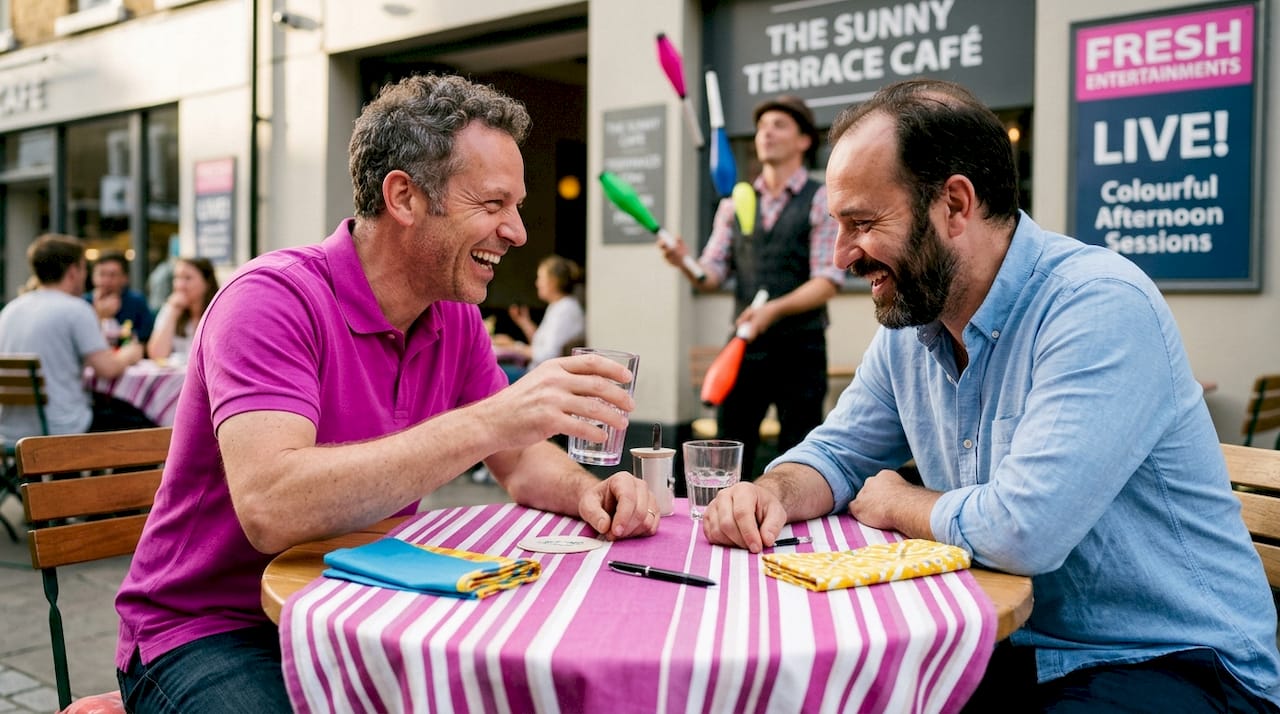
The benefits of corporate event entertainment become clearest when you examine what happens in the absence of it. Attendees forget most event content due to cognitive overload. Information stacked on information without emotional or sensory variation is the encoding equivalent of white noise. The brain has no distinguishing anchor to attach it to.
What actually improves memory retention:
- Multi-sensory experiences. Multi-sensory, participative entertainment activates multiple encoding pathways simultaneously, which is why a live saxophone performance during a product reveal is remembered far longer than a slide deck delivering the same information.
- Deliberate emotional high points. A surprise performer, a competitive team game with an unexpected outcome, or a genuinely funny MC moment all create the emotional contrast memory requires.
- Managed cognitive load. Entertainment breaks give the brain time to consolidate what it has already received before more information arrives.
- Post-event reinforcement. Memory consolidation continues after the event ends. Sending personalised highlight reels, short video clips, or event photo galleries within 48 hours reinforces engagement and locks in retention.
Pro Tip: Design one deliberate “peak moment” into your event programme and place it approximately two-thirds through the agenda. This is the sweet spot for emotional encoding. Make it surprising, participatory, and sensory. A live performance combined with an audience interaction segment typically works exceptionally well.
Balancing professionalism and fun
There is a version of corporate entertainment that actively damages trust. Planners sometimes confuse scheduled fun with genuine engagement, and the difference is immediately visible to attendees.
Forced or managed fun often produces cynicism when it is applied as a surface-level fix to deeper workplace problems. If your teams are burnt out, under-appreciated, or disconnected from leadership, a mandatory team-building entertainment activity signals tone-deafness rather than investment. This is what researchers call “joy theatre.” The event looks celebratory on the outside whilst the underlying issues remain unaddressed.
The contrast between organic and managed fun is worth understanding directly:
| Organic fun | Managed fun |
|---|---|
| Emerges from shared participation and peer interaction | Prescribed from the top down with an expected response |
| Feels spontaneous even when deliberately designed | Feels obligatory regardless of how enjoyable the activity is |
| Creates genuine social bonds across teams | Creates compliance without connection |
| Leaves people energised and positive about the organisation | Often leaves people feeling patronised or cynical |
| Reinforces psychological safety | Can expose those who feel excluded from the dominant culture |
The goal of good corporate event entertainment is to create conditions where organic fun can happen. Successful events design what researchers call “micro-environments” that foster psychological safety and allow natural social connection. That means choosing entertainment that invites participation without demanding it, and that respects different comfort levels in a room.
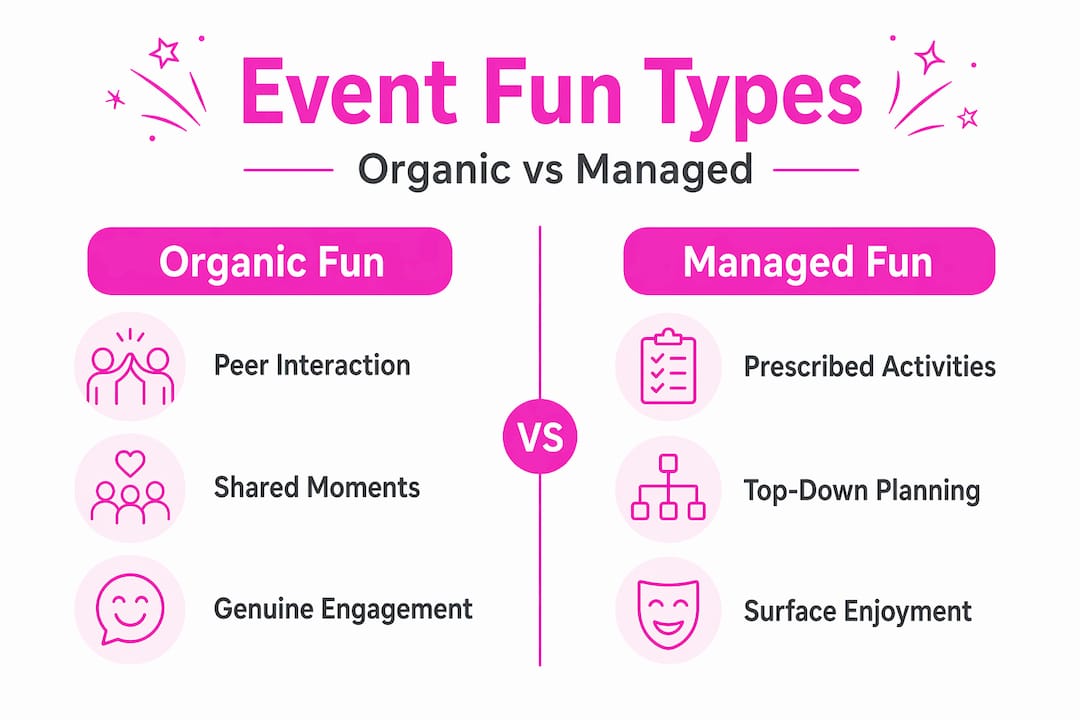
Employees who feel trusted by management show 76% higher engagement. Entertainment cannot substitute for that trust. But entertainment delivered thoughtfully, at the right moment, in a format that respects the audience, can reinforce it.
Practical strategies for selecting entertainment
The impact of entertainment on employee engagement is only as strong as the quality of the decisions made before anyone steps foot in the venue. Strategy determines outcome. Here is how to approach selection without guesswork:
- Anchor every entertainment choice to a specific objective. If the goal is cross-team connection, choose collaborative formats. If the goal is celebrating achievement, choose something spectacular that people will talk about for months. If the goal is energising a large group before an afternoon of workshops, a live DJ set or hosted music experience delivers measurably better results than a passive keynote.
- Audit your audience before the event. Age range, cultural diversity, seniority mix, and remote versus in-person attendance all affect which formats land well. An improv comedy show that delights one group might alienate another entirely.
- Avoid overprogramming. Unstructured time at corporate events is not wasted time. People network, debrief, and process during the gaps. Filling every minute with entertainment removes the breathing room that gives the entertainment itself context and contrast.
- Allow multiple participation pathways. Not everyone wants to be on stage. The best entertainment options for events offer visible active roles for willing participants and an equally satisfying spectator experience for those who prefer to observe.
- Consider sound design as a strategic element. Sound and tactile elements in event design profoundly affect mood and attention but are consistently underused compared to visual elements. The ambient music between sessions, the audio quality of a live performance, and the way a room sounds during networking all shape how people feel without them consciously registering it.
Pro Tip: Use your entertainment choices as a deliberate signal about company culture. Top corporate events use entertainment to communicate ambition, values, and character. A business that books a technically precise, high-production live music experience says something fundamentally different about itself than one that arranges a generic pub quiz. Choose entertainment that reflects the organisation you want people to believe you are.
My honest take on entertainment as strategy
I have worked with event organisers at every budget level, and the pattern I see most consistently is this: entertainment gets planned last and cut first. It is treated as the optional layer, the bit that arrives once the “important” decisions have been made. That framing is what produces forgettable events.
In my experience, the most impactful corporate events I have been involved with shared one characteristic. The organiser treated entertainment as the spine of the experience, not a garnish at the edges. The content was built around the emotional journey. The entertainment was not separate from the agenda. It was the agenda, in many of the moments that mattered most.
The most common mistake I see is hiring entertainment that has no connection to the event’s narrative or the company’s identity. A comedian who references nothing about the industry, a DJ playing tracks that ignore the room’s demographic, or an interactive activity that requires extroversion from a group of technically-minded introverts. These choices do not just fail to engage. They actively communicate that the organiser did not think carefully about the people in the room.
What I have found genuinely works is integrating entertainment into the event’s architecture from the very first planning conversation. When you ask “what do we want people to feel at each stage of this event?” rather than “what do we need to fill this 30-minute slot?”, the decisions become clearer and the outcomes become measurable. Entertainment is not a cost. It is a multiplier on everything else you have invested in the day.
— STUART
How Freshentertainments can help
If you are planning a corporate event and want entertainment that actually delivers, the quality of your provider makes an enormous difference.
Freshentertainments brings professional DJ hire, live MC services, and bespoke interactive entertainment to corporate events across Scotland and beyond. Every package is designed around your event objectives, not a generic template. Whether you need a high-energy music experience to reset a room after a morning of presentations, or a fully hosted interactive segment that brings cross-departmental teams together, Freshentertainments builds around your brief. Visit the corporate entertainment page to explore tailored options designed for events where memorable experiences are not optional. You can also view entertainment package details to understand the service quality and customisation on offer.
FAQ
Why does entertainment matter in corporate events?
Entertainment manages energy, improves memory retention, and drives engagement at points where passive content delivery fails. Well-placed entertainment transforms attendee experience and improves outcomes for the entire event.
How does entertainment improve employee engagement at events?
Active participation formats increase satisfaction and social connection, whilst entertainment breaks reset attention during predictable energy dips. Together, these effects keep attendees present and invested throughout the programme.
Can entertainment backfire at corporate events?
Yes. Forced or managed fun produces cynicism when it feels obligatory or disconnected from the audience’s needs. Entertainment must feel authentic, participatory by choice, and matched to the culture of the group.
What types of entertainment work best for corporate events?
Live music, hosted interactive games, comedy, and multi-sensory experiences all perform well depending on the event objective. The key is matching format to goal rather than choosing entertainment based solely on what is popular or easy to book.
How far in advance should entertainment be planned for a corporate event?
Entertainment should be decided at the same time as the agenda, not after it. Because effective entertainment is integrated into the event’s energy and narrative arc, late-stage decisions limit how well it connects to the overall experience.