
TL;DR:
- Planning effective corporate entertainment requires aligning activities with clear organizational goals and understanding audience demographics. Budgeting should include extensive lead times, technical costs, and contingencies to ensure quality, while integrating entertainment seamlessly into event flow enhances attendee engagement. Proper legal compliance and thorough on-the-day coordination are essential for a smooth, impactful experience that delivers measurable success.
Getting corporate entertainment right is harder than it looks. You have a room full of people with different tastes, a business outcome to hit, and a budget that never feels quite big enough. Knowing how to plan corporate entertainment properly means going well beyond booking a band or a DJ and hoping for the best. It means aligning every performance, activity, and moment with what your organisation actually needs from the event. This guide gives you a practical, experience-backed framework covering goals, budgets, formats, compliance, and day-of execution so your next event delivers on every level.
Table of Contents
- How to plan corporate entertainment that actually achieves something
- Setting your budget and timeline for premium entertainment bookings
- Choosing the right entertainment format and integrating it with event design
- Navigating legal compliance and risk management for your corporate event entertainment
- Coordinating execution and managing entertainment on event day
- Measuring success and gathering feedback after your corporate event
- Rethinking corporate entertainment: less excess, more intention
- Enhance your Scottish corporate events with Fresh Entertainments
- Frequently asked questions
Key Takeaways
| Point | Details |
|---|---|
| Start early | Begin planning and booking entertainment at least 12 months ahead for large corporate events to secure top-tier options. |
| Align goals | Clarify event objectives and audience needs first to choose entertainment that supports business outcomes effectively. |
| Budget comprehensively | Include production, travel, contingencies, and venue commissions in your entertainment budget for accurate cost planning. |
| Engage intentionally | Select entertainment formats and design event flow to create meaningful engagement, not just fill time. |
| Measure impact | Collect timely feedback and assess against KPIs to prove entertainment success and inform future events. |
How to plan corporate entertainment that actually achieves something
The most common mistake in corporate event entertainment strategies is starting with the entertainment and working backwards. You hear about a comedian who was brilliant at someone else’s event, and suddenly that becomes the plan. It rarely works, because the entertainment was not designed around your goals or your people.
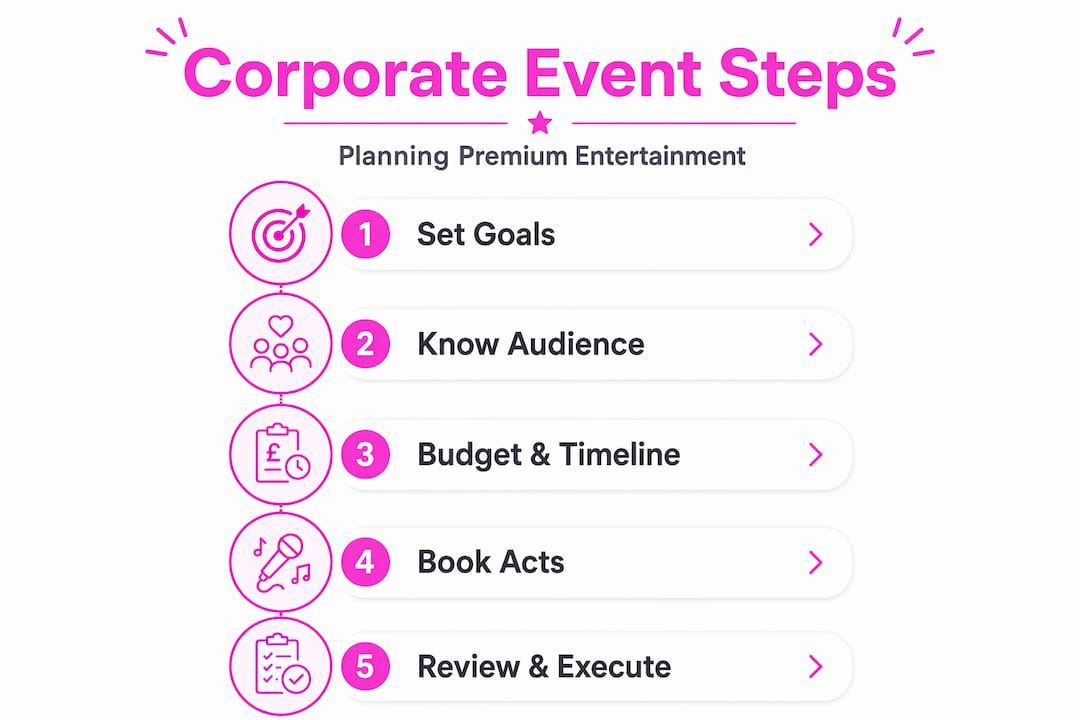
Corporate event planning starts with two or three concrete goals, such as reinforcing a cultural shift, rewarding a team, or strengthening client relationships. Once those goals are written down, every entertainment decision has a filter. A company celebrating a record-breaking year needs something celebratory and high-energy. A leadership off-site focused on strategic alignment needs something that encourages connection without being a distraction.
Understanding your audience is equally non-negotiable. Entertainment choices must consider audience demographics and cultural contexts to avoid costly mistakes. A multigenerational workforce responding to different music eras, international guests with varying cultural expectations, or a predominantly introverted team that will wilt under pressure to participate, these all require different approaches.
Key questions to answer before booking any entertainment:
- What are the two or three business outcomes this event must support?
- What is the age range, cultural mix, and professional background of attendees?
- Is participation voluntary or built into the programme?
- Does the event mix employees with external clients or stakeholders?
- What is the tone: celebratory, developmental, client-facing, or motivational?
Pro Tip: Send a short pre-event survey to a sample of attendees three to four weeks before the event. Even ten responses can reveal whether people want high-energy participation or a more relaxed, ambient experience. Check this corporate event entertainment checklist for a structured starting point.
Setting your budget and timeline for premium entertainment bookings
With goals and audience clarity in place, the next step is building a realistic budget and timeline. Both are consistently underestimated, and both have a direct impact on the quality of entertainment you can secure.
Premium venues in Edinburgh book 12 to 18 months in advance, and entertainment acts that match their calibre require six to twelve months of lead time. For events with over 200 delegates, starting your planning 12 months out is not cautious — it is essential.
AV production typically costs 15 to 25% of the total event budget, including labour and venue commissions. That proportion surprises many organisers who have only factored in the talent fee. A headline act booked at a reasonable rate can still break your budget if the technical requirements are extensive.
Entertainment fees range broadly depending on audience size and production complexity. Do not treat the quoted fee as the full cost. Add travel, accommodation, technical riders, and any crew requirements on top.
A realistic corporate entertainment budget framework:
| Budget item | Approximate proportion |
|---|---|
| Entertainment talent fees | 30 to 40% |
| AV and technical production | 15 to 25% |
| Venue hire and logistics | 20 to 30% |
| Catering and hospitality | 15 to 20% |
| Contingency fund | 10 to 20% |
Steps to build your entertainment budget:
- Define your total event spend ceiling before allocating to entertainment.
- Request itemised quotes from at least three entertainment suppliers.
- Get technical rider requirements from every performer before signing contracts.
- Add a minimum 10% contingency on top of confirmed quotes.
- Review budget allocations at 90, 60, and 30 days before the event.
Pro Tip: The contingency budget is not optional. Last-minute venue changes, equipment upgrades required by a performer, or a date shift can each add thousands to your costs if you have no buffer.
If you are unsure what a fully professional corporate entertainment package costs in Scotland, corporate event DJ guidance breaks down what to expect from a premium provider.
Choosing the right entertainment format and integrating it with event design
After budgeting and scheduling, selecting the right entertainment format and weaving it into the event’s flow is what separates a forgettable function from a genuinely memorable experience.
High-end entertainers adapt their acts to room layout, audience profiles, and event goals rather than delivering a fixed show regardless of context. That adaptability is part of what you are paying for. A cabaret-style dinner has completely different spatial and tonal requirements to a conference reception.
Aligning people, place, and purpose creates intentional engagement and prevents the kind of unfocused event where attendees check out after the meal. Think about where entertainment sits in the programme, not just what it is.
Entertainment formats and their best use cases:
| Format | Best suited for | Watch out for |
|---|---|---|
| Stage show or headline act | Awards evenings, gala dinners | Requires strong AV setup |
| Close-up or roving performers | Networking receptions, drinks receptions | Can feel intrusive in the wrong space |
| Interactive activities | Team-building days, internal conferences | Needs voluntary participation to land well |
| DJ and live music combination | Company parties, celebrations | Venue acoustics must support it |
| Facilitated group experiences | Leadership events, culture programmes | Requires skilled facilitation to avoid awkwardness |
- Plan entertainment as part of the event flow, not a separate element bolted on at the end.
- Use lighter, ambient entertainment during arrival and networking to ease guests in.
- Save your highest-impact moment for the natural peak of the event, usually after dinner or a keynote.
- For larger venues in Scotland, consider event entertainment management professionals who understand local venue dynamics.
- Corporate photo booth solutions work well as engagement touchpoints that keep guests interacting between main programme items.
Pro Tip: Map your entertainment onto the event timeline in fifteen-minute blocks. When you see it laid out, gaps in engagement become obvious — and so do moments of overload.
Navigating legal compliance and risk management for your corporate event entertainment
With the entertainment plan set, ensuring your event meets all legal and safety requirements is not optional. In Scotland, as across the UK, the obligations are clear and the consequences of ignoring them are serious.
Corporate events must comply with the Health and Safety at Work Act 1974, the Licensing Act 2003, and carry a minimum of £5m public liability insurance. Your venue may have its own insurance, but you and your entertainers need separate cover.
Your compliance checklist:
- Confirm the venue holds a premises licence covering both entertainment and alcohol service.
- Obtain certificates of public liability insurance from every external performer and supplier.
- Commission a written risk assessment covering all event activities, including temporary staging.
- Review accessibility provisions under the Equality Act 2010, covering mobility, hearing loops, and sight lines.
- Appoint a named health and safety contact for the event day with clear authority to act.
Compliance is not bureaucracy — it is what keeps your event running and your organisation protected. One incident without adequate insurance or a missing licence can end the event and expose your company to significant liability.
Pro Tip: Ask your venue coordinator for their event-specific licence conditions in writing before finalising your entertainment booking. Some venues have noise curfews or restrictions on certain types of performance that will directly affect your format choices. Review your corporate event entertainment compliance obligations early so they shape your decisions rather than force last-minute changes.
Coordinating execution and managing entertainment on event day
Having ensured legal compliance, the focus shifts to delivering everything you have planned without it unravelling on the day. The gap between a well-planned event and a well-executed one is almost always communication.
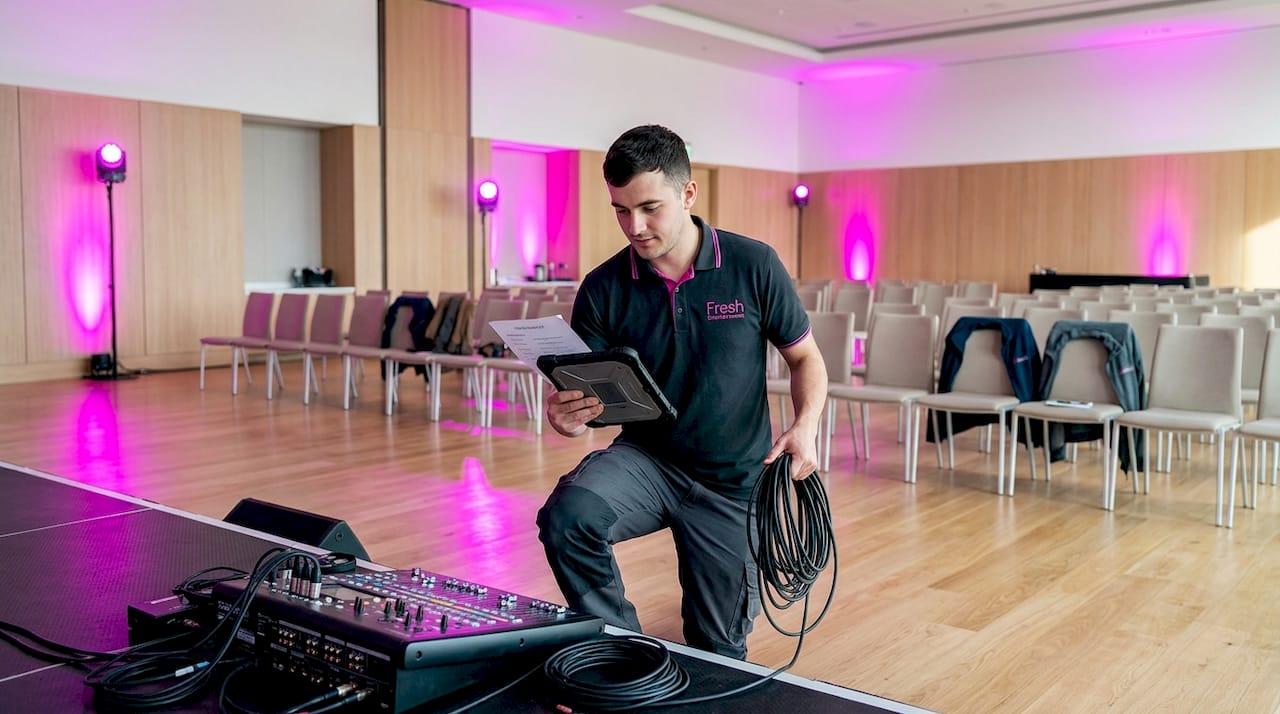
Involving AV and production teams early prevents costly rush fees and technical limitations. A proper dry run, combined with final confirmations sent 48 hours before the event, removes the majority of day-of surprises.
On-day execution steps:
- Begin load-in and technical setup at least three to four hours before guests arrive.
- Complete a full sound check and lighting review before the venue opens.
- Hold a team briefing one hour before doors open, confirming roles, timings, and escalation contacts.
- Walk the room with your entertainment lead and AV technician to identify any last-minute spatial issues.
- Confirm all contingency plans are understood by key staff — who calls what if a performer is delayed or equipment fails.
Signs your day-of coordination is working:
- All suppliers have confirmed arrival and load-in times in writing.
- Every team member has a printed or digital run-of-show with exact timings.
- You have a direct contact number for every performer and AV technician on-site.
- Backstage and green room requirements are confirmed and ready before the talent arrives.
Pro Tip: Brief your MC or host on the event’s specific business context. A host who understands what the company is celebrating, or what message leadership wants to land, can bridge the entertainment and the agenda in a way that feels natural rather than scripted. For detailed guidance, explore managing corporate entertainment and event entertainment coordination resources that cover professional execution standards.
Measuring success and gathering feedback after your corporate event
Once the event concludes successfully, measuring its entertainment impact is the step most organisers skip — and then wonder why planning the next one feels like starting from scratch.
Post-event follow-up within 48 hours and measurement against KPIs within two weeks are critical for proving value and informing future planning. Attendee memory fades quickly. A short survey sent the morning after captures honest, specific impressions before they blur.
Leadership ultimately values decisions, behaviour, or relationship changes resulting from the event rather than raw attendance figures. Build your evaluation framework around those outcomes, not just satisfaction scores.
Structured feedback steps:
- Send a post-event survey within 24 to 48 hours to all attendees.
- Include both rating scales and at least two open-ended questions about entertainment specifically.
- Review results against your pre-set KPIs within two weeks of the event.
- Schedule a debrief with key stakeholders to review qualitative feedback alongside the data.
- Document decisions made and relationships built as a direct result of the event where possible.
What to measure:
- Overall entertainment satisfaction rating.
- Specific performer or activity scores.
- Whether the entertainment felt aligned with the event’s purpose.
- Net Promoter Score for the overall event experience.
- Qualitative comments on what attendees would change or repeat.
Use your findings to evaluate corporate entertainment performance and build a supplier record that informs your next booking cycle.
Rethinking corporate entertainment: less excess, more intention
Here is something the industry rarely says out loud: bigger budgets do not produce better events. They often produce more complicated ones.
After years of working across premium Scottish venues with clients ranging from financial services firms to technology companies, the pattern is consistent. The events people remember are rarely the ones with the largest production spend. They are the ones where everything felt considered. The entertainment suited the room. The tone matched the moment. Nobody felt forced to participate in something awkward.
Less excess and more impact creates stronger connections and greater ROI than a bigger budget thrown at spectacle. That is not a budget-saving argument. It is a design argument. The best corporate entertainment we have seen in Scotland works because it was chosen for that specific group of people, in that specific space, at that specific point in the company’s story.
Constraints, when respected, often produce more creative solutions. A company with a modest entertainment budget that invests it in one perfectly matched act will consistently outperform a company that spreads a larger budget across too many moving parts.
The other thing worth saying plainly: attendee time is the most valuable resource in the room. Every entertainment choice is a request for attention. When that attention is rewarded with something genuinely relevant and well-executed, the goodwill generated reflects directly on the organisation that planned it. When it is not, the awkwardness is equally memorable.
Design your entertainment around what your audience will feel, not what looks impressive in a post-event report. Focus on purposeful corporate entertainment that earns its place in the programme rather than filling time.
Enhance your Scottish corporate events with Fresh Entertainments
Planning memorable corporate entertainment in Scotland takes more than a good idea. It takes the right partner — one who understands the nuances of premium Scottish venues, diverse corporate audiences, and the difference between entertainment that impresses and entertainment that delivers.
Fresh Entertainments specialises in premium corporate entertainment options tailored to your organisation’s goals, culture, and audience. From high-energy DJ sets and live saxophone performances to fully coordinated entertainment packages for gala dinners and company parties, every booking is built around your brief. With experience across Scotland’s most prestigious venues and a commitment to flawless execution, Fresh Entertainments is the partner you want when the stakes are high. Ready to start planning? Use our booking form for corporate entertainment to outline your event and receive a tailored proposal.
Frequently asked questions
How far in advance should I book entertainment for a large corporate event in Scotland?
For events with over 200 delegates, book entertainment and venues at least 12 months ahead. Premium Edinburgh venues fill 12 to 18 months in advance, and top entertainment acts follow a similar lead time.
What legal requirements must I consider for corporate entertainment in the UK?
You must comply with the Health and Safety at Work Act 1974, Licensing Act 2003, and carry a minimum of £5m public liability insurance. UK event compliance obligations also include written risk assessments and accessibility provisions.
How can I ensure the entertainment appeals to a diverse corporate audience?
Use pre-event surveys and demographic analysis to guide your selection. Planners often misjudge entertainment fit by choosing based on personal preference rather than audience demographics and cultural context.
What proportion of the event budget should go to AV and production?
Allow 15 to 25% of your total event budget for AV production. Corporate AV costs include labour, equipment, and venue commissions, which together can significantly exceed the initial quote.
How do I measure the success of corporate event entertainment?
Collect attendee feedback within 48 hours and measure against KPIs within two weeks. Also track behaviour and relationship changes resulting from the event, which leadership values more than satisfaction scores alone.
What are common mistakes when budgeting for corporate entertainment?
Failing to account for technical riders, travel, accommodation, and contingency is the most frequent cause of budget overruns. Entertainment budgets routinely overrun without a 10 to 20% buffer built in from the start.