
TL;DR:
- Event production involves the technical and creative execution of live event environments, focusing on audio, lighting, staging, and video elements that audiences experience directly. Proper coordination of these interconnected disciplines ensures seamless, memorable events, which require early planning, clear communication, and specialized crew roles. Effective event production is often invisible to guests because of meticulous design, timing, and contingency planning that deliver a flawless experience.
Event production is the technical and creative process of executing an event’s physical and sensory environment, covering audio, lighting, staging, video, and live operations from load-in to strike. Where event planning focuses on strategy and logistics, production is what audiences actually see, hear, and feel on the day. Whether you are organising a wedding in Edinburgh or a corporate conference in Glasgow, understanding what event production involves is the difference between a forgettable occasion and one that lands exactly as intended.
What are the key elements of event production?
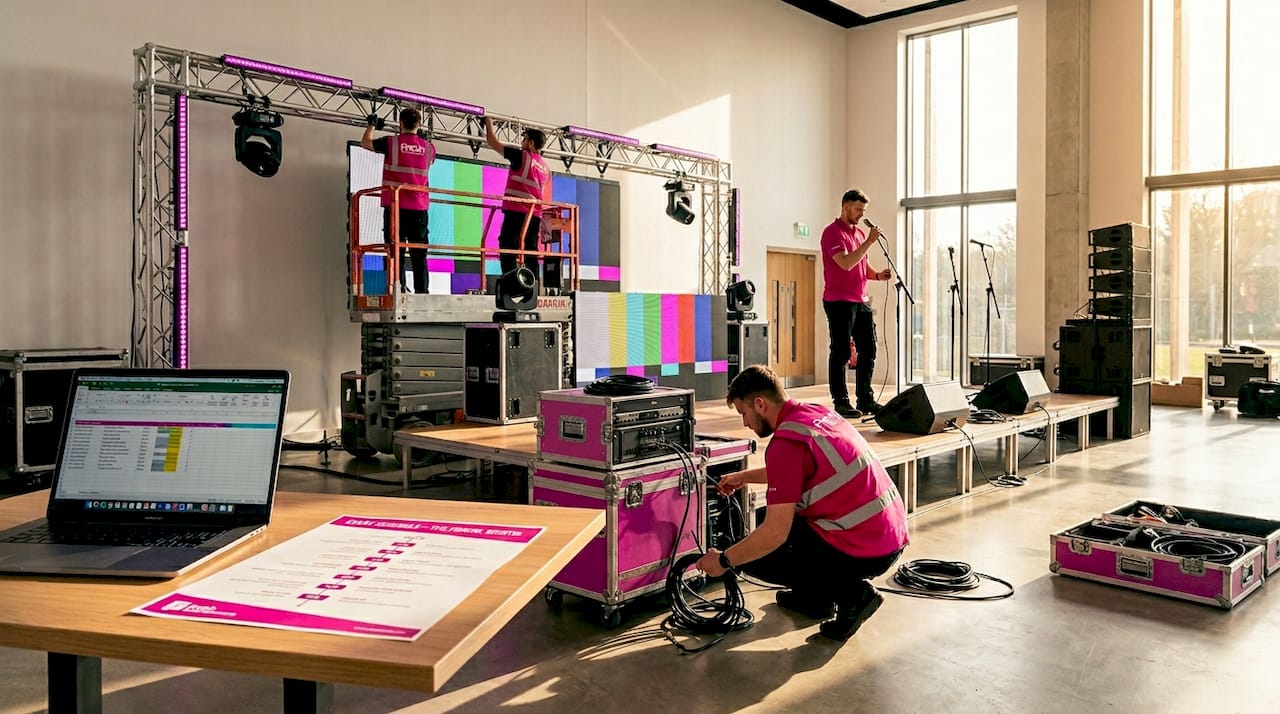
Event production is built on six interconnected technical disciplines, each managed by specialist crew members working to a shared plan. Ignore any one of them and the experience suffers. Master all six and the event feels effortless to every person in the room.
Audio systems
Audio is the backbone of any live event. A typical production rig includes microphones, mixing consoles, amplifiers, front-of-house speaker arrays, and stage monitors. For weddings, clear ceremony audio is non-negotiable. For corporate events, distributed speaker systems cover breakout rooms and main stages simultaneously.
Lighting design
Lighting sets mood, directs attention, and transforms a plain venue into something memorable. Productions use a combination of stage wash fixtures, intelligent moving heads, ambient uplighting, and gobo projectors. Good event lighting design does not just illuminate a room. It tells the audience where to look and how to feel.
Video and content playback
LED walls, projection screens, confidence monitors, and camera systems all fall under the video discipline. A corporate keynote without a reliable content playback system is a presenter’s nightmare. For weddings, a well-placed screen showing a photo montage during dinner adds an emotional layer that no other element can replicate.
Staging and rigging
Staging covers physical platforms, scenic backdrops, trussing, and the rigging points that suspend equipment above the audience. Production teams own the technical build, including rigging, power distribution, and signal flow, integrating audio, video, and lighting into a single coherent system. Safety is the primary consideration at every stage of this process.
Crew roles
A production crew typically includes a technical director, stage manager, audio engineer, lighting operator, video operator, and riggers. Each role has a defined responsibility. The stage manager calls cues from a run-of-show document, coordinating every department in real time.
Pro Tip: Ask your production company for a crew list before the event. Knowing who owns each technical area means you can direct questions to the right person on the day, saving time and reducing confusion.
- Audio: microphones, consoles, speakers, monitors
- Lighting: intelligent fixtures, ambient uplighting, gobos
- Video: LED walls, projectors, cameras, playback systems
- Staging: platforms, scenic design, trussing, rigging
- Crew: technical director, stage manager, engineers, operators
- Logistics: load-in, rehearsals, show calling, strike
How does event production differ from event management and planning?
These three terms are used interchangeably far too often, and the confusion costs people money. Each discipline has a distinct scope, and on larger events, three separate teams handle them.
| Role | Primary focus | Typical tasks |
|---|---|---|
| Event planner | Strategy and guest experience | Venue booking, catering, budgeting, invitations |
| Event manager | Overall coordination | Scheduling, vendor liaising, day-of logistics |
| Event producer | Technical build and live operation | Audio, lighting, video, staging, crew management |
On a large corporate conference, the event planner books the venue and manages the delegate experience. The event manager coordinates suppliers and keeps the schedule on track. The production team arrives the day before, rigs the LED wall, calibrates the sound system, and runs the show from a technical desk at the back of the room.
On a smaller wedding, one person often covers planning and management, while a specialist entertainment provider like Freshentertainments handles the production side. Understanding how to choose event hosts and technical crew separately is one of the most practical steps you can take when budgeting for any event.
The clearest way to separate the three roles is this: planners decide what happens, managers decide when it happens, and producers decide how it looks, sounds, and feels.
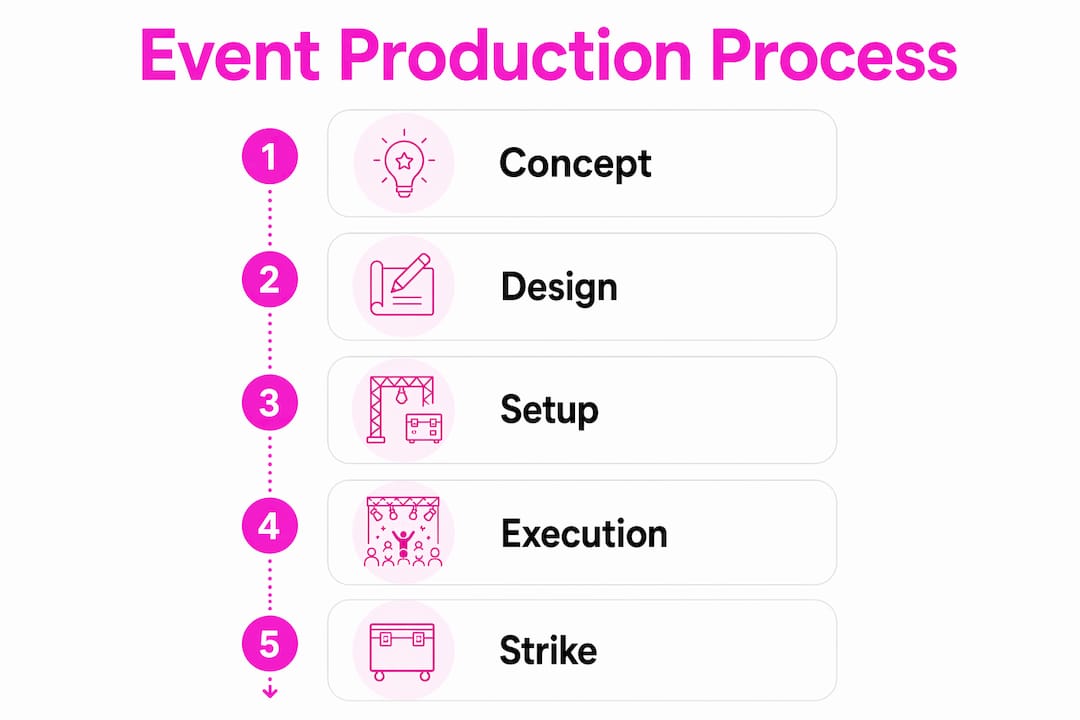
What is the typical event production process from concept to strike?
The event production process follows a defined sequence of stages. Skipping any stage creates problems that compound under pressure on the day.
-
Discovery and needs assessment. The production team meets with the client to understand event goals, audience size, venue specifications, and technical requirements. Sightlines, power supply, and rigging points are assessed at this stage.
-
Design and planning. System design documents are produced, equipment is selected, and a run-of-show is drafted. Corporate event timelines typically span 16 to 24 weeks for strategy, with production design finalised between 10 and 16 weeks out. This means production decisions need to be made well before most clients expect.
-
Load-in and setup. Equipment arrives at the venue, rigging is installed, and all systems are cabled and tested. Production companies invest 10 to 40 hours of planning before a single piece of gear is delivered. Load-in itself ranges from 6 to 10 hours for a 300-person event, and up to 48 hours for a large conference.
-
Technical rehearsals. Complex events require 4 to 6 hours of full technical rehearsal. This is where lighting cues are programmed, microphone levels are set, and video content is tested against the actual screens and projectors in the room.
-
Live event operations. The stage manager calls cues from the run-of-show document. Audio, lighting, and video operators respond in real time. The run-of-show document is a living roadmap coordinating cues, safety checks, and contingencies throughout the event.
-
Strike and post-event teardown. Production continues until all equipment is safely de-rigged, packed, and removed from the venue. This stage is often underestimated in planning timelines.
Pro Tip: Build your wedding entertainment timeline around the production schedule, not the other way around. If the production team needs four hours to set up, your venue access time must account for that before guests arrive.
What are best practices and common challenges in event production?
The most experienced producers share a consistent set of habits that separate reliable events from chaotic ones.
“The biggest mistake on short timelines is trying to force a full six-month vision into six weeks. Lock in venue, guest count, and production needs quickly to ease every downstream process.” — Bizbash
- Prioritise impact over perfection. On compressed timelines, momentum outweighs perfection. Focus on the elements guests will notice most: audio clarity, lighting atmosphere, and smooth transitions.
- Communicate fast. A 10-minute phone call outperforms a four-day email chain. Production teams need decisions quickly, and delays cascade into technical compromises.
- Involve production early in site visits. Experienced producers assess venue-specific rigging points, power supply, and sightlines during early planning. Discovering a venue has no suitable rigging points on load-in day is an expensive problem.
- Treat the run-of-show as a living document. Update it as decisions change. Every vendor and crew member should be working from the same version.
- Build in emergency preparedness. Production teams carry backup cabling, signal converters, and spare components. A 10-minute technical delay can cascade into a major disruption if no contingency plan exists.
- Budget for planning hours, not just equipment. The difference between a low quote and a premium one is often the planning investment, not the gear. Full-service production integrates all technical and logistical elements under one plan, reducing surprises and delivering a consistent attendee experience.
- Build strong vendor relationships. Trusted suppliers accommodate changes more readily and suggest alternatives under pressure. This matters most when something goes wrong at 6pm on event day.
How to approach event production for weddings and corporate events
The fundamentals of event production apply to every event type, but weddings and corporate functions each carry specific priorities that shape how production is planned and executed.
Weddings
Audio clarity during the ceremony is the single most important technical element at a wedding. Guests who cannot hear the vows remember nothing else. Beyond the ceremony, mood lighting transforms a reception venue from a functional space into something genuinely beautiful. Managing entertainment coordination across ceremony, drinks reception, and evening party requires a clear handover plan between each phase.
- Ceremony audio: lapel microphones for the couple, a clear speaker position for the officiant
- Mood lighting: warm uplighting, candle-effect fixtures, and a dance floor wash
- Entertainment transitions: smooth handovers between live music, DJ sets, and speeches
- Timeline discipline: production setup must be complete before guests arrive at the venue
For Scottish weddings in particular, venue access times and curfews vary significantly. Upscale Scottish wedding entertainment requires production teams who know local venues and can adapt quickly to their specific constraints.
Corporate functions
Corporate events add layers of complexity that weddings rarely require. Multi-room coordination, content playback for presentations, live streaming, and branded staging all demand a higher level of technical planning. Entertainment in corporate events is not a luxury. It is a direct driver of delegate engagement and brand perception. A poorly produced awards ceremony undermines the credibility of every award given.
Production timelines for corporate events are longer. Decisions on staging design, screen placement, and audio configuration need to be made weeks before the event, not days. The earlier you bring a production team into the planning process, the fewer expensive surprises you face on the day.
Key takeaways
Successful event production requires early technical involvement, a living run-of-show document, and clear communication across every crew role and vendor relationship.
| Point | Details |
|---|---|
| Define roles clearly | Event planners set strategy, managers coordinate logistics, producers execute the technical build. |
| Start production planning early | Corporate events need production design finalised 10 to 16 weeks before the event date. |
| Use a run-of-show document | Update it continuously and share it with every vendor and crew member involved. |
| Prioritise audio and lighting | These two elements have the greatest impact on how guests experience any event. |
| Budget for planning, not just gear | Premium production quotes reflect planning hours invested, which directly reduces on-day risk. |
Why great production is the part nobody notices
The most telling sign of excellent event production is that nobody in the audience mentions it. When audio is clear, lighting is beautiful, and every cue lands on time, guests focus entirely on the content and the people around them. That invisibility is the goal, and it takes considerable skill to achieve.
I have seen events where the technical team was brought in two days before the show, and events where they were involved from the first site visit. The difference in outcome is not subtle. Early involvement means the production design fits the venue rather than fighting it. It means the run-of-show reflects what is actually possible, not what someone assumed was possible from a floor plan.
The other thing I would stress is this: decisiveness matters more than perfection on any compressed timeline. Clients who agonise over speaker placement for three weeks while leaving audio specification unconfirmed create problems that no amount of technical skill can fully solve on load-in day. Make the big decisions early. Trust your production team on the details. That combination produces events that feel effortless, even when the preparation behind them was anything but.
The creative and the operational have to coexist in event production. The best producers I have worked with hold both in equal regard. They care deeply about how the room looks and feels, and they are equally rigorous about cable management, power distribution, and contingency planning. That balance is what separates a truly memorable event from one that merely ran without incident.
— STUART
How Freshentertainments brings event production to life
Freshentertainments delivers professional event production and entertainment services across Scotland and beyond, combining premium audio, lighting, and live performance into a single, coordinated experience.
Whether you are planning an intimate wedding or a large corporate function, Freshentertainments provides experienced crews, bespoke sound and lighting design, and MC services that hold the entire event together. Their wedding entertainment packages are built around your timeline, your venue, and the atmosphere you want to create. From ceremony audio to the final song of the evening, every technical element is planned, rehearsed, and delivered by a team that treats your event as its own. Get in touch to discuss a bespoke production plan for your occasion.
FAQ
What is event production in simple terms?
Event production is the technical and creative process of building and operating the audio, lighting, video, and staging that make an event work. It covers everything from equipment setup to live show operation and post-event teardown.
How does event production differ from event planning?
Event planning covers strategy, venue booking, catering, and guest experience. Event production covers the technical build and live operation of audio, lighting, video, and staging on the day itself.
How long does event production take to set up?
Load-in ranges from 6 to 10 hours for a 300-person event and up to 24 to 48 hours for a large conference. Production companies also invest 10 to 40 hours of planning before any equipment arrives at the venue.
What is a run-of-show document?
A run-of-show is a live document that coordinates every cue, safety check, and contingency across the production team. It is updated continuously and shared with all crew and vendors before and during the event.
Do I need a separate event production company for a wedding?
Not necessarily. Many full-service entertainment providers like Freshentertainments integrate production capabilities, including audio, lighting, and staging, directly into their wedding packages, removing the need to coordinate multiple separate suppliers.