
TL;DR:
- Successful event hosting relies on early planning, clear roles, and thorough risk management to prevent common pitfalls.
- Implementing a structured lifecycle from goal setting through post-event review ensures smooth execution and continuous improvement.
Whether you are planning a corporate conference, a charity gala, or a wedding celebration, the event hosting process can unravel quickly without a clear structure behind it. Most events that go wrong do not fail because of bad ideas. They fail because of skipped steps, unclear roles, and decisions made too late. This guide walks you through every phase of the process, from setting your foundations before a single booking is made, through to the post-event review that makes your next occasion even better.
Table of Contents
- Key takeaways
- The event hosting process: foundations first
- Step-by-step guide to hosting an event
- Handling challenges on event day
- Post-event activities and continuous improvement
- My perspective on getting the event hosting process right
- Bring your event to life with Freshentertainments
- FAQ
Key takeaways
| Point | Details |
|---|---|
| Start early on bookings | Venue and vendor commitments made 6–12 months ahead give you better options and negotiating power. |
| Treat risk planning as a playbook | A risk management document with named response owners enables faster, calmer decisions on event day. |
| Assign roles before the day | Clear team responsibilities prevent confusion and speed up real-time problem solving during execution. |
| Post-event review closes the loop | Surveys, metrics, and debriefs turn every event into a learning opportunity for the next one. |
| Communication is non-negotiable | Consistent communication with your team, vendors, and attendees throughout the full event lifecycle keeps everyone aligned. |
The event hosting process: foundations first
Before you book a venue or send a single invitation, you need a clear understanding of what you are actually trying to achieve. Event management covers the full lifecycle including strategy, logistics, communication, and post-event analysis. Event planning, by contrast, focuses largely on the pre-event phase. Knowing which hat you are wearing at any given moment helps you prioritise the right tasks.
Define your goals and budget
Every successful event begins with a specific objective. Are you celebrating a milestone, generating leads, building relationships, or launching a product? Write it down in one sentence. That sentence becomes your filter for every decision that follows.
Your budget should be built around your goals, not the other way around. List your non-negotiable costs first: venue, catering, entertainment, and AV equipment. Then layer in the desirables. A budget built this way is far less likely to collapse under pressure when a surprise cost appears mid-planning.
Build your team and tools
Effective staffing requires designated roles including an event lead, logistics coordinator, marketing lead, registration manager, and on-site support. Vague responsibilities cause delay and miscommunication, particularly on event day when decisions need to happen quickly.
Here is a quick overview of the core tools and resources you will need at this stage:
| Resource | Purpose |
|---|---|
| Event planning checklist | Tracks all tasks and deadlines across the full timeline |
| Budget spreadsheet | Monitors spend against allocations in real time |
| Venue research shortlist | Compares options across capacity, location, and availability |
| Vendor contact sheet | Centralises supplier details and contract status |
| Communication platform | Keeps team updates and approvals in one place |
Timeline planning deserves particular attention. Starting venue and vendor booking 6–12 months in advance is not overcaution. It is the difference between your preferred venue and your backup. For weddings especially, popular venues and entertainment providers book out well in advance across Scotland and beyond.
Pro Tip: Book your venue and headline entertainment provider at least six to twelve months out. The venues and performers that everyone wants are gone fastest. Locking them in early also gives you more leverage when negotiating packages.
Step-by-step guide to hosting an event
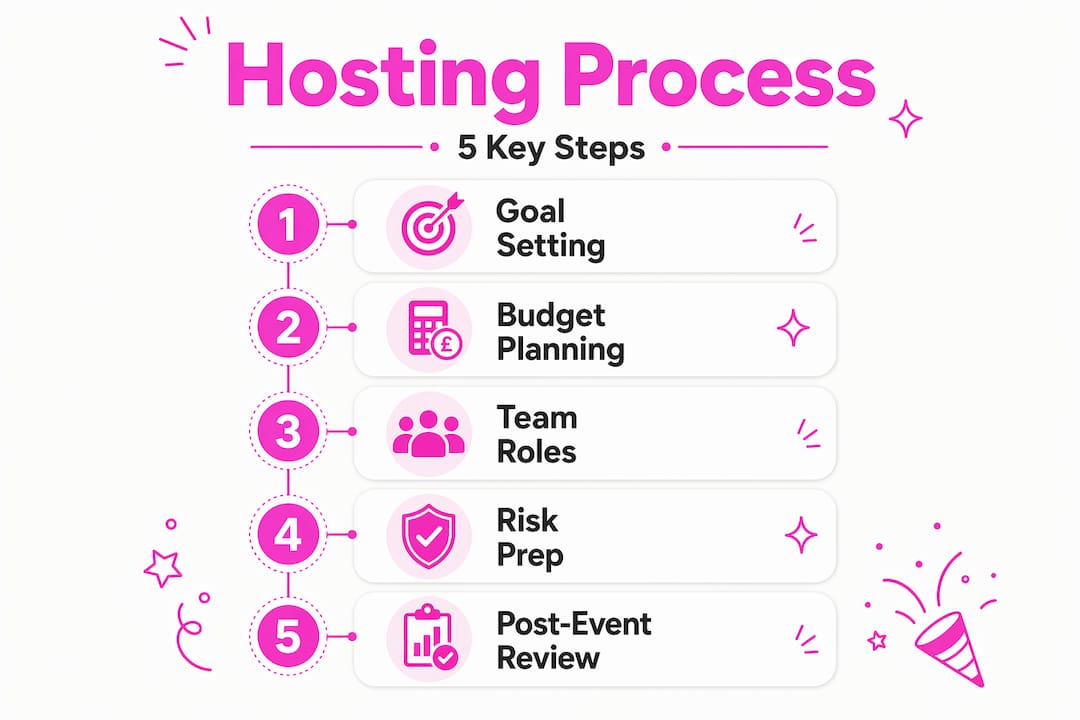
The event hosting process is typically structured as a lifecycle with common stage breakdowns ranging from seven to nine core steps. What follows is a chronological framework you can apply to almost any event type.
-
Set your goals and success criteria. Define what a successful outcome looks like before spending a penny. Include measurable targets such as attendance numbers, satisfaction scores, or revenue generated.
-
Build your budget. Allocate funds by category and include a contingency reserve of at least ten per cent. Unexpected costs are not exceptions. They are the rule.
-
Confirm your date and set your timeline. Work backwards from the event date. Assign deadlines to every major task and identify dependencies early, such as which bookings need to be confirmed before others can proceed.
-
Select and book your venue. Match the venue to your audience, your programme, and your budget. Check capacity, accessibility, parking, catering facilities, and technical infrastructure before signing anything.
-
Book your vendors and entertainment. Confirm suppliers in writing with contracts that specify deliverables, cancellation terms, and payment schedules. For weddings and corporate events, entertainment is one of the most impactful investments you can make. Well-planned entertainment coordination for weddings can transform a good event into an extraordinary one.
-
Promote the event and manage invitations. Build a communication plan that covers save-the-dates, formal invitations, reminders, and event-day logistics for attendees. Tailor your channels to your audience.
-
Conduct a venue walkthrough and finalise logistics. Venue walkthroughs paired with checklists help identify crowd flow issues, ingress and egress concerns, and emergency response requirements before they become problems on the day.
-
Execute on the day. Assign a single point of decision authority for the event day itself. Brief your full team on the run of show, their individual roles, and the contingency plans in place.
-
Post-event follow-up and evaluation. Send thank-you communications, distribute resources, gather feedback, and conduct your internal debrief within the first week. Speed matters here. Impressions fade quickly.
Risk management deserves its own focus within this process. A risk management plan should identify risks, assign roles, and define procedures with checkpoints at roughly three months, one month, and one week before the event, plus a final brief on the day itself. Consider risks across vendor reliability, weather, venue access, budget overrun, and health and safety compliance.
Pro Tip: Do not treat your risk management document as a formality. Assign a named owner to every risk scenario, define what action they should take, and review it at each checkpoint. When something goes wrong on event day, and something usually does, a team that has rehearsed its response acts with confidence instead of panic.
Handling challenges on event day
Even the most thoroughly prepared events face complications. Day-of operations require real-time logistics coordination and proactive communication with both attendees and staff. The difference between a minor hiccup and a full disruption is usually how quickly and calmly your team responds.
Here are the most common challenges you should plan for specifically:
- Vendor no-shows or late arrivals. Have a direct contact number for every supplier and a backup plan for your highest-risk dependencies. For entertainment, know who to call if your primary provider cannot make it.
- Technology failures. For secured or government venues in particular, offline check-in options are critical when connectivity fails. Paper-based backups and locally synced devices protect your attendance data and keep guest flow moving.
- Last-minute programme changes. Designate a single decision-maker with authority to approve changes on the day. Multiple people second-guessing one another in real time is how small problems become public ones.
- Unexpected weather. Outdoor or partially outdoor events need written contingency plans, not just verbal agreements. Know in advance which elements move inside, who communicates the change to attendees, and how quickly it can be executed.
- Attendee communication gaps. Have a system for pushing real-time updates to guests, whether that is a dedicated event app, text notifications, or clear signage at the venue.
“Briefing your team on top risks and named response owners in the final week, and again on event day, reduces improvisation under pressure and speeds up incident response significantly.” Event risk management plan template
The morning briefing on event day is often underestimated. A focused fifteen-minute session with your full team covering the run of show, known risks, and who owns what decisions sets the tone for everything that follows. Teams that are briefed properly stay calm. Teams that are not briefed properly make noise.
Post-event activities and continuous improvement
The event hosting process does not end when the last guest leaves. What happens in the days that follow determines how much value you extract from the experience and how much better your next event will be.
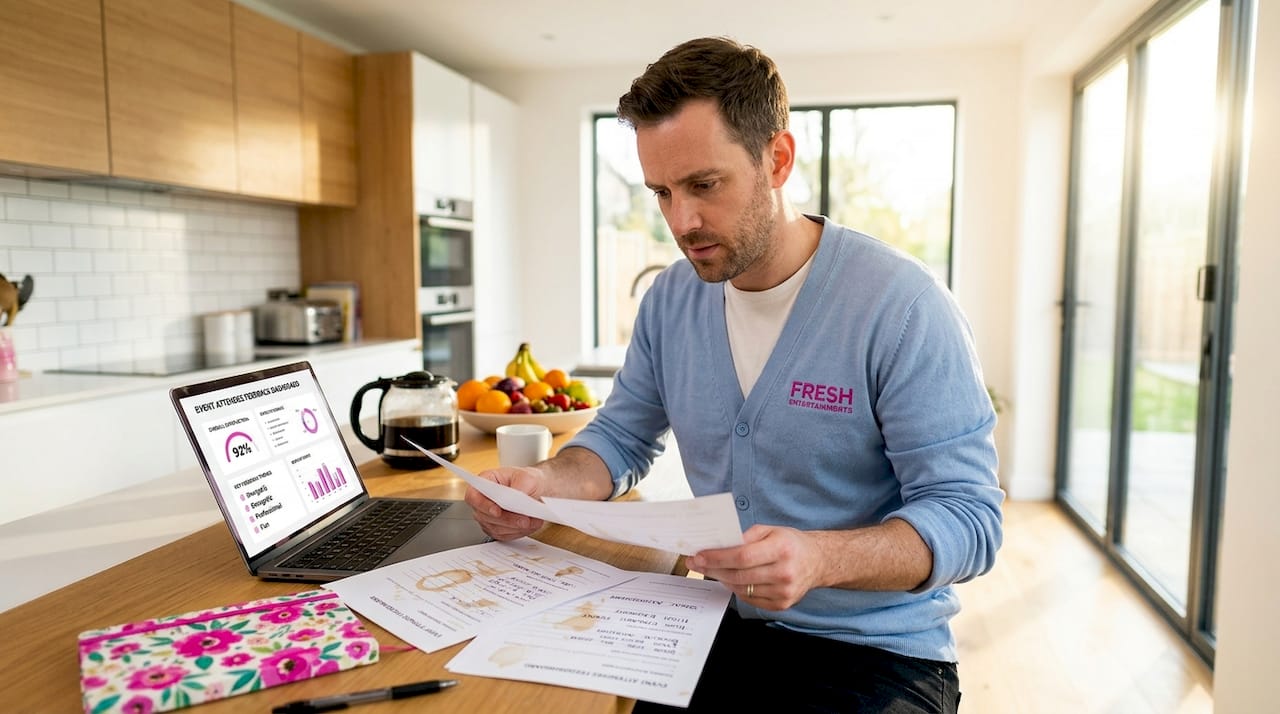
Post-event steps include sending thank-you emails, distributing recordings or resources, gathering surveys, running reports, analysing metrics, and conducting internal debriefs. Each of these steps feeds into your ongoing improvement cycle.
The key activities to complete within the first week after your event:
- Send personalised thank-you messages to attendees, speakers, sponsors, and key vendors
- Distribute any promised content such as recordings, slides, or photos
- Launch your attendee satisfaction survey while the experience is still fresh
- Pull your attendance and engagement metrics and compare them against your original targets
- Conduct an internal team debrief to capture what worked, what did not, and what to do differently
Pro Tip: Use event management technology to centralise your data, feedback, and attendee insights in one place. When it comes to planning your next event, having a structured record of what happened last time is worth more than any template you can download.
Stakeholder communication after the event is just as important as the pre-event variety. Share results with your sponsors and leadership team promptly, and document your lessons learned in a format that your team can actually use next time.
My perspective on getting the event hosting process right
I have worked on events ranging from intimate private celebrations to large-scale corporate productions, and one thing I have noticed consistently is this: the planning stage gets all the attention, while execution and flexibility are what actually determine the outcome.
Most hosts spend weeks on spreadsheets and vendor calls, then walk into event day without a clear chain of command. When a problem appears, and it will, nobody knows who is making the call. That hesitation costs time, composure, and sometimes the confidence of your guests.
What I have found genuinely useful is treating communication cadence as a system, not a reaction. Communication with stakeholders and attendees throughout the lifecycle is what keeps everyone aligned and surfaces issues before they become crises. Build in regular touchpoints. Do not wait for someone to raise a flag.
The other thing I would say is that risk management is not paperwork. It is a rehearsal. When your team has read the plan, knows their role in a contingency, and has had it reinforced in a morning brief, they respond with muscle memory rather than guesswork. I have seen that distinction make a tangible difference on difficult event days.
Early booking and thorough contingency preparation are not luxuries. For anyone managing entertainment at a wedding or premium corporate event, in particular, they are the foundation everything else sits on.
— STUART
Bring your event to life with Freshentertainments
Getting the logistics right is only part of the equation. The moments your guests actually remember come from the atmosphere, the energy, and the entertainment. Freshentertainments specialises in precisely that. From bespoke wedding entertainment packages that incorporate DJ hire, MC services, live saxophone, and professional lighting, to corporate event entertainment designed to engage and impress, the team brings award-winning expertise to every occasion. If you are building your event programme and want to understand how entertainment shapes the guest experience from start to finish, explore how great entertainment lifts guest engagement and makes your event genuinely memorable.
FAQ
What are the main stages of the event hosting process?
The event hosting process typically covers seven to nine stages, from goal setting and budgeting through to venue selection, vendor booking, day-of execution, and post-event evaluation. Each stage builds on the last, and skipping steps is where most events run into trouble.
How far in advance should I start planning an event?
For most events, starting the planning process six to twelve months ahead is recommended, particularly for venue and entertainment bookings. Vendor commitments are typically confirmed four to nine months out, with risk reviews conducted closer to the event date.
What should be on an event preparation checklist?
A solid event preparation checklist covers goal definition, budget allocation, venue research and booking, vendor contracts, promotional communications, a venue walkthrough, team role assignments, and a risk management plan with named response owners for each scenario.
How do I handle problems on event day?
Designate a single decision-maker before the day begins, brief your full team on known risks and contingency procedures, and have offline fallback options for technology-dependent tasks such as registration. A fifteen-minute morning briefing with your team is one of the most effective things you can do.
What happens after an event is over?
Post-event activities include sending thank-you communications, gathering attendee surveys, analysing attendance and engagement metrics, conducting an internal debrief, and documenting lessons learned. Completing these steps within the first week keeps the data accurate and the insights actionable.