
TL;DR:
- Choosing the right venue is crucial because it influences guest attendance, atmosphere, and event success.
- Venue selection accounts for 25% to 35% of the event budget and shapes the overall experience.
Venue selection is the single decision that determines whether a wedding or special event succeeds or fails before a single guest arrives. The right venue sets the tone, dictates logistics, and shapes every memory made on the day. Location, capacity, and ambiance are the three pillars that experienced planners and couples must assess before committing to any space. Brands such as Tickts and Tivoli Hospitality have codified these pillars into professional frameworks, and the guidance below draws on those standards to give you a clear, practical path through one of the most consequential choices you will make.
Why the role of venue selection defines your entire event
Venue selection is the process of identifying and committing to a physical space that can support your event’s purpose, guest numbers, and desired atmosphere. Get it right, and every other decision, from catering to entertainment, falls into place. Get it wrong, and no amount of flowers or lighting will compensate.

Venue hire typically accounts for 25%–35% of a total event budget. That proportion means the venue is not just a backdrop. It is the largest single investment you will make, and it must earn its share of the spend.
The importance of venue choice extends beyond cost. A venue communicates your event’s values before a word is spoken. A converted Victorian warehouse signals creativity and informality. A grand Scottish country house signals tradition and occasion. Couples and planners who understand this use the venue as a deliberate storytelling tool, not simply a container for guests.
How does venue location affect attendance and guest experience?
Location is the first filter every guest applies when they receive an invitation. A venue that is difficult to reach, poorly served by public transport, or situated in an unfamiliar area will reduce attendance and raise anxiety before the day begins.
Transport links, parking provision, and nearby accommodation are the three practical tests of any location. A standard parking ratio for large events is approximately one space per two to three delegates. Falling short of that ratio forces guests to park remotely, which creates late arrivals and a fractured start to proceedings.
Venue location significance also extends to the surrounding area. Guests arriving after dark need to feel safe walking from a car park or taxi drop-off. Nearby hotels matter enormously for weddings where guests travel from across Scotland or further afield. A venue in Edinburgh’s city centre, for example, offers dozens of accommodation options within walking distance, whereas a rural estate may require a dedicated shuttle service.
Local identity adds a layer of meaning that guests remember long after the event. Venues with a strong local character improve guest engagement by grounding the occasion in a place that feels real and specific. A wedding held at a venue with genuine regional history gives guests something to talk about that goes beyond the décor.
Key location factors to assess before shortlisting:
- Transport links: rail, bus, and road access for guests travelling from multiple origins
- Parking provision: ratio of spaces to expected guest numbers, including accessible bays
- Accommodation proximity: hotels or guest houses within a short distance or on site
- Area safety: well-lit approaches, clear signage, and a welcoming arrival experience
- Nearby amenities: restaurants or bars for pre-event gatherings and post-event continuity
What capacity and layout mean for your event
Capacity is the most misunderstood figure in venue selection. Fire code maximum occupancy rarely reflects comfortable usable capacity because staging, catering stations, dance floors, and circulation routes all consume significant floor space. A room licensed for 300 people may comfortably host 180 once a DJ booth, bar, and buffet tables are in place.
The gap between headline capacity and working capacity catches couples and planners off guard more than almost any other factor. Always request layout-specific capacity figures from the venue, not just the fire code maximum. Ask the venue coordinator to show you a floor plan with your specific configuration drawn in.
Pro Tip: Request a scaled floor plan from the venue and overlay your intended layout, including the dance floor, top table, bar, and entertainment area, before you sign any contract. What looks spacious in an empty room can feel cramped once the furniture arrives.
Layout flexibility matters as much as raw numbers. A venue that can reconfigure from a ceremony layout to a reception layout within 30 minutes is worth considerably more than one that requires a two-hour changeover. Technical infrastructure is equally critical. Dedicated high-bandwidth Wi-Fi lines are non-negotiable for events with live streaming, digital guest books, or AV-heavy entertainment programmes.
| Layout factor | What to check |
|---|---|
| Usable floor area | Ask for layout-specific capacity, not fire code maximum |
| Reconfiguration speed | Confirm changeover time between ceremony and reception |
| AV infrastructure | Verify dedicated power circuits and bandwidth for entertainment |
| Accessibility | Check step-free routes, lifts, and accessible toilet provision |
| Back-of-house access | Confirm loading routes that do not cross guest areas |
How does ambiance shape the guest experience?
Event venues function as a primary communication tool that influences guest behaviour and expectations from the moment they arrive. A venue with low ceilings and warm lighting encourages intimacy. A venue with soaring glass walls and a city skyline creates energy and spectacle. Neither is better in the abstract. The question is which atmosphere serves your specific event.
The most common mistake couples make is falling in love with a venue’s appearance before defining what the event needs to feel like. Rushing to book based on aesthetics before clarifying guest numbers, entertainment requirements, and catering style leads to compromises that chip away at the guest experience. A stunning venue that cannot accommodate a live band, or that restricts noise after 10pm, will frustrate rather than delight.
“The venue is not the event. It is the frame. Choose a frame that makes the picture inside it look its best, not one that competes with it.” This principle, widely shared among experienced event designers, captures why ambiance alignment matters more than visual impact alone.
Adaptability is the quality that separates a good-looking venue from a genuinely effective one. Venues that allow you to control lighting colour and intensity, bring in external entertainment suppliers, and adjust room dividers give you the tools to shape atmosphere rather than accept it. When assessing ideal venue characteristics, ask specifically what the venue will and will not permit in terms of decoration, sound levels, and supplier access. Those answers reveal more about a venue’s suitability than any photograph.
For weddings in Scotland, working with entertainment partners who know the venue is a significant advantage. A DJ or MC who has performed in the space before understands its acoustics, its layout quirks, and its curfew realities.
Venue selection checklist: how to evaluate venues properly
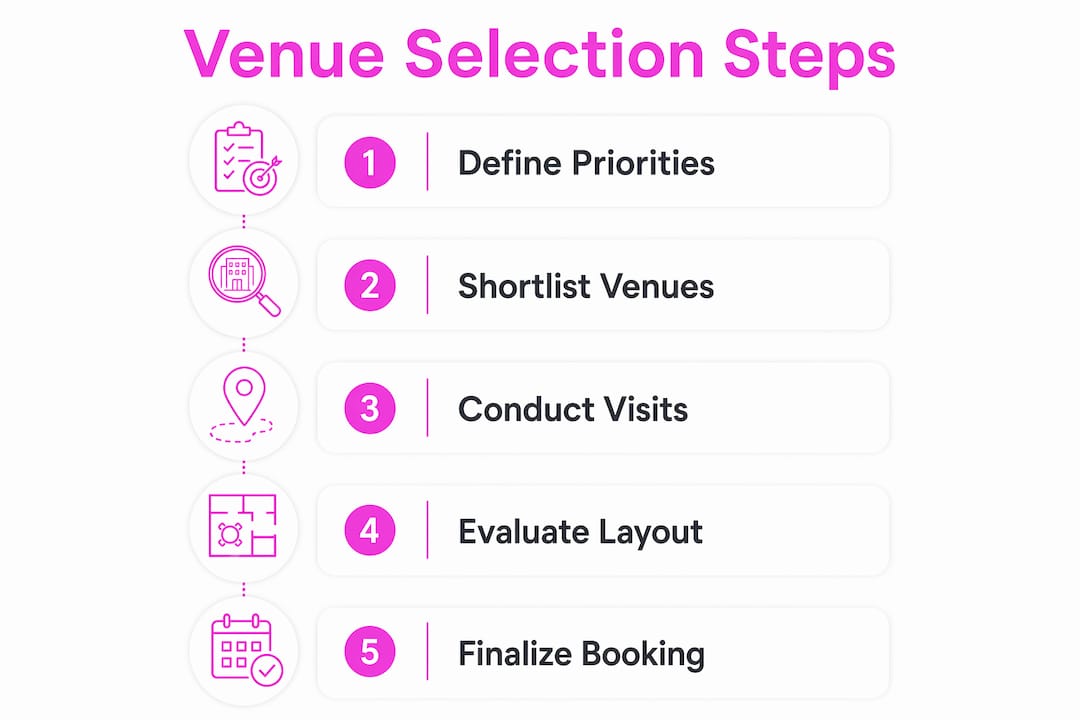
Planners should shortlist a minimum of three candidate venues and conduct back-to-back site visits using standardised checklists before making any commitment. Visiting venues consecutively, rather than weeks apart, makes direct comparison far more accurate.
A structured venue selection checklist covers four categories: logistics, hospitality, budget, and experience. Scoring each venue against the same criteria removes the distortion of first impressions and keeps decisions grounded in what the event actually requires.
Follow this sequence during every site visit:
- Arrive as a guest would. Walk from the car park or nearest transport stop to the entrance. Note signage, lighting, and the quality of the approach.
- Assess the front-of-house spaces. Check the ceremony room, reception area, and toilets for condition, capacity, and atmosphere.
- Request a back-of-house tour. Loading docks, prep rooms, and freight routes must be checked to prevent operational disruption and protect the guest environment.
- Test the acoustics. Clap, speak, and listen. Hard surfaces create echo. Soft furnishings absorb sound. Both affect entertainment quality significantly.
- Confirm technical infrastructure. Ask for written confirmation of available power circuits, AV connections, and internet bandwidth.
- Review the contract terms. Check curfew times, approved supplier lists, damage deposit requirements, and cancellation policies before any discussion of price.
Pro Tip: Bring your entertainment supplier to the site visit if possible. A DJ or live act who can assess the room’s acoustics, power supply, and load-in route will flag problems that neither you nor the venue coordinator will notice.
Advanced planners weight their scoring criteria according to the event’s priorities. A wedding where the dance floor is central scores acoustics and entertainment infrastructure more heavily. A corporate dinner scores catering facilities and AV capability at the top. Tailoring the checklist to your specific event prevents a venue that excels in one area from masking weaknesses in another.
Objective evaluation frameworks consistently outperform gut-feel decisions. Couples who score venues numerically before discussing their feelings about each one make faster, more confident decisions and report fewer regrets after the event.
Key takeaways
Venue selection is the foundational decision that shapes every other element of a wedding or special event, from guest attendance to entertainment quality and overall atmosphere.
| Point | Details |
|---|---|
| Location drives attendance | Assess transport links, parking ratios, and nearby accommodation before shortlisting any venue. |
| Capacity figures mislead | Always request layout-specific capacity, not fire code maximums, to understand true usable space. |
| Ambiance must match purpose | Define the event’s desired atmosphere before visiting venues to avoid decisions based on appearance alone. |
| Structured checklists work | Score at least three venues against logistics, hospitality, budget, and experience criteria for objective comparison. |
| Back-of-house matters | Check loading docks, prep rooms, and freight routes during every site visit to protect the guest experience. |
Venue selection: what I’ve learned from years of event work
The most expensive mistake I see couples and planners make is treating venue selection as a visual exercise. They tour a beautiful room, picture themselves in it, and sign before they have asked a single question about curfews, supplier restrictions, or acoustic properties. The venue looks perfect in photographs. On the night, the sound bounces off bare stone walls, the DJ cannot load in until an hour before guests arrive, and the bar closes at 11pm. None of that was visible in the brochure.
My strongest advice is to define your event’s non-negotiables before you visit a single venue. Write down the entertainment format you want, the guest count, the latest acceptable finish time, and the suppliers you intend to use. Take that list to every site visit and treat it as a filter, not a wish list. If a venue cannot accommodate your entertainment setup, it is not the right venue, regardless of how beautiful it is.
The second thing I have learned is that early venue selection shapes everything else. Couples who lock in their venue six to twelve months ahead gain access to preferred supplier lists, better catering options, and the time to build a coherent event around the space. Those who book late spend the rest of their planning process making compromises. The venue is not one decision among many. It is the decision that makes all the others possible.
Balancing aesthetics with functionality is not a compromise. It is the mark of a well-planned event. The best venues I have worked with are the ones that look extraordinary and perform flawlessly behind the scenes. Those two qualities are not in conflict. You just have to know what questions to ask.
— STUART
How Freshentertainments brings your venue choice to life
Choosing the right venue is only half the work. The other half is filling that space with an atmosphere that guests feel from the first song to the last dance. Freshentertainments specialises in exactly that, working with couples and planners across Scotland to match premium entertainment to the specific character of each venue.
Whether your venue is a grand Highland estate, a converted Glasgow warehouse, or a contemporary Edinburgh hotel, Freshentertainments builds a bespoke entertainment programme around its acoustics, layout, and atmosphere. From award-winning DJ sets and live saxophone performances to professional MC services, every element is tailored to the space. Explore the wedding party atmosphere guide to see how entertainment and venue work together to create something genuinely memorable. Get in touch with Freshentertainments to discuss your event and venue in detail.
FAQ
What is the role of venue selection in event planning?
Venue selection determines the physical, logistical, and atmospheric foundation of any event. It shapes guest attendance, entertainment options, catering capacity, and the overall experience from arrival to departure.
How much of an event budget should go on venue hire?
Venue hire typically accounts for 25%–35% of the total event budget. Staying within that range leaves sufficient funds for entertainment, catering, and décor.
What is the difference between fire code capacity and usable capacity?
Fire code capacity is the legal maximum number of people permitted in a space. Usable capacity is lower because it accounts for staging, dance floors, catering stations, and circulation routes that all reduce available floor area.
How many venues should you visit before deciding?
Shortlist at least three venues and visit them back to back using a standardised checklist. Consecutive visits make direct comparison far more accurate than visits spread across several weeks.
Why does back-of-house access matter at a wedding venue?
Back-of-house logistics including loading docks and prep rooms directly affect how smoothly suppliers can set up and operate without disrupting the guest experience. Poor access causes delays and can force equipment through guest areas.