
TL;DR:
- A venue entertainment checklist ensures all bookings, technical needs, legal obligations, and logistics are properly managed for successful events. It emphasizes early planning, detailed contracts, coordinated AV systems, outdoor-specific permits, and thorough risk documentation to prevent avoidable failures. Regularly updating and sharing a comprehensive, minute-by-minute run-of-show across teams is essential for seamless event execution in 2026.
A venue entertainment checklist is the structured planning document that governs every booking, technical requirement, legal obligation, and logistical decision involved in delivering live entertainment at an event. Without one, even experienced coordinators face avoidable failures: missed permits, underpowered audio, or a band that turns up without a signed contract. For weddings, corporate celebrations, and milestone parties in 2026, this guide covers the full entertainment venue checklist from first booking to final loadout, drawing on production standards, AV best practices, and booking insights from sources including Eventory, the Mississauga Convention Centre, and DJ Will Gill.
What does a venue entertainment checklist 2026 cover?
The checklist spans six core areas: booking timelines, AV and technical logistics, outdoor-specific requirements, performance scheduling, and risk and legal documentation. Each area has its own lead times, dependencies, and failure points. Treating them as one integrated plan rather than separate to-do lists is what separates a smooth event from a chaotic one. The sections below address each area in sequence, so you can build your own checklist as you read.
What are the essential booking timelines and prerequisites?
Live entertainment booking requires 6 to 12 months of advance planning, with progressive confirmation steps at each stage. That timeline is not a suggestion. Acts at premium venues book out quickly, and leaving it to four months before the event limits your choices significantly.
Follow this sequence to stay on track:
- 6 to 12 months out. Shortlist acts, confirm availability, and agree provisional fees. Check that each act holds public liability insurance and can supply a technical rider.
- 4 to 6 months out. Issue written contracts, collect signed copies, and take deposits. Confirm cancellation terms, payment schedules, and substitution clauses in writing.
- 8 to 12 weeks out. Rider collection begins at this stage, covering production requirements, hospitality needs, and travel arrangements. Vague riders at this point are a warning sign.
- 1 to 2 months out. Send final confirmations to all acts, the venue, and your AV supplier. Reconfirm load-in times, soundcheck slots, and parking access.
- Day of event. Run a morning briefing with all technical and performance teams. Confirm emergency contacts, set times, and break durations.
Incomplete paperwork and vague rider details are the most common source of disputes between venues and entertainment providers. A contract that specifies exact set times, deposit amounts, refund triggers, and substitution rights removes ambiguity before it becomes a problem.
Pro Tip: Request a copy of each act’s public liability insurance certificate at the contract stage, not the week before the event. Chasing it last-minute adds unnecessary pressure and occasionally reveals that cover has lapsed.
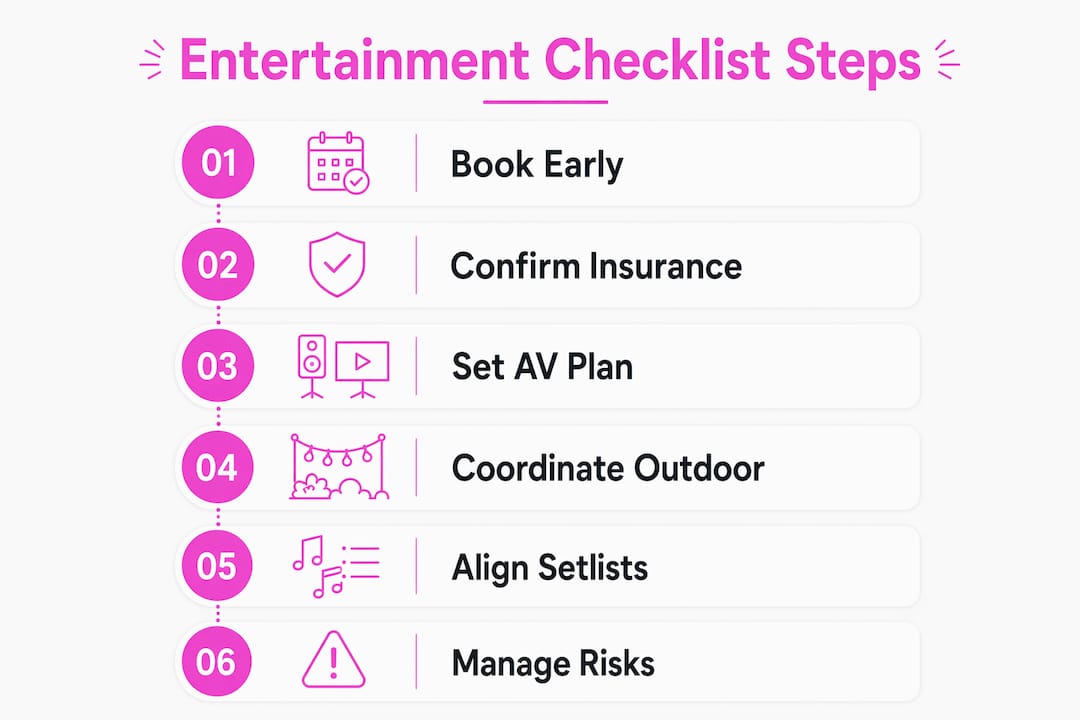
How to coordinate AV and technical logistics for your entertainment checklist
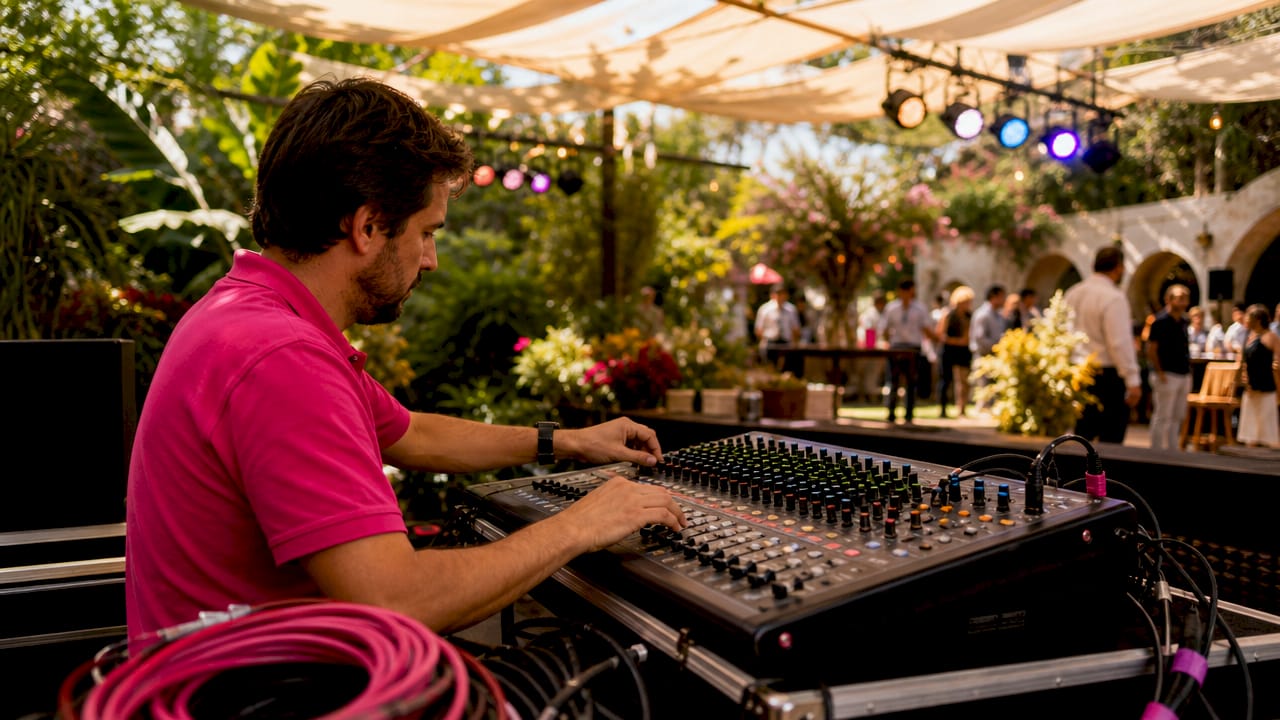
AV reliability comes from treating the technical setup as a coordinated system with documented roles rather than a collection of equipment checks on the day. The Mississauga Convention Centre’s AV framework structures this across five phases: discovery, design, advancing, rehearsals, execution, and strike. Each phase has defined deliverables and responsible parties.
Choosing your AV model
| Model | Best suited to | Key advantage | Key risk |
|---|---|---|---|
| In-house AV | Smaller, single-room events | Familiar with venue acoustics | Limited equipment range |
| External vendor | Large productions, touring acts | Specialist kit and crew | Requires detailed advancing |
| Hybrid | Multi-room or complex events | Flexibility and redundancy | Coordination complexity |
For most weddings and mid-scale corporate events, a hybrid model works well. The venue handles fixed infrastructure such as house PA and lighting rigs, while your entertainment provider brings their own DJ equipment or backline.
What your AV checklist must include
AV checklist failures most commonly stem from late content delivery, insufficient backup equipment, unclear crew roles, and skipped rehearsals. Build these items into your planning document explicitly:
- Audio: PA specification, monitor mix requirements, microphone count, and backup channels
- Video: screen formats confirmed against presenter content, projector lumens checked against room lighting
- Lighting: rig plot, cue sheet, and operator briefed on run-of-show
- Power: load calculations completed, dedicated circuits confirmed, no daisy-chained extension leads
- Safety: all cabling taped or covered, emergency lighting tested, fire exit routes unobstructed
Pro Tip: Standardise file formats for all presentation content at least two weeks before the event. Mismatched aspect ratios and missing fonts are the most common technical failures on the day, and both are entirely preventable.
What are the special considerations for outdoor venue entertainment?
Outdoor events introduce regulatory, logistical, and technical variables that indoor venues simply do not have. The most overlooked is noise compliance. For example, Woodstock, Vermont’s noise ordinance restricts amplified sound after 10 PM on weekdays and 11 PM on Fridays and Saturdays. Most UK local authorities operate similar frameworks, and breaching them mid-event can result in immediate shutdown.
Your outdoor entertainment checklist should cover:
- Permits. Confirm which licences apply: Temporary Event Notice (TEN) for events under 500 people in England and Wales, or a full premises licence for larger gatherings. Apply at least 10 working days before the event.
- Noise ordinance compliance. Identify the specific quiet-hour rules for your site’s local authority. Build a hard curfew into your run-of-show that ends 30 minutes before the legal limit.
- Load-in and setup duration. Outdoor productions typically require 8 to 14 hours for full setup. Schedule stage delivery the day before where possible.
- Power and generator placement. Generators placed 75 to 100 feet from the stage reduce noise bleed and protect audio clarity. This is not just a technical preference. It directly affects the quality of sound your guests hear.
- Soundcheck timing. Schedule soundcheck at least 90 minutes before doors open. Build a 30-minute buffer for technical issues.
- Loadout. Confirm loadout start time with the venue and all suppliers. Leaving this undefined causes overtime charges and neighbour complaints.
How to align setlists and run-of-show with venue logistics
Performance scheduling is where entertainment planning and venue operations intersect most directly. Getting this wrong creates energy mismatches, catering conflicts, and confused guests.
Follow this sequence when locking down your run-of-show:
- Request an ordered setlist, not a genre description. Bands that cannot produce a quick setlist or refuse to accept a Do-Not-Play list present a creative risk for structured event schedules. An ordered setlist tells you exactly what will happen and when.
- Collect a written Do-Not-Play list from the client. This protects against inappropriate songs at weddings, brand-sensitive content at corporate events, and personal triggers at private celebrations.
- Build a minute-by-minute run-of-show. Include load-in, soundcheck, doors open, welcome, meal service, speeches, first dance, band sets, DJ sets, breaks, and curfew. Share it with every team lead.
- Confirm break durations with the band. Phase-specific setlists for different event segments and clearly agreed break times prevent room energy from dropping at critical moments.
- Distribute day-of contacts to all parties. Every team lead, including the venue manager, AV technician, band leader, DJ, and catering supervisor, should have a single point of contact for the event.
For 2026 weddings and celebrations, Freshentertainments recommends reviewing entertainment trends shaping 2026 before finalising your run-of-show, as guest expectations around interactive entertainment and live music formats have shifted noticeably.
What risk management and legal documentation should your checklist include?
Legal and risk documentation is the section most planners deprioritise until something goes wrong. At that point, the absence of proper paperwork becomes very expensive.
Your checklist must include:
- Public liability insurance. UK guidance recommends indemnity limits of £2m to £10m for live music events, with event-specific declarations and cover confirmed for the exact dates of the event. Collect certificates from every performer and supplier.
- Written contracts for all acts. Contracts must specify set times, fees, deposit amounts, cancellation triggers, refund terms, and substitution rights. Verbal agreements are unenforceable.
- Contingency plans. Identify a replacement act or DJ for every live performance booking. Document who makes the call if an act cancels and what the financial remedy is.
- Risk assessments. Complete a written risk assessment covering crowd management, electrical safety, noise levels, and emergency evacuation. This is a legal requirement for most licensed events in the UK.
- Compliance checks. Confirm that all entertainment activities comply with your venue’s licence conditions. A DJ playing beyond the licensed hours or a band exceeding the permitted decibel level can invalidate your insurance.
The most common oversight is assuming the venue’s insurance covers the entertainment. It does not. Every performer and supplier needs their own cover, and you need proof of it before the event day.
Key takeaways
A well-executed venue entertainment checklist in 2026 requires documented timelines, confirmed insurance, ordered setlists, and a minute-by-minute run-of-show shared across every team involved.
| Point | Details |
|---|---|
| Start booking 6 to 12 months out | Shortlist acts early to secure premium performers before they book out. |
| Collect riders 8 to 12 weeks before | Confirm production, hospitality, and travel needs progressively to avoid day-of surprises. |
| Treat AV as a system, not a checklist | Document roles, standardise formats, and rehearse transitions to prevent technical failures. |
| Outdoor events need permits and curfews | Apply for licences early and build a hard curfew 30 minutes before the legal noise limit. |
| Require insurance certificates from all suppliers | Public liability cover of £2m to £10m is the standard for live music events in the UK. |
What I have learned from years of entertainment planning
Stuart’s perspective
The most expensive mistakes I see in event entertainment planning are not technical. They are administrative. A planner who books a brilliant band but forgets to collect a signed contract, or who assumes the venue’s PA will cover the band’s monitor requirements, is setting up a crisis that no amount of talent can fix on the night.
The checklist framework in this article is not theoretical. It reflects the kind of structured approach that separates events people talk about for years from events people quietly forget. The booking timeline is the piece most often compressed. Clients come to us six weeks before a wedding wanting a live band and a DJ, and while we can often accommodate that, the options narrow significantly. Starting at six months gives you leverage, choice, and time to get the paperwork right.
One thing I would add that most guides skip: treat your checklist as a living document. Update it after every supplier conversation, every site visit, and every contract exchange. A checklist that sits in a folder untouched from the day you created it is not a planning tool. It is a liability. The best event planners I have worked with review their entertainment checklist weekly in the final two months before an event, and they always catch something that would have caused a problem.
The run-of-show is where the checklist pays off most visibly. When every team lead has the same minute-by-minute document and a single point of contact, the event runs itself. When they do not, you spend the night firefighting.
— STUART
How Freshentertainments can support your 2026 event planning
Planning entertainment for a wedding or celebration in Scotland in 2026 requires more than a checklist. It requires a supplier who already understands the logistics, the venues, and the expectations of high-end clients.
Freshentertainments provides award-winning DJ hire, MC services, and bespoke entertainment packages tailored to weddings and corporate events across Scotland. From creating the perfect party atmosphere to managing every technical detail on the night, the team works directly with your venue and coordination team to deliver a flawless experience. Explore the full range of wedding entertainment packages and find the right fit for your 2026 celebration.
FAQ
How far in advance should I book entertainment for a 2026 event?
Book live entertainment 6 to 12 months before your event date. Premium acts and in-demand DJs at popular venues fill their calendars quickly, particularly for summer and festive season dates.
What insurance does a live music act need for a UK venue?
Every performer should carry public liability insurance with indemnity limits between £2m and £10m, with the policy covering the specific event dates and activities. Collect certificates before the event day.
What should a venue entertainment checklist include for outdoor events?
Your outdoor checklist must cover permits, local noise ordinance curfews, generator placement, load-in schedules, soundcheck timing, and loadout arrangements. Outdoor productions typically need 8 to 14 hours for full setup, so plan stage delivery for the day before where possible.
Why is a Do-Not-Play list part of the entertainment checklist?
A written Do-Not-Play list protects against inappropriate songs at weddings and brand-sensitive content at corporate events. Acts that refuse to accept a DNP list present a creative risk for structured event schedules and should be reconsidered.
When should I collect technical riders from performers?
Rider collection should begin 8 to 12 weeks before the event. This gives enough time to resolve production conflicts, confirm hospitality requirements, and align all technical teams before the advancing phase begins.