
TL;DR:
- Lighting influences every emotional moment and shapes the atmosphere of your wedding more than florals or décor. It enhances photography, guides storytelling, and creates layered depth through ambient, task, accent, and feature lighting. Investing 8 to 15 percent of your budget in professional lighting design ensures a stunning, cohesive celebration that leaves lasting memories.
Your venue is booked, your florals are chosen, and your dress is everything you dreamed of. Yet there is one element that will shape every photograph, define every emotional moment, and determine how your guests feel from ceremony to last dance. It is not the centrepieces. It is the lighting. Research consistently shows that lighting matters more than florals because it influences every single image captured on your day, not just the three hours your flowers are at their freshest. This guide will help you understand, plan, and invest in lighting design that truly transforms your Scottish wedding.
Table of Contents
- Why lighting design matters for weddings
- Key layers of wedding lighting design explained
- Popular lighting options for Scottish wedding venues
- Budgeting for wedding lighting: What to expect
- Practical planning: Steps to a stunning wedding lighting scheme
- A fresh perspective: Why lighting is the ultimate storytelling tool
- Bring your lighting vision to life with expert support
- Frequently asked questions
Key Takeaways
| Point | Details |
|---|---|
| Lighting transforms atmosphere | Strategic lighting design changes how your venue feels and how every moment is remembered. |
| Layered approach is best | Combining ambient, task, accent, and feature lighting creates dynamic, impactful results. |
| Budget for impact | Investing 5–10% of your wedding budget in lighting delivers more value in photos and ambience than many décor items. |
| Tailor lighting to venue | Choose lighting solutions that enhance your unique Scottish venue, from castles to marquees. |
| Expert planning pays off | Working with professional lighting and entertainment teams ensures flawless execution and stunning results. |
Why lighting design matters for weddings
Lighting is the invisible hand behind every memorable wedding atmosphere. It shapes how your guests feel when they first walk through the doors, directs their attention towards the altar during your ceremony, and lifts the energy of the room the moment your first dance begins. When lighting is designed well, guests rarely notice the fixtures or the equipment. They simply feel the magic, whether that is the warmth of a softly lit aisle or the electric atmosphere of a packed dance floor.
One of the most underestimated benefits of great lighting is what it does to your photography and videography. Your photographer can only work with the light that is available to them. Strategic lighting gives them rich contrast, beautiful depth, and flattering colour that elevates every shot. Exploring your wedding lighting options early in your planning process means your photos will look as stunning as the day felt.
“Great lighting does not just decorate a room. It tells a story, guiding the eye, shaping emotion, and transforming an ordinary venue into something extraordinary.”
Lighting also supports the narrative structure of your day. Consider these key storytelling moments where lighting plays a central role:
- Ceremony: Soft, directional light focuses attention on the couple and creates reverence
- Drinks reception: Warmer, relaxed tones encourage conversation and ease
- Dinner: Dimmed, intimate levels promote comfort and connection
- First dance: A single spotlight creates a cinematic, unforgettable moment
- Party: Dynamic colour and movement build energy and excitement
As evidence continues to emerge, uplighting at weddings has been shown to be superior to traditional overhead lighting for creating depth, personalisation, and photo vibrancy. Crucially, uplighting does not replace base lighting. It works alongside it to create a layered, professional result. Understanding this distinction is the foundation of great wedding lighting design, and it is precisely what shapes unforgettable wedding memories that couples talk about for years.
Key layers of wedding lighting design explained
Professional lighting designers work with a four-layer approach, and understanding it will help you ask the right questions when speaking with suppliers. According to a detailed wedding lighting design guide, layered lighting methodology is essential for wedding design and consists of four distinct components: ambient or base light for safety and overall brightness, task light for specific functional needs, accent light for drama and personality, and feature light to highlight key focal points.
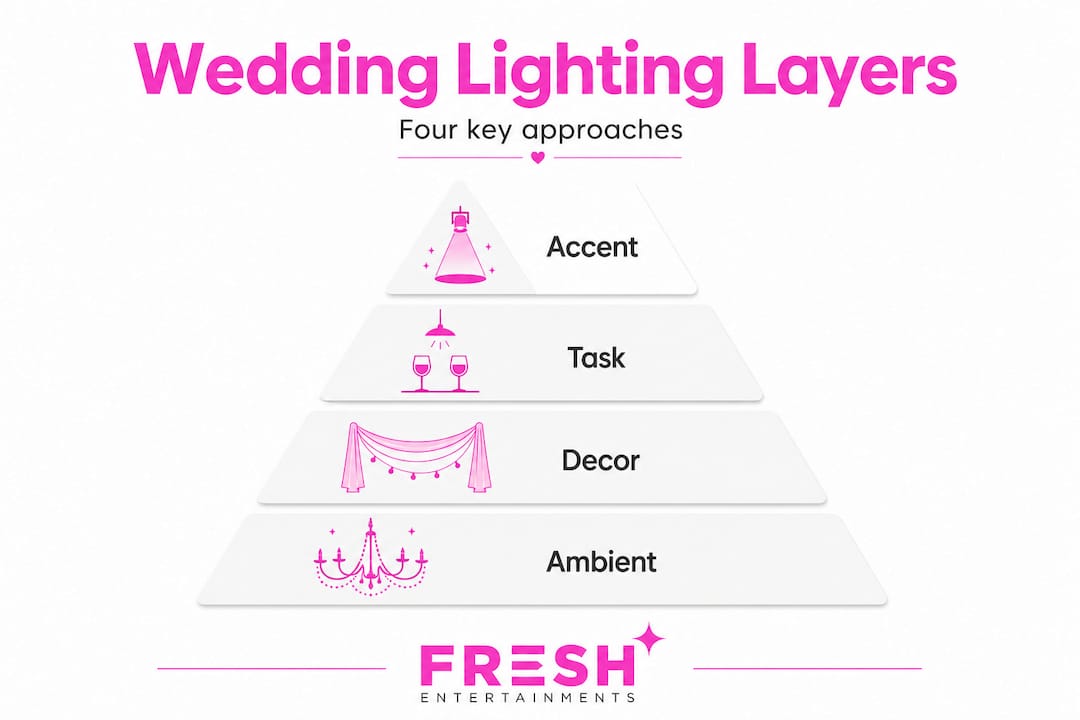
Here is a clear breakdown of how each layer works in practice:
| Layer | Purpose | Examples |
|---|---|---|
| Ambient/base | Overall illumination and guest safety | House lighting, chandeliers, candles |
| Task | Functional lighting for specific activities | Aisle lighting, reading menus, cake table |
| Accent | Drama, colour, and personalisation | Uplights, pin spots, coloured washes |
| Feature | Highlight focal points and installations | LED dance floor, light-up letters, gobo |
The balance between these layers is what separates a professionally lit venue from one that simply has lights switched on. Too much ambient light and the room feels flat and clinical. Too little and guests feel uncomfortable. The art lies in knowing how much of each layer to apply and precisely when to adjust levels as the evening progresses.
Pro Tip: When partnering with your venue early in your planning, ask specifically which layers of lighting they provide as standard. This tells you exactly where the gaps are and where your lighting hire budget is best directed.
Never neglect the task layer. It is easy to focus all your energy on dramatic accent lighting while forgetting that guests need enough light to comfortably read menus or navigate steps safely. A thoughtful lighting plan always accounts for practicality first, drama second.
Popular lighting options for Scottish wedding venues
Scotland offers a stunning variety of wedding venues, from ancient castles to converted barns, modern city ballrooms to open-air marquees. Each setting responds differently to lighting, and knowing which options suit your venue type will help you make confident choices.
Here is a practical overview of the most popular and effective lighting options:
| Lighting type | Best venue types | Key effect |
|---|---|---|
| Uplighting | Castles, ballrooms, barns | Colour, warmth, depth |
| Pin spotting | All venues | Highlights cakes, florals, displays |
| Fairy or string lights | Barns, marquees, outdoor areas | Soft, romantic ambience |
| Gobo projection | Dance floors, walls, entrances | Monograms, patterns, branded visuals |
| LED dance floors | Ballrooms, modern venues | Focal energy, drama, modernity |
| Candlelight or flame effect | Historic venues, intimate spaces | Warmth, intimacy, timeless elegance |
A general planning rule is to use approximately one uplight per 150 square feet of venue space as a starting baseline. This ensures even colour wash coverage without leaving dark or patchy areas. For a large Scottish castle with grand stone walls, this number may increase significantly, as rough stone absorbs light rather than reflecting it.
Uplighting’s superiority over standard overhead lighting comes from its ability to create depth and a sense of occasion that flat, downward light simply cannot achieve. Rather than washing everything evenly from above, uplighting sculpts architecture and draws the eye upward, making even modest spaces feel grand.
For couples choosing rustic barns in Perthshire or the Scottish Borders, fairy lights strung across wooden beams create an immediately romantic and intimate atmosphere. For those saying “I do” in a grand Edinburgh or Glasgow ballroom, intelligent LED fixtures with programmable colour shifts allow the mood to evolve dynamically throughout the evening. And for a truly personalised touch, gobo projection of your initials or a favourite pattern onto the dance floor becomes a talking point that guests photograph and share for days afterwards.
If your priority is enhancing your Scottish wedding experience from the first moment guests arrive to the final song of the night, lighting is the single investment that delivers the greatest breadth of impact.
Budgeting for wedding lighting: What to expect
One of the most common mistakes couples make is treating lighting as a last-minute addition rather than a core line item in the budget. The financial reality is straightforward. A basic uplighting package of 12 to 24 fixtures typically costs between $900 and $2,500, while a full reception package with multiple elements ranges from $1,800 to $4,200. In the UK market, comparable packages start from approximately £700 for entry-level uplighting and rise to £3,000 or more for full, bespoke production design.

The guidance from experienced lighting designers is to allocate 8 to 15 percent of your total wedding budget to lighting for the highest return on investment across both photographs and live atmosphere. For couples working to a tighter budget, a minimum of 5 percent is still meaningful and impactful when spent strategically.
Why does lighting offer such strong value? Because, as research clearly shows, lighting impacts every photo taken throughout your entire day, whilst florals and centrepieces only influence images during specific periods. Your lighting investment works continuously from your ceremony through to midnight.
Here is a practical approach to allocating your lighting budget effectively:
- Prioritise the ceremony space. This is where the most emotional photographs are taken. One beautiful lighting effect here goes a long way.
- Invest in the dance floor area. Energy and atmosphere peak here, and this is where your most memorable party photographs will be captured.
- Use pin spotting on your focal décor. Your cake table and floral centrepieces will look dramatically better with targeted pin spots.
- Add personality through a gobo. A monogram gobo is relatively affordable and creates an instantly personalised focal point.
- Review what the venue already provides. Do not pay for base ambient lighting you already have. Direct your budget to accent and feature layers instead.
Pro Tip: Even on a tight budget, one or two well-placed uplights in your ceremony space and a pin spot on your cake table will deliver far more visual impact than a wide spread of inexpensive fairy lights. Concentration beats coverage when resources are limited. Reviewing DJ and lighting package pricing early allows you to bundle services for better value.
Practical planning: Steps to a stunning wedding lighting scheme
Turning a lighting vision into a polished reality requires a clear process. The layered lighting methodology is most successfully applied when couples approach planning systematically rather than reactively.
Follow these steps to create a scheme that feels both intentional and effortless:
- Visit your venue at the right time. Attend a walk-through at the same time of day as your ceremony. Natural light changes dramatically in Scotland across seasons. What looks beautiful in August afternoon light may be completely dark for a December ceremony at 3pm.
- Map your focal areas. Walk through the space and identify every key moment: the aisle, the ceremony backdrop, the cake table, the entrance, the dance floor, and any natural photography spots.
- Match layers to your vision. Use the four-layer table from earlier to plan which elements you need at each focal point and which the venue already supplies.
- Request a visual plan from your supplier. Any reputable lighting designer should be able to provide a floor plan showing fixture placement, colour choices, and the progression of levels throughout the evening.
- Check credentials, reviews, and contingency plans. Ask about backup equipment and how technical issues are handled on the day.
- Coordinate with your entertainment team. Your DJ or band will directly influence and interact with lighting throughout the evening. Coordinating your entertainment and lighting as a combined package ensures both elements work in perfect harmony rather than competing for attention.
Pro Tip: The best lighting moments at weddings happen when the DJ triggers a lighting change in sync with a musical transition. This synchronisation requires pre-event communication and planning, not on-the-day improvisation.
A fresh perspective: Why lighting is the ultimate storytelling tool
After working with hundreds of Scottish couples across iconic venues from the Highlands to the Borders, we have reached a firm conclusion that challenges conventional wedding planning wisdom. Couples consistently underestimate lighting not because they do not care, but because lighting is invisible when it works well. You notice a beautiful floral arch. You do not consciously notice the perfectly placed spotlight that made it look breathtaking in every photograph. That invisibility is precisely what makes lighting so powerful.
Think of your wedding day as a film. The venue is the set. The décor is the costume. The lighting is the cinematography. Nobody leaves a cinema talking about the cameras, but remove great cinematography and the emotional impact collapses entirely. The same is true at weddings. When lighting shifts to a single warm spot for your first dance, something changes in the room. Guests quieten. Attention focuses. Emotion rises. That is not an accident. It is design.
What we see again and again is that the most breathtaking wedding images all share one common factor, regardless of venue, season, or budget. They have exceptional light. Not expensive florals, not bespoke stationery, not even the most stunning gown. Light. The couples who treat wedding lighting inspiration as a creative priority rather than a technical afterthought end up with galleries they genuinely treasure.
Our honest advice to every couple is this: do not add lighting to the bottom of your planning list. Build it in from the start, alongside catering and music. It is not a luxury. It is the edit that makes your story sing.
Bring your lighting vision to life with expert support
Your wedding lighting plan deserves the same care and creativity as every other detail of your day. Working with experienced professionals who understand both the technical requirements and the artistic vision makes all the difference between a room that looks nice and a room that takes your breath away.
At Fresh Entertainments, we specialise in bespoke lighting and entertainment packages tailored specifically for Scottish weddings. From intimate barn celebrations to grand castle receptions, our team brings technical expertise and genuine creative passion to every event. We work closely with you from initial consultation through to on-the-day coordination, ensuring your lighting and music work together seamlessly to create the perfect wedding party atmosphere. Discover how entertainment shapes memories that last a lifetime and explore our full range of wedding entertainment packages to find the perfect fit for your vision and budget.
Frequently asked questions
How much should I budget for wedding lighting in Scotland?
Plan to allocate between 5 and 15 percent of your total wedding budget to lighting, with 8 to 15 percent delivering the highest ROI in photos and overall atmosphere.
Does lighting really matter more than florals in photos?
Yes, because lighting enhances every photograph from ceremony to last dance, whereas florals primarily influence images during specific moments of the day.
What is uplighting and why is it recommended for receptions?
Uplighting is an accent lighting technique that adds depth, custom colour, and vibrancy to your venue and, as research confirms, complements rather than replaces essential base lighting for a balanced and beautiful result.
How do I choose the right lighting for my wedding venue?
Work with your venue and an experienced lighting professional to apply a layered lighting methodology that matches your venue’s architecture, your event style, and your personal vision for the day.