
TL;DR:
- Modern corporate event success focuses on engagement, connections, and brand impressions rather than applause.
- Interactive and experiential entertainment formats foster genuine connections, unlike traditional passive acts.
- Measuring KPIs like Net Promoter Score and lead generation provides a clearer picture of event impact.
Applause used to be the ultimate verdict on a corporate event. If guests clapped, the entertainment worked. Simple. But event success metrics have shifted dramatically, with modern benchmarks now including Net Promoter Score, genuine engagement levels, and the number of meaningful connections forged on the night. For corporate event organisers across Scotland, this shift is not just academic. It changes how you plan, what you book, and how you measure whether your investment actually delivered. This article will walk you through a clearer definition of corporate event entertainment, compare the formats available, and give you a practical framework for making smarter decisions.
Table of Contents
- What is corporate event entertainment?
- Traditional versus modern entertainment styles
- Measuring the impact: Beyond applause
- Selecting the right entertainment for your Scottish corporate event
- Why defining entertainment success requires a wider lens
- Enhance your event with bespoke entertainment solutions
- Frequently asked questions
Key Takeaways
| Point | Details |
|---|---|
| Redefine success metrics | Focus on guest engagement, Net Promoter Score, and brand impact rather than just applause. |
| Prioritise modern styles | Interactive and tech-driven entertainment fosters stronger connections at corporate events. |
| Match entertainment to goals | Align choices with your event objectives, guest profile, and emerging trends for best results. |
| Avoid false economies | Cheaper entertainment can reduce value and harm your brand—prioritise professionalism and engagement. |
What is corporate event entertainment?
Corporate event entertainment is not simply about hiring an act to fill a time slot. At its core, it is about creating conditions where your guests engage, connect, and leave with a positive impression of your brand or organisation. That is a meaningfully different ambition from booking a band to play background music during dinner.
The distinction matters because corporate events carry commercial weight. A product launch, an awards evening, a client hospitality night, a team building day: each one has specific goals that go well beyond keeping people entertained. Entertainment at corporate events now extends beyond performance to encompass the entire guest experience, including how people feel, what they remember, and what they say afterwards.
In Scotland’s corporate market, the range of entertainment options has expanded considerably. Organisers now regularly consider:
- Live music acts (bands, soloists, jazz ensembles)
- Interactive experiences (game shows, quiz formats, escape room activations)
- Tech-enabled entertainment (virtual reality, AI-powered matchmaking, live polling)
- Roaming performers (magicians, caricaturists, immersive theatre)
- Professional DJ and MC services that hold the room and guide the programme
Understanding corporate event DJ roles is particularly valuable here, because a skilled DJ does far more than play music. They read the room, manage energy, and keep the event flowing seamlessly from one moment to the next.
| Entertainment type | Primary benefit | Best suited for |
|---|---|---|
| Live band | Atmosphere and prestige | Gala dinners, award nights |
| Interactive game show | High engagement | Team building, staff events |
| Roaming performers | Natural mingling | Networking receptions |
| DJ and MC | Programme cohesion | All corporate formats |
| Tech-enabled acts | Innovation signalling | Product launches, conferences |
Pro Tip: Before booking any act, write down the single most important outcome you want guests to walk away with. Every entertainment decision should trace back to that one goal.
The shift towards personalised entertainment options reflects a broader truth: generic experiences are forgettable. Corporate guests, especially senior stakeholders and clients, have attended hundreds of events. What cuts through is something specifically crafted for them.
Traditional versus modern entertainment styles
Most corporate event budgets historically went towards traditional formats: a live band after dinner, a comedian between courses, a string quartet during the drinks reception. These remain popular because they carry a sense of occasion and are low-risk in the sense that audiences know what to expect.
But that predictability is also their limitation. Passive entertainment keeps people in their seats. It does not spark conversations, generate leads, or create the kind of shared experiences that bond teams and impress clients.
“The future of corporate events belongs to formats that prioritise authentic connection over polished performance.” This insight reflects a growing consensus among event professionals, supported by emerging corporate event trends that place interaction and experience at the forefront.
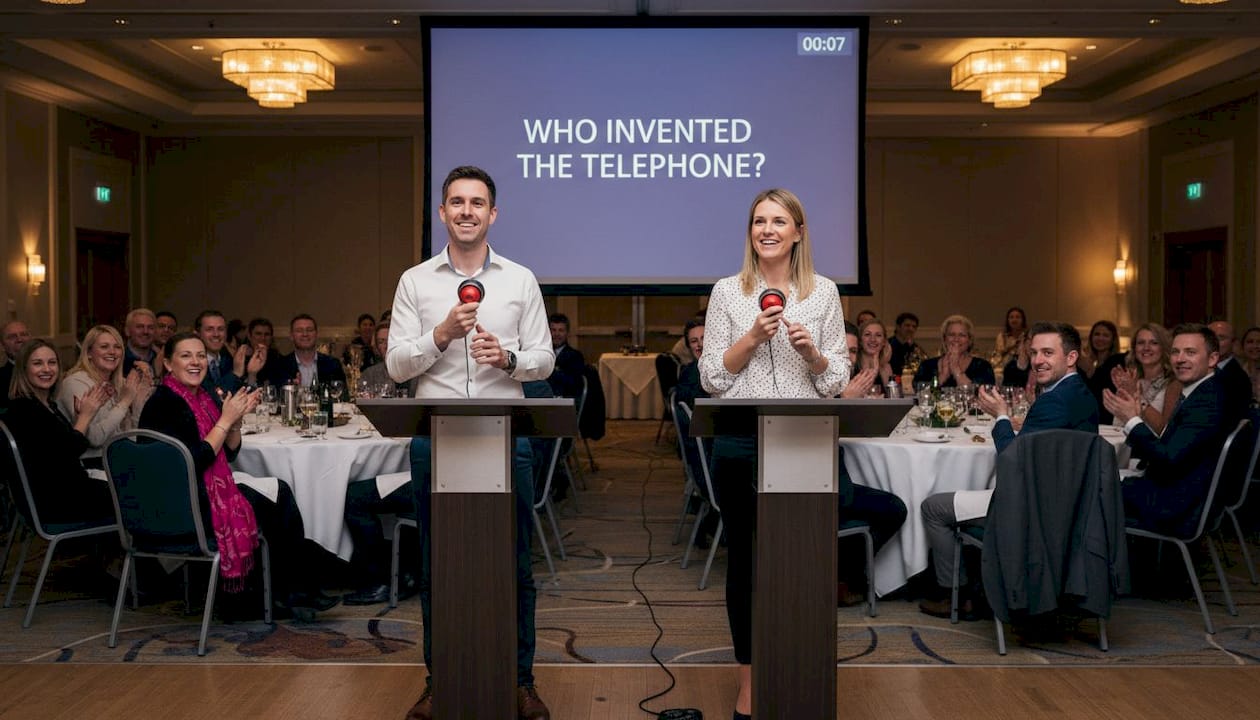
Modern entertainment styles lean into active participation. Interactive game show formats, for example, turn passive attendees into competitors and teammates. Roaming magicians create one-to-one moments that naturally break the ice between strangers. Interactive entertainment drives conversation in a way that a stage act simply cannot replicate.
| Format | Engagement level | Networking value | Cost range |
|---|---|---|---|
| Live band | Moderate | Low | High |
| Comedian | Low (passive) | Low | Medium |
| Game show host | Very high | High | Medium |
| Roaming performers | High | Very high | Medium |
| DJ with MC | High | Moderate | Medium to high |
Here is where the comparison becomes instructive:
- Traditional formats offer prestige and polish but risk disengagement if guests are not in the mood
- Interactive formats carry higher energy but require confident facilitation to avoid awkwardness
- Tech-enabled options signal innovation and work brilliantly for product launches, though they need robust technical support
- Hybrid formats are becoming standard, blending live and digital elements for events with remote attendees
Scottish corporate events increasingly benefit from working with established entertainment partners who understand local venues, audiences, and logistical realities. The best providers will advise on which format fits your specific objectives rather than simply selling you what they have available.
The key question to ask yourself is not “which option is most impressive?” but rather “which option will elevate guest engagement for this particular audience, at this particular event?” That reframe changes everything.
Measuring the impact: Beyond applause
Knowing which entertainment formats exist is useful. Knowing how to evaluate whether they delivered is essential. Too many organisers rely on gut feel: people seemed to enjoy it, the room felt lively, nobody complained. These are comfort signals, not performance indicators.
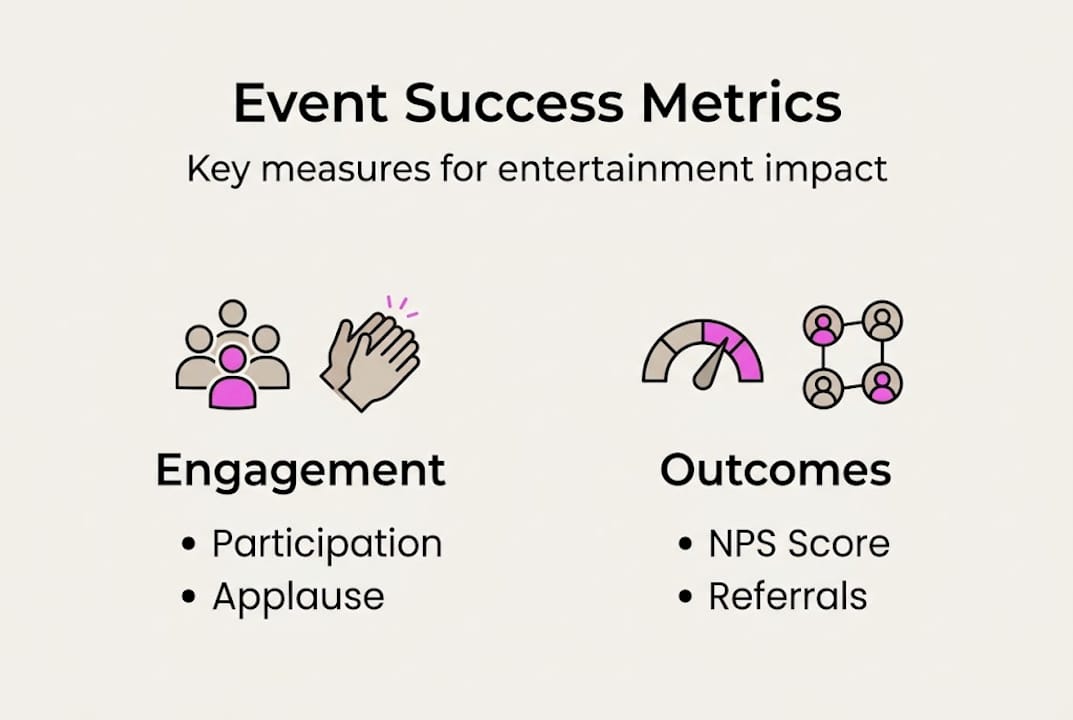
Modern corporate event measurement uses defined KPIs that tell a more complete story. Key event metrics include an average Net Promoter Score of 75, lead generation averaging 1,200 per event, and positive guest impressions reaching 74%. These numbers give organisers a framework that goes far beyond whether the act got a standing ovation.
Here is how to apply measurement practically:
- Pre-event benchmarking: Set a target NPS before the event. Survey guests immediately after and compare.
- Engagement tracking: Monitor participation rates in interactive segments, dwell time at key areas, and social media mentions during the event.
- Lead and connection data: For commercial events, track how many new contacts were made and how many follow-up meetings were booked within 48 hours.
- Brand sentiment: Gather qualitative feedback on how guests perceived your company or brand as a result of the event.
- ROI calculation: Compare total entertainment investment against measurable commercial outcomes.
| Metric | What it measures | How to collect it |
|---|---|---|
| NPS | Guest advocacy | Post-event survey |
| Engagement rate | Active participation | Live polling, check-ins |
| Lead generation | Commercial output | CRM tracking |
| Positive impressions | Brand sentiment | Feedback forms |
| Social reach | Organic amplification | Social media analytics |
The risk in prioritising low-cost entertainment is not just a dull evening. A poor experience actively undermines the unforgettable entertainment impact you are trying to create. Guests remember how they felt at your event, and that feeling becomes part of how they perceive your brand long after the evening ends.
Statistic to note: events with average NPS scores of 75 consistently report stronger post-event commercial outcomes, reinforcing that emotional experience and business results are directly linked.
Selecting the right entertainment for your Scottish corporate event
With measurement frameworks in place, the practical question becomes: how do you actually choose? The decision involves more variables than most organisers initially realise, and getting it wrong is costly in both budget and brand terms.
Start by anchoring every decision to your event objectives. A product launch calls for entertainment that signals innovation and generates buzz. A client hospitality evening requires warmth, prestige, and natural conversation starters. A team building day needs high-energy participation that breaks down hierarchy. The entertainment must serve the purpose, not the other way around.
Future event trends for 2026 emphasise authenticity, technology integration, and tailored experiences across both hybrid and physical formats. Scottish organisers should factor these trends into their planning, particularly for events with a forward-thinking brand identity.
A practical selection checklist:
- Know your audience: Senior executives, junior staff, clients, and prospects all respond differently to the same entertainment
- Clarify your objectives: Engagement, networking, brand reinforcement, or celebration?
- Set a realistic budget: Understand what quality costs, and budget accordingly
- Prioritise personalisation: Generic acts feel generic. Customised formats resonate
- Check venue compatibility: Not all acts work in all spaces. Sound, lighting, and layout matter enormously
- Ask for references: A credible provider will share testimonials and case studies from comparable events
- Consider sustainability: Increasingly, corporate clients expect their events to reflect responsible values
Pro Tip: Always ask your entertainment provider how they have handled a technical failure or a difficult crowd. Their answer will reveal far more about their professionalism than any showreel.
Common mistakes include booking entertainment purely on price, ignoring the engagement potential of less familiar formats, and leaving entertainment decisions too late in the planning process. For bespoke custom event entertainment, early engagement with a specialist provider gives you the best options and the most time to personalise the experience.
Consulting 2026 entertainment trends before finalising your brief is also worthwhile, particularly if your event audience includes industry peers who will have seen many formats before.
Why defining entertainment success requires a wider lens
Here is the uncomfortable truth most event guides will not tell you: many organisers are measuring the wrong things, not because they are careless, but because the old metrics felt sufficient for so long. Applause in the moment is seductive. It feels like proof. But it fades quickly.
Engagement and brand effects linger well beyond event day, shaping perceptions, referrals, and commercial relationships in ways that a round of applause never could. The organisations that invest strategically in premium entertainment are not just buying a good evening. They are investing in how their brand is remembered, discussed, and recommended.
The long-term entertainment impact of a genuinely exceptional corporate event can include stronger client retention, higher employee satisfaction, and measurable lifts in brand advocacy. That is a return on investment that justifies premium choices every time. Defining success more broadly is not idealism. It is simply good business.
Enhance your event with bespoke entertainment solutions
If this article has shifted how you think about corporate entertainment, the next step is working with a provider who already thinks this way. At Fresh Entertainments, we specialise in crafting experiences that go beyond the expected, combining professional DJ and MC services, live performance, and interactive elements into cohesive, results-driven event programmes.
We work with Scottish corporate clients across a wide range of formats and venues, and every solution we offer is built around your specific goals. Whether you are planning an intimate client evening or a large-scale awards night, our custom entertainment packages are designed to leave a lasting impression. Explore what creating unforgettable memories looks like when entertainment is planned with purpose.
Frequently asked questions
How can I measure if my corporate event entertainment was successful?
Use defined KPIs including Net Promoter Score, guest engagement rates, lead generation figures, and positive impressions; event success metrics show these tell a far more complete story than audience reaction alone.
What types of entertainment work best for Scottish corporate events?
Interactive and experiential formats such as roaming performers, game show hosts, and tech-driven experiences are increasingly popular because they foster genuine connections rather than passive observation.
Is more expensive entertainment always better for corporate events?
Not necessarily, but cheap entertainment risks real brand damage if quality is compromised; the true measure of value is relevance and engagement, not price alone.
What are emerging trends in corporate event entertainment?
Personalisation, sustainability, AI matchmaking, and hybrid format integration are shaping how forward-thinking organisations plan their 2026 events and beyond.
Recommended
- Wedding Entertainment Trends 2026 – Unforgettable Experiences Await
- Bespoke Wedding Entertainment: Creating Unforgettable Moments
- Wedding Entertainment Packages: Creating Unforgettable Events
- Wedding Pricing | Fresh Entertainments
- Corporate Yacht Charters, Luxury Venue for Corporate Events in Singapore
- 7 Premier Corporate Event Entertainment Options Explained