
TL;DR:
- A well-structured wedding timeline is crucial for a relaxed, smoothly run Scottish wedding day.
- Building buffers and anchoring the schedule around the ceremony helps prevent overruns and stress.
- Focus on personal key moments and simplicity, prioritizing emotion over rigid scheduling.
Your wedding day will not fall apart because of bad luck. It will fall apart because of a missing 20-minute buffer between the ceremony and the drinks reception. A wedding timeline is not simply a list of events printed on card and handed to your caterer. It is the invisible architecture behind every relaxed smile, every perfectly timed first dance, and every hot plate of food that arrives before the speeches drag on for a third unexpected encore. In Scotland especially, where castle venues, changeable weather, and beloved traditions like ceilidh dancing all compete for your carefully planned minutes, getting your timeline right is the single most important logistical decision you will make.
Table of Contents
- What is wedding timeline planning?
- Anchor your timeline: Ceremony time and key moments
- Building buffers: Avoiding overruns and ensuring guest comfort
- Personalising your timeline: Scottish traditions, priorities, and venue differences
- Finalising your timeline: Review, share, and adapt effortlessly
- Why most couples overcomplicate timelines, and what actually works
- Discover expert entertainment and timeline support for your Scottish wedding
- Frequently asked questions
Key Takeaways
| Point | Details |
|---|---|
| Anchor your timeline | Base your wedding schedule around the ceremony time and main moments for a seamless flow. |
| Build in buffers | Allow extra time for speeches, photos, and guest movements to prevent overruns and stress. |
| Personalise for Scotland | Adapt your timeline according to Scottish traditions, venue logistics, and unpredictable weather. |
| Keep it simple | Focus on 3-5 important moments and avoid packing the day with too many activities. |
| Share and review | Distribute your timeline to all suppliers and coordinators, and prepare to adapt as needed. |
What is wedding timeline planning?
Wedding timeline planning is the process of mapping every significant moment of your wedding day onto a structured sequence, with realistic durations, intentional breathing room, and clear communication shared across every supplier involved. It is not the same as a basic running order. A running order tells you what happens next. A timeline tells you how long each element will take, who needs to be where, and what happens if things run late.
The distinction matters enormously in Scotland. A wedding destination in Scotland brings unique logistical considerations that couples from elsewhere often underestimate. A highland castle may have a single access corridor that slows guest movement. An outdoor ceremony in Perthshire may need a ten-minute contingency if the sky decides to change its mind. These are not inconveniences. They are simply part of what makes Scottish weddings so richly atmospheric, and your timeline should account for them from the outset.
“Effective timelines enhance experience by building buffers, consulting experts, and personalising to venue, weather, and priorities, allowing couples to truly relax. This is especially vital for Scotland’s variable conditions and historic castle venues.” Country House Weddings
Good timeline planning draws on event checklist principles that professional event managers use, adapted for the deeply personal nature of a wedding. Key benefits include:
- Reduced stress on the day, because decisions have already been made
- Better guest experience, with smooth transitions and minimal waiting
- Fewer overruns that push back the evening entertainment
- More enjoyment for you as a couple, because you are present rather than problem-solving
The foundation of good timeline planning is consultation. Speak to your venue coordinator, your photographer, your caterer, and your entertainment provider early. Each will give you realistic duration estimates that no online template can replicate.
Anchor your timeline: Ceremony time and key moments
The most effective wedding timelines are not built from the start of the day forward. They are built outward from a single anchor point: the ceremony. Everything before it and everything after it is structured around that fixed moment.
Most Scottish wedding ceremonies take place between 1pm and 3pm, which gives a natural rhythm to the rest of the day. An early afternoon ceremony allows ample time for photographs in natural light, a relaxed drinks reception, a full sit-down meal, speeches, and a long evening of dancing. Working backwards from your ceremony time, you can establish a realistic hair and make-up start time, calculate when the wedding party needs to leave for the venue, and build in a quiet moment for the couple before the ceremony begins.
Here is a sample timeline anchored to a 2pm ceremony:
| Time | Event | Suggested duration |
|---|---|---|
| 8:00am | Hair and make-up begins | 3 to 4 hours |
| 12:30pm | Couple and party ready | 30 minutes prep |
| 1:15pm | Guests arrive at venue | 45 minutes |
| 2:00pm | Ceremony begins | 30 to 45 minutes |
| 2:45pm | Drinks reception and photos | 90 minutes |
| 4:15pm | Guests seated for meal | 15 minutes |
| 4:30pm | Wedding breakfast begins | 90 minutes |
| 6:00pm | Speeches | 45 to 60 minutes |
| 7:00pm | Evening guests arrive | 30 minutes |
| 7:30pm | First dance and dancing | 4 to 5 hours |
Once you have this skeleton in place, personalising your Scottish wedding becomes much easier because you can see exactly where time exists and where it does not. Your wedding entertainment timeline planning should then be layered on top of this structure, identifying precisely when music begins, when the DJ needs to be set up, and when the MC will make key announcements.
Pro Tip: Ask your photographer how long group photos typically take with your expected guest count. For a wedding of 100 guests, formal group shots alone can consume 45 minutes. This often surprises couples who have only budgeted 20.
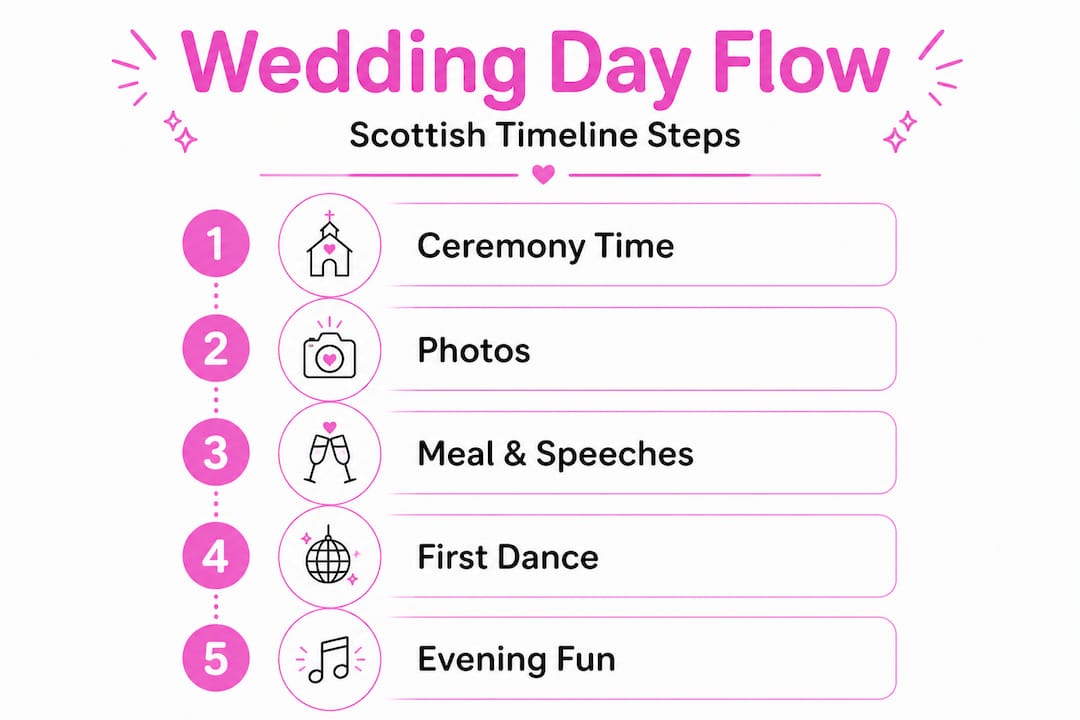
Working through each key moment in sequence, assigning a realistic duration, and then reviewing the total is a simple but powerful exercise. Most couples discover their first draft overruns by 30 to 45 minutes before a single guest has arrived.
Building buffers: Avoiding overruns and ensuring guest comfort
The most common mistake couples make is filling every minute. A timeline with no slack is a timeline waiting to fail. Buffers, those deliberately empty pockets of time built into your schedule, are what transform a rigid timetable into a living, breathing plan that can absorb the unexpected.
Speeches before the meal reduce overrun risk significantly and ensure food arrives hot rather than after an hour of toasts. Spreading speeches between courses is a strategy that sounds elegant in theory but creates logistical chaos in practice. Kitchens cannot hold dishes indefinitely, and guests seated for three hours lose their energy.
Consider these common overrun risks at Scottish weddings:
- Speeches that run well beyond the planned ten minutes per speaker
- Guest movement between the ceremony room and the dining space, which can take 15 to 30 minutes for larger groups
- Outdoor weather delays requiring a quick reconfiguration of the room layout
- Extended photography sessions, particularly at venues with spectacular grounds
- Ceilidh band setup time, which is often underestimated by those unfamiliar with the format
A VIP event experience does not happen by accident. It happens because every element has been given enough room to breathe.
| Timeline approach | Result for guests | Result for couple |
|---|---|---|
| No buffers built in | Rushed, waiting, cold food | Anxiety, apologies, lost moments |
| Buffers at each transition | Comfortable, relaxed | Confident, present, enjoying the day |
| Overpacked schedule | Confusion, overruns | Stress, disappointment |
| Simplified, focused plan | Memorable, smooth | Truly enjoyable experience |
It is also worth noting that not every wedding needs a full-day timeline. For couples choosing Scottish wedding entertainment that centres on a vibrant evening party rather than a formal meal, a 5pm or later ceremony with a focused two-hour window for photography and dining before the evening kicks off is a perfectly valid approach. Your DJ and MC services provider can help you structure the evening programme around your energy goals rather than a traditional sequence.
Pro Tip: Build a 15-minute buffer after every major transition: after the ceremony, after photographs, and after the meal. These three buffers alone will absorb the vast majority of on-the-day delays.
Personalising your timeline: Scottish traditions, priorities, and venue differences
A generic wedding timeline template downloaded from the internet has never been to Skibo Castle. It does not know that your venue’s main hall takes twelve minutes to walk through from the car park, or that your bagpiper will need to be cued from a specific position to carry across the courtyard. Personalisation is what makes your timeline genuinely useful rather than merely decorative.
Scottish weddings carry their own beautiful traditions, and each one deserves a place in your plan. Scottish customs like handfasting and similar rituals need time built in during the ceremony itself. A live bagpiper piping guests into the ceremony room requires coordination with the venue entrance and a clear cue from your master of ceremonies. A ceilidh requires a band setup window that most couples forget to include, often discovering too late that the band needs 45 to 60 minutes to configure sound equipment after the meal tables have been cleared.
Key personal elements to build into your timeline:
- Bagpipe arrival: Typically 15 to 20 minutes of piping as guests assemble, followed by a processional cue
- Handfasting ceremony: Add 10 to 15 minutes to your ceremony duration estimate
- Ceilidh dancing: Allow 45 to 60 minutes for band setup after room turnover
- Outdoor photography at Scottish venues: Add a weather contingency window of 15 minutes
- Whisky or gin welcome toast: A lovely Scottish touch that needs a specific slot in your drinks reception
Use your venue coordinator as an expert resource. They have seen dozens or hundreds of weddings in that specific space and will tell you things no planning guide can anticipate. Perhaps the kitchen needs 90 minutes for a particular menu, or the lighting system takes time to reset between the ceremony and the reception. These details directly affect your timeline and are worth asking about explicitly.
Custom event entertainment for Scottish weddings often includes special moments that need careful placement in the timeline, such as a live saxophone performance during the drinks reception or an interactive lighting display at the first dance. Planning these moments alongside your entertainment provider ensures they land at exactly the right emotional beat in your day. Exploring must-have Scottish wedding reception activities early in your planning process will help you identify which traditions and experiences matter most to you as a couple.
Looking at wedding trends in Scotland for 2026, there is a clear shift towards more intimate, intentional celebrations where quality of experience outweighs quantity of events. Couples are choosing bridal collaboration with suppliers who truly understand their vision, rather than trying to fit every possible element into a single day.
Pro Tip: Focus your timeline on three to five moments that genuinely matter to you. Identify them early and protect the time around them fiercely. Everything else on the schedule exists to serve those moments.
Finalising your timeline: Review, share, and adapt effortlessly
Once your draft timeline exists, it needs to be stress-tested by everyone who will be executing it. This final review stage is where most couples underinvest their energy, assuming the plan is complete once it is written. In reality, sharing the timeline is what makes it functional.
Follow these steps to finalise your wedding timeline:
- Send a draft to every supplier: Your caterer, photographer, videographer, entertainment provider, florist, and venue coordinator should all receive a copy and be invited to flag any concerns.
- Book a coordination call: Bring key suppliers together, even briefly, to walk through the timeline sequentially. Conflicts or gaps become visible in conversation that are invisible on paper.
- Identify your three to five big moments: These are the scenes you most want to remember. Make sure the timeline protects them with adequate lead-in time and no competing activities.
- Print copies for your day-of coordinator: A digital file is useful for planning. A printed copy in hand is what your coordinator needs when the photographer is asking a question and the caterer is calling simultaneously.
- Build a personal version: This is a simplified, one-page version for the wedding party that shows only what they need to know, without the operational detail.
Choosing venues and suppliers who actively participate in your timeline review signals professionalism and genuine investment in your day. If a supplier is unresponsive or dismissive of your timeline questions, that is useful information.
On the day itself, appoint someone other than yourself to manage the timeline. This role, often filled by your MC or a dedicated coordinator, ensures you are free to be present and enjoy the experience rather than watching a clock. Your investment in premium guest entertainment will only reach its full potential if you are relaxed enough to notice it.
Pro Tip: Create a simple version of your timeline for the wedding party showing only their call times and locations. It reduces confusion and the number of messages you receive on the morning of your wedding.
Why most couples overcomplicate timelines, and what actually works
Here is the honest truth after working across hundreds of Scottish weddings: the couples who enjoy their day the most are almost never the ones with the most detailed timelines. They are the ones with the simplest ones.
There is a particular kind of planning anxiety that leads couples to schedule every quarter hour with something meaningful, as though an empty slot on the timeline is wasted time. It is not. Empty time is where conversations happen. It is where you look at your new spouse and actually see them. It is where your grandmother tells a story you will repeat for decades.
The focus on flow over perfection is not a compromise. It is the goal. A Scottish wedding benefits from a certain unhurried quality, the sense that today is expansive and generous rather than tightly managed. That feeling is engineered through simplicity: fewer hard deadlines, wider buffers, and a clear understanding of what you are actually trying to experience.
Our strongest recommendation, born from years of flawless wedding timeline planning across Scottish venues, is to build your timeline around emotion rather than logistics. Ask yourself how you want to feel at each point in the day, and then structure the schedule to protect that feeling. The logistics exist to serve the emotion, never the other way around.
Discover expert entertainment and timeline support for your Scottish wedding
Planning a seamless wedding day in Scotland is genuinely exciting, and you do not have to approach it alone. Fresh Entertainments specialises in helping couples translate their vision into a flowing, energetic, and deeply personal celebration.
From award-winning DJ and MC services to live saxophone performances and bespoke lighting design, we work closely with couples and venue coordinators to ensure every entertainment element lands at exactly the right moment in your timeline. Our online wedding planner tool makes it straightforward to coordinate entertainment cues, set lists, and supplier communication in one place. Whether you are planning an intimate highland gathering or a grand ballroom celebration, explore our wedding packages to discover how professional entertainment support can take your timeline from organised to truly unforgettable.
Frequently asked questions
What is the ideal start time for a Scottish wedding ceremony?
Most Scottish ceremonies begin between 1pm and 3pm, which balances guest comfort with the natural light available for photography and a full evening of entertainment.
How much buffer time should we allow for speeches?
Allocate 45 to 60 minutes for speeches and always pad for overruns, as even well-rehearsed speakers tend to run longer than planned, particularly in front of a warm crowd.
How can we adapt our timeline for unpredictable Scottish weather?
Include transition buffers at each major outdoor movement point and discuss contingency room layouts with your venue coordinator well in advance of the day.
Should speeches happen before or after the meal for best flow?
Speeches before the meal reduce overruns significantly and keep the food service on schedule. Avoid splitting them between courses, as this disrupts both the kitchen and the guests.
How many key moments should we focus on for a relaxed timeline?
Identify three to five big moments that matter most to you, share your timeline with all suppliers, and build everything else around protecting those experiences.